The hardliner who blinked: To unseat Netanyahu, Israel’s once-unyielding Liberman turns to compromise
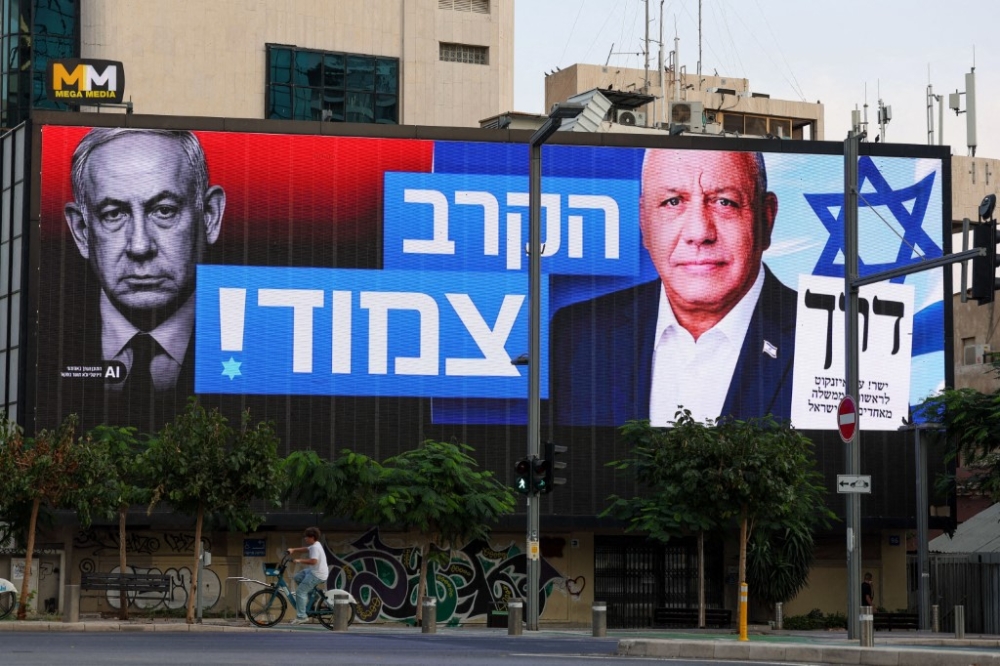

Posters of former Israeli Chief of General Staff and Yashar Party leader Gadi Eisenkot (right) and Prime Minister and Likud Party leader Benjamin Netanyahu (left) are seen as election campaigns intensify two days before the vote as campaign posters of candidates are displayed on billboards and buildings across the streets ahead of the Knesset elections scheduled for October 27, in Tel Aviv, Israel, on October 25, 2026. — Nir Keidar/Anadolu pic via AFP
First Published: Tuesday, 10 Nov 2026 10:53 AM MYT
JERUSALEM, Nov 10 — He built his career on unyielding principles, but the Israeli secular nationalist Avigdor Liberman is now preaching compromise in a bid to bring down Benjamin Netanyahu, his former mentor whom he now despises.
For three decades, Liberman’s steely blue eyes, steadily greying whiskers and ample use of chess metaphors have been an ever-present part of Israeli political life.
So too has been the unwavering defence of secularism by the 68-year-old immigrant from the former Soviet Union, as religious Jews gain political influence inside Israel.
But it is towards ultra-Orthodox Jews, derided as draft-dodgers by his political base, that Liberman is now extending a hand, in the service of what he considers an even greater goal — removing Netanyahu.
Liberman, who shares Netanyahu’s hawkish worldview and antipathy to the idea of a Palestinian state, was credited with helping first bring the prime minister to power in his razor-thin 1996 election upset.
Liberman served as Netanyahu’s first chief of staff. But as Netanyahu rose to become Israel’s longest-serving prime minister, in power on and off for nearly 20 years, Liberman turned into a staunch critic.
Years before the October 7, 2023 Hamas attack and Israel’s massive retaliation in Gaza that brought Netanyahu international notoriety, Liberman advocated such total war and accused Netanyahu of being too hesitant.
Liberman resigned as Netanyahu’s defence minister in 2018 to protest the government’s acceptance of a previous ceasefire with Hamas. Liberman has also lashed out at Netanyahu for tacitly backing Qatari funding to keep Gaza afloat before the Hamas attack.
U-turn on ultra-Orthodox
A resident of one of the West Bank’s settlements, which are illegal under international law, Liberman is, like Netanyahu, a vociferous critic of the Palestinian Authority, the semi-autonomous, European-supported body set up in the 1990s under the Oslo peace accords.
During the latest election campaign, Liberman called for Jordan to retake control of the parts of the West Bank now under Palestinian Authority administration, saying it was the most practical option.
The stance sparked a furious rebuke from Netanyahu, who has flirted with annexing the West Bank and accused his foe of letting a foreign army “rule over territories in the land of Israel”.
Liberman also fell out with Netanyahu over the premier’s alliance with the ultra-Orthodox, who have been allowed an exemption to Israel’s usually mandatory military service, angering many Israelis at a time when reservists are serving multiple tours of duty.
But last week, Liberman stunned his party by announcing he was lifting a veto on working with the ultra-Orthodox and saying he was ready for a compromise on military service.
Liberman remains adamantly opposed to working with lawmakers from Israel’s Arab minority, who have enough votes to put in power opposition leader Gadi Eisenkot.
Liberman’s Yisrael Beiteinu party won seven seats, the fewest among the core opposition parties, but every vote is critical for Eisenkot.
Posters of former Israeli Chief of General Staff and Yashar Party leader Gadi Eisenkot (right) and Prime Minister and Likud Party leader Benjamin Netanyahu (left) are seen as election campaigns intensify two days before the vote as campaign posters of candidates are displayed on billboards and buildings across the streets ahead of the Knesset elections scheduled for October 27, in Tel Aviv, Israel, on October 25, 2026. — Nir Keidar/Anadolu pic via AFP
Russian immigrant base
Born in Soviet Moldova, Liberman immigrated to Israel in 1978, serving in the military before working for a time as a nightclub bouncer and studying political science.
He was originally part of Netanyahu’s Likud party, but in 1999 founded Yisrael Beiteinu, which means “Israel Our Home”, to appeal to the more than one million Israelis who had immigrated from the former Soviet Union.
Responding to speculation regarding his about-face on the ultra-Orthodox, Liberman blamed lingering prejudice against Russian speakers, who have become increasingly integrated since mass immigration in the 1990s.
“I have been witnessing a parade of foolishness by a string of commentators, journalists acting on behalf of vested interests, bots and people with prejudiced views, sometimes with a distinctly racist undertone,” Liberman wrote in a series of defiant social media posts.
Some commentators speculated that Liberman, whose base has expanded beyond Russian-speaking immigrants, was seeking a political deadlock that would then make him the consensus candidate. He denied he was seeking to become prime minister himself.
“I am not engaged in political manoeuvring, nor am I trying to undermine anyone,” Liberman said.
Liberman said there was no choice but compromise, even though he has previously called the ultra-Orthodox “anti-Jewish” for refusing military service and denounced an ultra-Orthodox rally last year against conscription as “spit in the face of our heroic soldiers”. — AFP
KioskNews shows a cleaned-up reading view extracted from the publisher’s page — the original always lives on their site, not ours.