Delhi AQI at 377, CAQM cracks down on stubble burning in Punjab
The Commission for Air Quality Management in National Capital Region and Adjoining Areas (CAQM) on Wednesday issued show cause notices to the deputy commissioners (DCs) and senior superintendents of police (SSPs) of Jalandhar, Faridkot, Bathinda, Barnala and Fazilka districts in Punjab for failing to contain incidents of paddy stubble burning.
The notices were issued for non-compliance and contravention of the commission’s directions, taking the total number of Punjab districts facing direct regulatory action over farm fires to nine in the last four days.
Similar action was initiated by the CAQM against the DCs and SSPs of Gurdaspur and Kapurthala on November 3, and Amritsar and Tarn Taran on November 1.
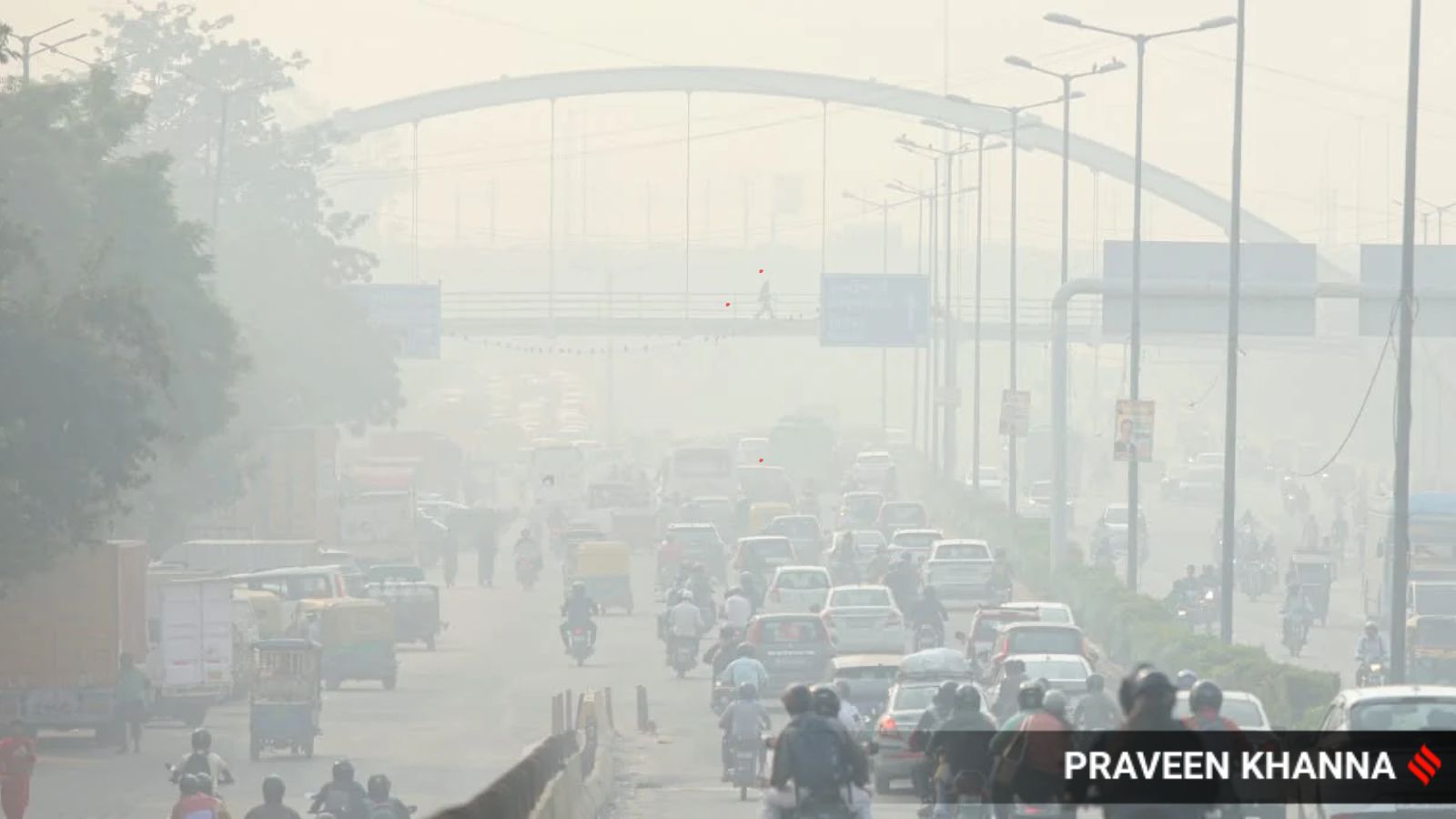
The crackdown coincided with a sharp deterioration in Delhi’s air quality, as a thick layer of haze enveloped the city. The Capital recorded its worst air in 288 days on Wednesday, with the 24-hour average Air Quality Index (AQI) spiking to 377 at 4 pm in the ‘Very Poor’ category, according to the Central Pollution Control Board (CPCB) bulletin.
The city had last witnessed worse air on January 20, when the index stood at 378. Gurugram and Noida also reported Very Poor AQI levels at 322 and 330, respectively, on Wednesday.
By 6.30 pm, real-time pollution readings across more than a dozen monitoring stations in Delhi breached the hazardous ‘Severe’ threshold of 400.
The monitoring station at IIT Delhi recorded an AQI of 455, followed by Jahangirpuri (449), Punjabi Bagh (446), Mundka (439), Vivek Vihar (436), Delhi Technological University (434), Rohini (432), and Alipur and Narela (429).
Story continues below this ad
In NCR, while Sector 62 in Noida touched 425 (Severe), Panchgaon (391) and Bahadurgarh (365) in Haryana recorded Very Poor AQI. Gajraula in Uttar Pradesh reported AQI of 390 (Very Poor).
According to CPCB data, the prominent pollutants driving the spike were fine particulate matter — PM2.5 and PM10.
As per the Decision Support System (DSS) developed by the Indian Institute of Tropical Meteorology (IITM), regional stubble burning contributed an estimated 16.28% to Delhi’s PM2.5 concentration on Wednesday, closely trailing the local transport sector, which accounted for 18.17% of emissions.
As per ICAR-Indian Agricultural Research Institute (IARI), satellites detected 467 active paddy residue burning events across six northern and central states on Wednesday.
Story continues below this ad
Madhya Pradesh led the single-day count with 157 fire incidents, followed by Punjab (151), Rajasthan (111), Uttar Pradesh (33), Haryana (10) and Uttarakhand (5). No such incident was reported in Delhi.
Between September 15 and November 4, Punjab recorded 2,347 farm fires, down from 2,839 during the corresponding period in 2025 and 14,173 in 2023. Within Punjab, the highest daily residue fires on Wednesday were detected in Bathinda (19), Patiala (17), Ludhiana (13), and Tarn Taran (13). In Haryana, Kaithal recorded 4 incidents, taking the state’s cumulative tally to 62.
According to IITM officials, Delhi’s AQI is forecast to remain in the Very Poor category on November 5, before deteriorating into Severe category on Friday and Saturday. Delhi-NCR will celebrate Diwali on Saturday and Sunday.
The extended outlook for the subsequent six days said that AQI is likely to be in the Severe category as unfavourable weather conditions set in.
Story continues below this ad
At Safdarjung, Delhi’s base station, the maximum temperature on Wednesday settled at 29.8 degrees Celsius, while the minimum settled at 16.1 degrees Celsius — both near normal for this time of the year.
Shallow fog was reported at Safdarjung airport in the morning, where the lowest visibility dropped to 800 m between 6.30 am and 9.30 am, before gradually improving to 1,000 m by 10 am, IMD officials said. Surface winds blew at speeds of up to 15 kmph from the west during the past 24 hours, dropping to around 10 kmph during the forenoon.
As per IMD forecast, Delhi will see mainly clear skies with shallow fog or mist at isolated places during the morning hours over the next three days. Predominant surface winds are expected to blow from the north-west at speeds reaching up to 20 to 22 kmph during the afternoon, before decreasing to 10 to 12 kmph during the evening and night.
KioskNews shows a cleaned-up reading view extracted from the publisher’s page — the original always lives on their site, not ours.