There’s a lot of racism, a lot of hatred’: Far right gains predicted as Israel heads to the polls

Four decades ago, when the extremist rabbi Meir Kahane won a single seat in Israel’s Knesset, other legislators passed a law to prevent him running again, left the chamber when he rose to speak and worked together to block discussion of his ethnonationalist proposals.
These ranged from mass expulsions of Palestinians to apartheid provisions such as segregated beaches and the criminalisation of sex between Jews and gentiles.
This month, Kahane’s political heirs may claim more Knesset seats in national elections than the remains of the once mighty Labor party, home of Yitzhak Rabin, Shimon Peres and Golda Meir.
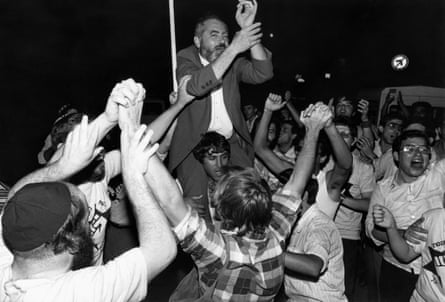
At an election rally this week, Israel’s national security minister, Itamar Ben-Gvir, mixed calls for ethnic cleansing and jokes about starving Palestinian prisoners with a proud anecdote about his conviction in 1998 over bumper stickers that read “Rabbi Kahane was right”.
A poll for the Israel Hayom newspaper, published on Friday, forecast his Jewish Strength party would win nine seats in the 27 October election. The Democrats, successor to the Labor party led by former general Yair Golan, were predicted to claim eight seats.
Ben-Gvir’s rise is one of the more extreme manifestations of a broad shift to the right among Jewish citizens of Israel. It is particularly pronounced among the young and will shape the country’s next government, regardless of who becomes prime minister after closely fought elections.
More than 500,000 Israelis have reached voting age since the last election in 2022, and three-quarters of first-time Jewish voters define themselves as right or centre-right, a recent poll for Channel 12 television found (it did not survey Palestinian citizens of Israel).

The generation voting for the first time came of age after the Oslo process collapsed, when the prospect of negotiating a political resolution to the Israel-Palestine conflict seemed to be fading.
They were teenagers during the Hamas attacks on 7 October 2023, which resulted in the deaths of about 1,200 people, the majority of them civilians. Militants took 251 living hostages and dead bodies to Gaza, leading to a two-year hostage crisis.
“There’s a lot of people, especially young people, who think that there is no solving the conflict, that we’ll always be at war. There’s a lot of racism, a lot of hatred, but most of all, there’s fear,” said Erez Uzan, vice-chair of the Young Democrats.
Bucking global trends, young Israelis are more rightwing than older generations and are likely to vote in a new Knesset with more rightwing members than the current chamber, said Dahlia Scheindlin, a political analyst and public opinion researcher.
Consistently rightwing ultra-Orthodox and nationalist religious communities make up a growing proportion of Israel’s Jewish population but still account for only around a quarter of the electorate, so demographics alone do not explain the growing age gap on political issues.
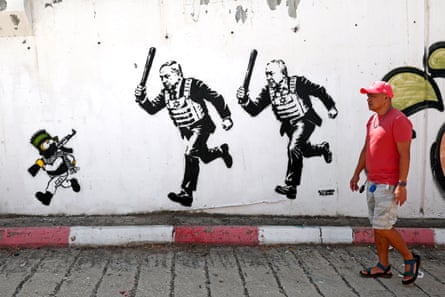
“All Israelis, and particularly younger people, have been living in a political environment where not only is the government rightwing but the general terms of debate are really populist and ultra-nationalist. That’s all they know. They’re socialised into it,” Scheindlin said.
“There’s been a real downplaying of anything to do with democracy, universal values or human rights. Those are seen as weak, if they’re discussed at all, possibly as bad as betrayal. And very few politicians talk about peace, concessions, negotiations, Palestinian self-determination, or even Palestinian wellbeing.”
A consistent majority of Israeli polls show prime minister Benjamin Netanyahu’s current coalition bloc with the ultra-Orthodox and the far right will fall well below the threshold of 61 seats needed to form a government.
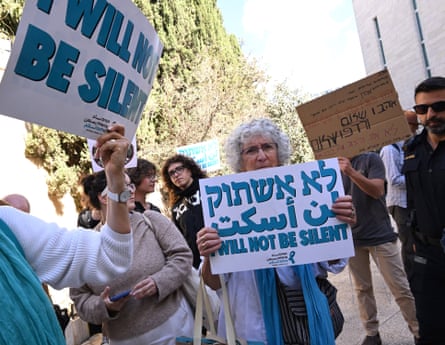
The opposition has a clear path to power through an alliance with parties representing Palestinian citizens of Israel, known as Arab parties inside the country. But the political shift right means most of the Jewish-led parties have ruled out such a coalition, although similar promises have been broken after past elections.
Particularly when it comes to Palestine, most offer little challenge to Netanyahu’s claim that security can only be pursued through military domination and annexation of territory from Gaza to Syria and Lebanon.
The peace deals that secured Israel’s borders with Jordan and Egypt, once seen as no less an existential threat than Iran is today, do not feature in political debate as an alternative path.
Their campaigns focus on other issues, from promises to tackle corruption and bring accountability for the 7 October attacks to improving schools and stopping ultra-Orthodox draft dodging.
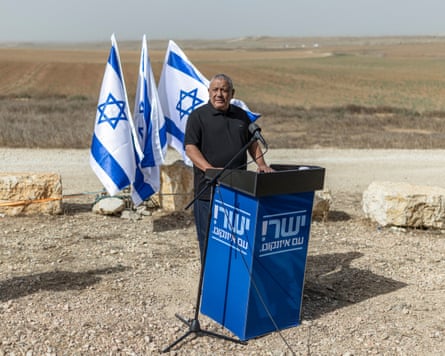
The man leading the field to replace Netanyahu, Gadi Eisenkot, is a former head of the Israeli military who formulated the notorious Dahiya doctrine of using “disproportionate force” to cause damage and destruction.
Naftali Bennett is a former prime minister and former chair of the settler council, who supports annexing much of the West Bank. Avigdor Lieberman wants to dismantle the Palestinian Authority and replace it with an Israeli-Jordanian confederation (though apparently he did not consult the Jordanians about this plan).
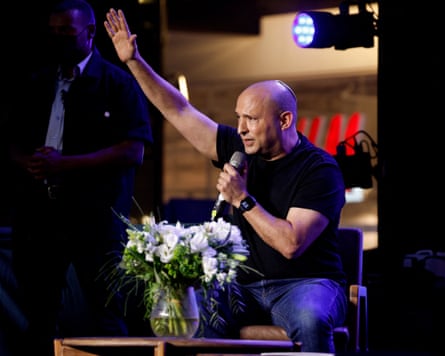
No Jewish-led party backed a future Palestinian state and only the Democrats opposed settlement expansion, the Yedioth Ahronoth newspaper reported, after seeking all parties’ positions on the future of the occupied West Bank.
Eisenkot’s Yashar party pledged to strengthen and expand settlements, which are legal under Israeli law. All settlements are illegal under international law.
The Democrats, the only remaining political home for Israel’s Zionist left, are led by Golan, a former general and deputy head of Israel’s military who personally rushed to border communities under the Hamas attack on the morning of 7 October to rescue civilians.

Golan rejects a two-state solution and is campaigning on a policy platform that would be solidly centrist in much of Europe. Yet even so, Israel’s political shift to the right is so pronounced that the party’s campaigners have been repeatedly attacked – physically and verbally – as a radical fringe.
Last week, rightwing thugs assaulted Democrats volunteers manning a stand at Jerusalem’s historic Mahane Yehuda market, kicking, hitting and spitting at the group and stealing a phone while police stood by and watched.
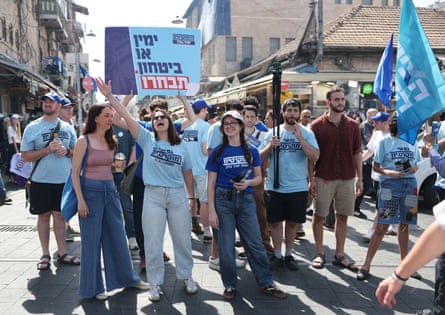
The scale of abuse prompted the party to train campaigners in non-violent direct action, “so they know how to handle themselves in a situation where they can keep safe and de-escalate,” said Uzan of the Young Democrats.
The far right is on the rise globally, but Israeli politics that “revolve round constant conflict” heighten the appeal of ethnonationalist messages, Uzan said.
“We grow up in fear, seeing war all around us – and that leads to a certain perspective. In the last 20 years, our leadership in the centre-left camp has avoided talking about security issues,” Uzan said, adding they had ceded that ground to the right.
Now he and fellow campaigners are trying to tackle that failure at a grassroots level, including speaking to young people about the peace agreements with Egypt and Jordan that were unpopular when signed but have brought lasting stability.
The process is slow but effective, he says, pointing to an active young membership several thousand strong, well above parties who attract more young voters.
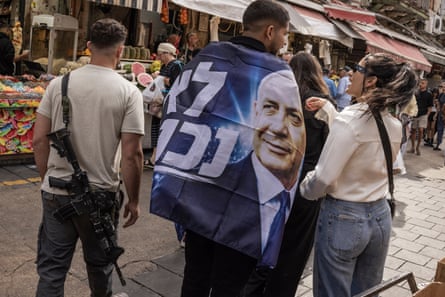
Comedian turned activist Lior Schleien has been trying to have similar conversations with groups of young Israelis about the deadly futility of pursuing “total victory” in endless wars. He posts footage of some of the most shocking exchanges, featuring smiling teens advocating on camera for the mass killing or expulsion of Palestinians.
“Lots of Arabs live here. They were born here, they are citizens like you and me. What will you do with them?” Schleien asks one group.
“Kill them … give me a knife and I’ll murder them,” says one young man.
Ben-Gvir is particularly adept on social media, where posts like a recent AI video laying out plans for ethnic cleansing have helped build more engagement with young voters than any Israeli politician except Netanyahu.
But he is not an outlier for extremism among allies of the prime minister. Finance minister Bezalel Smotrich is a messianic settler who recently called to “wipe out Gaza”, and has vowed to “bury” a future Palestinian state.
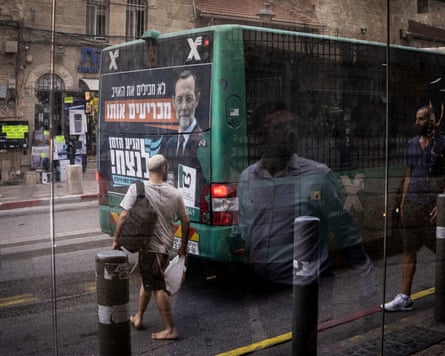
For this election, Smotrich has joined forces with Moshe Feiglin, a fundamentalist who has long called for the mass expulsion of Palestinians and the construction of a biblical Jewish temple where the al-Aqsa mosque compound now stands.
The rise of the far right and religious fundamentalism, combined with Netanyahu’s assault on institutions protecting Israel’s partial democracy (Palestinians living under Israeli military rule in the occupied West Bank do not have the rights of citizens), mean many Israelis on the centre and left see this vote as existential.
David Harel, the president of the Israel Academy of Sciences and Humanities, says the country’s current path leads towards a bleak future as a corrupt, impoverished pariah state, dominated by messianic fundamentalists maintaining a “violent, cruel occupation”.
“We are already in ‘stoppage time’. If we lose this time, there will be no second chance. The country we love so dearly will breathe its last. Plain and simple!” he told a rally in the northern city of Haifa.
“That is why I have come here today, to ask and to implore. And if necessary, I will get down on my knees and beg. Please, please, please! Just go out and vote!”
KioskNews shows a cleaned-up reading view extracted from the publisher’s page — the original always lives on their site, not ours.