Power protests light fuse on $2 billion data centre implosion, as NextDC shares plummet
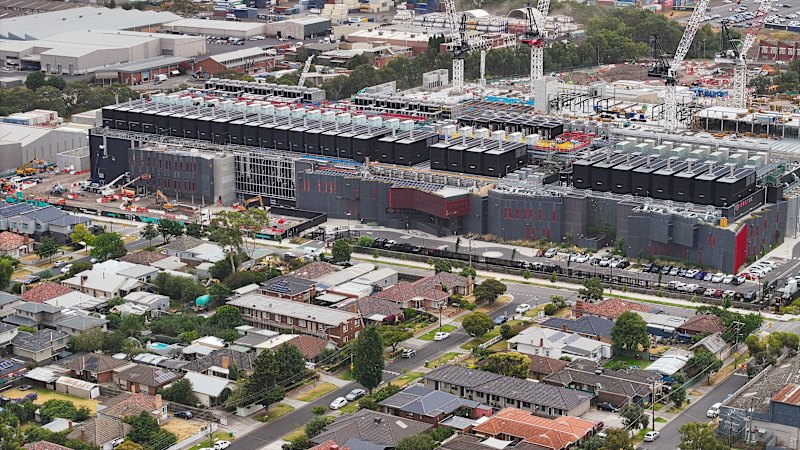
What began as a community protest in Melbourne’s inner west over enormous electricity poles being installed on narrow residential streets has now rocked the nation’s highest-profile data centre developer, as it scrambles to find a new way to supply energy to its flagship centre.
On Wednesday, ASX-listed NextDC told investors it would slash its expected profits and construction spending as it dealt with delays in supplying energy to its M3 centre in West Footscray, triggering a share price plummet.
NextDC came out of a two-day trading halt on Wednesday warning investors that the final stages of the politically contentious development would also not be approved until after next month’s state election.
The delays are the result of a community blockade in September, revealed by this masthead, against electricity distributor Jemena’s rollout of 15-metre tall 66,000-volt residential power poles. The protests prompted Jemena to halt construction until at least February.
The delays have left NextDC saying it now lacks the extra grid capacity needed to power its expanding data halls at West Footscray.
The market reaction against the data centre developer was sharp: NextDC shares collapsed to $5.46 on Wednesday, down more than 40 per cent from their Monday closing price of $9.57. The crash wiped billions off the company’s valuation, driving its stock to its lowest point since 2019 – a far cry from its peak of $17.22 a year ago.
NextDC on Wednesday also revealed it was putting the brakes on its wider construction pipeline, in a move which could alarm state and federal governments as data centre construction is one of the few bright spots in the sluggish Australian economy.
NextDC slashed its construction budget for the coming financial year from up to $5.75 billion to between $4.5 billion and $5 billion, pausing developments without client contract commitments. Previously, the company had built new data centres without having tenants contracted to go into them.
NextDC chief executive Craig Scroggie said the company had paused expectations from its West Footscray project, and would halt speculative expansion projects and land buys not already locked in by paying clients.
“With [West Footscray] revenue deferred, we have paused projects not backed by customer contracts and put that capital behind the capacity our customers have already contracted,” he said.
Yarraville resident Milco Bogoevski was among those who led the community protest to stop Jemena installing its enormous power poles in his residential street.
He said while he was sympathetic to data centre operators – “No one here wants to see industry fail; we want industry to succeed” – what had happened was the direct result of power companies and business not listening to the community.
“These power lines, this material, it was going to be in our street, we were going to have to deal with it for decades after they left – power operators like Jemena, and [businesses like NextDC], they’re going to need to engage more with the community.”
Bogoevski said the community opposition to the enormous West Footscray data centre and the impact of other data centres in Melbourne’s inner west could help swing seats in the November 28 election.
“The state government is responsible for power – it comes down to them. There is a good chance that an issue like this could flip this seat away from Labor; we’ve got a couple of issues like this that Labor hasn’t paid attention to,” he said.
NextDC’s market shock represents the clearest evidence yet that Victoria’s rapid push to attract power-hungry artificial intelligence infrastructure has run into severe grid constraints and suburban backlash.
The M3 facility in West Footscray is designed to eventually span 10 hectares in an industrial pocket adjacent to residential homes. The site already occupies five hectares and was undergoing a $750 million expansion.
However, feeding the expanding site required Jemena to replace standard wooden electricity poles with 15-metre concrete poles carrying 66,000 volts along residential streets in West Footscray and neighbouring Yarraville.
A typical residential power pole carries about 400 volts.
A Maribyrnong City Council spokeswoman noted that some poles in the rollout rise as high as 22 metres, which is equivalent to seven storeys.
The rollout ground to a halt in Yarraville last month following direct action by residents, who blockaded contractor trucks with parked cars, ignored door-knocks and filled excavation pits to stop high-voltage lines reaching the NextDC site. Jemena bowed to pressure and paused work to consult further, leaving the high-capacity route unfinished.
NextDC said a state a planning permit decision for its next stages of its West Footscray project had also been delayed.
With the Victorian government entering caretaker mode on November 3 ahead of the election, a planning decision for the site is now not expected until 2027.
The mounting political and community friction creates a growing challenge for the election. As premier, Jacinta Allan and her then-economic development minister Danny Pearson aggressively courted hyperscale data operators, using fast-tracked planning schemes to bypass municipal councils and grant approvals in as little as 28 days.
Data centres consume about 2 per cent of national grid power, but the Australian Energy Market Operator has forecast that share could rise to 9 per cent by 2035 as AI adoption accelerates.
To address growing concerns, Premier Ben Carroll last month introduced new rules requiring data centre developers to supply their own renewable energy, use recycled water, and maintain a minimum 150-metre buffer from homes.
Community pushback is now hitting projects nationwide. Developer Green Square was recently forced to pull a proposed project in Western Australia, Goodman Group shelved a $1.2 billion facility in the Sydney suburb of Lane Cove, and private developer Firmus was forced to abandon a planned $44 billion stock market float.
Start the day with a summary of the day’s most important and interesting stories, analysis and insights. Sign up for our Morning Edition newsletter.

KioskNews shows a cleaned-up reading view extracted from the publisher’s page — the original always lives on their site, not ours.