Gen Z has very strong opinions about age gap relationships – and it could be right | Zoe Williams
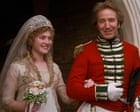
I looked up the cast before I saw the new film adaptation of Sense and Sensibility, thinking: “Who could be as good as Emma Thompson and Kate Winslet?” because of course I did. One, they were peerless and two, this is the condition of middle age, constantly looking at the world thinking: “This could be considerably improved by the presence of Emma Thompson.”
The notable casting update was Col Brandon, whose passion for Marianne would now be known as an “age gap” relationship. In the last film, Alan Rickman (born 1946) was in love with Winslet (born 1975), who cycles through a fair amount of: “Yuck, no thanks,” before having an epiphany.
Sorry if that spoiled the end. I don’t really see Jane Austen as a suspense-monger.
Winslet could easily have been Rickman’s daughter and, biologically speaking, just about his granddaughter. In the 90s, though, the age gap was a distant second consideration to the fact that Brandon was grumpy and boring, although his gruff exterior masked a serious mind and a heart of gold. I have my own thoughts on this romantic trope as a long‑term cohabitation prospect, but we can do those another day. Besides, look at that age gap. The term might not be all that long.
To the modern audience, however, the age gap simply wouldn’t “sit right”, as one gossip zine put it. I’m not wild about this terminology: “sit right”, “uncomfortable”. The subtext is: “You are in breach of absolutely fundamental and self-evident values, which I am too gracious and polite to mention, yet not to do so is bringing me discomfort.”
Nevertheless, those values are self-evident and fundamental. The average gen Zer thinks an age gap of a single school year is a red flag of exploitation. So the film-makers got Herbert Nordrum, who is only 13 years older than Esmé Creed-Miles, but – per my point about school years – this is still way too many.
Some age gap must be present, however, to stay true to the text, with its 19-year difference. So they cover him in a bushy beard and make him unaccountably Norwegian, thereby creating enough visual ambiguity and sensory confusion that he could be any age. Now, there’s an indeterminate gulf between them, which could be due to their respective ages or the stark differences in their personalities (in other words, it could be sense or sensibility), but none of that amounts to a hill of beans once their true feelings have been unearthed.
Rats, sorry, just spoiled the ending again.
Obviously, that wasn’t the only age gap to grace a 90s screen, but it was sufficiently unusual for it to be part of the plot. More often, in those days, you were supposed to simply not notice that a woman with newly minted A-levels had fallen in love with a guy who was surely nearly ready for his free bus pass. If all that sounds very UK-centric, that’s only because I’m feverishly trying not to use words such as “Jack”, “Nicholson”, “Richard” and “Gere”.
Often, when you watch a classic film with youngsters today and they’re doing wild vomit-mimes and yelling: “No, seriously, what is wrong with you people?” it’s not immediately obvious what they’re objecting to. It could be that what you thought of as a sudden and dramatic romantic clinch assumes consent that has not been expressed, or it could be that the woman is visibly 15 years younger than the man, or it could be something else entirely, like: “She is quite cool and he is a jerk.” I’m thinking, specifically, of Hannah and Her Sisters, which I erroneously put on once, trying to introduce the younger generation to jazz. I think it’s safe to say that I learned more from that experience than they did.
In fact, Daisy Edgar-Jones and Esmé Creed-Miles are different from Emma Thompson and Kate Winslet, but equally good. And gen Z’s perception of what is acceptable on screen and how it might feed into wider society is different from mine, but possibly better. Maybe it’s time I make my peace with the condition of modernity.
KioskNews shows a cleaned-up reading view extracted from the publisher’s page — the original always lives on their site, not ours.