In this Sydney suburb you need to earn $6.3m to be in the top 1%: How does your area compare?
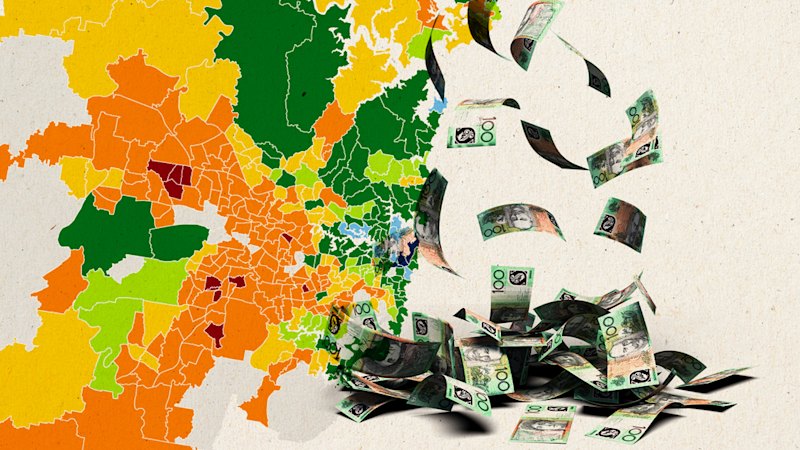
The top 1 per cent of income earners in 83 Sydney suburbs take home over $1 million a year on average, while in a cluster of harbourside neighbourhoods, to make the 1 per cent bracket, you need to earn more than $3 million.
Analysis of official personal income data by this masthead casts fresh light on how ultra-high pay packets are distributed across the city.
In Bellevue Hill, about five kilometres east of Sydney’s central business district, the average income for the highest paid 1 per cent of taxpayers was $6.3 million in 2022-23. That was $1.2 million lower than the previous year but it was still the highest average for the 1 per cent in any city suburb.
The adjacent neighbourhood of Rose Bay-Vaucluse-Watsons Bay had the city’s second-highest average earnings for the top 1 per cent at $6.12 million (down from $6.37 million the previous year). Third was Woollahra, where the top 1 per cent took home an average of $5.05 million (up from $4.99 million).
There were eight Sydney neighbourhoods where the top 1 per cent had average earnings between $3 million and $5 million (all of them waterfront suburbs) and 72 where average earnings were between $1 million and $3 million.
You can search how suburbs and localities across NSW compare here:
While suburbs with the highest average incomes for the top 1 per cent were mostly in the eastern suburbs and on the north shore, several were located in the city’s north-west, including Dural-Kenthurst ($1.66 million) and Glenhaven ($1.58 million).
In two outer western Sydney neighbourhoods – Horsley Park-Kemps Creek and Mulgoa-Luddenham-Orchard Hills – the top 1 per cent took home just over $1 million a year.
Demographer and social researcher Mark McCrindle said the high average earnings for the top 1 per cent in parts of western and north-western Sydney showed how patterns of income and wealth have shifted.
“It tells a story of a changing Sydney,” he said. “Yes, we’ve got very high incomes in those harbourside suburbs which has been the case for 100 years, but we’ve got new locations with high incomes as well. The dynamics of wealth have spread geographically.”
McCrindle said income distribution patterns across Sydney showed not all high-income earners wanted to live on the waterfront.
“Some choose to invest their money in a large property, perhaps in bushland, rather than in the harbour area. Places like Dural, Kenthurst and Glenhaven in Sydney’s north-west have really changed economically.”
However, in some western suburbs, the earnings of the top 1 per cent was well below the citywide average. Lowest was Auburn North, about 20 kilometres west of the CBD, where the average income of the best paid 1 per cent was $200,656.
Suburbs where the top 1 per cent have especially high incomes correlate closely with house prices. Bellevue Hill, which had Sydney’s best paid 1 per cent of earners, also had the city’s highest median house price of $10.4 million, according to Domain’s June quarter House Price Report. In neighbouring Vaucluse, the median house price was $9.5 million and in Rose Bay it was $6.5 million.
The top 1 per cent of earners across the whole of Greater Sydney had an average income of $1,027,863 in 2022-23.
That was about 12 times more than the average annual personal income for all Greater Sydney taxpayers of $84,947 and 16 times the city’s median income (the middle value of all earners) of $62,180.
Sydney was the only Australian capital where the average earnings for the top 1 per cent was a seven-figure total. Next highest was Perth, with average earnings of $928,762 a year for the top 1 per cent, followed by Melbourne with $792,491.
The earnings figures show Sydney is Australia’s most unequal capital city for income: the top 1 per cent of earners received 12.1 per cent of the city’s income in 2022-23. That compares with 11.1 per cent in Perth, 10.2 per cent in Melbourne and 8.7 per cent in Brisbane. Nationally, the top 1 per cent earned 9.9 per cent of all personal income.
Outside of Sydney there were some localities where the top 1 per cent had extremely high earnings. In the Upper Hunter town of Scone, the average income of the top 1 per cent of earners was just under $5 million, the fourth highest in NSW.
In Bangalow, near Byron Bay, the average income for the top 1 per cent was $1.9 million while in Robertson-Fitzroy Falls in the Southern Highlands, that average was $1.87 million.
The suburb with the highest 1 per cent average income of anywhere in Australia was Cottesloe in Perth, where you need to be bringing in $36 million a year on average to be in that suburb’s top 1 per cent.
In many neighbourhoods, including Cottesloe, the average income among the top 1 per cent is skewed by a few earners with extremely high earners – the top 0.1 per cent – who drive up the average.
The analysis used Australian Bureau of Statistics personal income data, which draws on Tax Office records for the 2022-23 financial year, the most recent available. It includes figures for “Statistical Area Level 2” (SA2) localities that are similar to suburbs.
The data covers only individual pre-tax income; it does not include assets owned by individuals such as housing and shares.
Start the day with a summary of the day’s most important and interesting stories, analysis and insights. Sign up for our Morning Edition newsletter.


KioskNews shows a cleaned-up reading view extracted from the publisher’s page — the original always lives on their site, not ours.