Australia’s ‘pioneer’ colonists profited from slavery. That truth must be acknowledged | Paul Daley
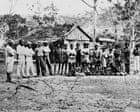
What’s in a name? If that name happens to be Townsville, the coastal north-east Queensland city, the answer is: slavery.
While he scarcely went to the place that still bears his name, Robert Towns, the 19th century British-born Australian colonist, has largely been warmly and sentimentally regarded as a genteel, civic-minded merchant and entrepreneur. Like so many bastards of Australian colonisation, history has coddled him in soft biography, and continues to celebrate him in nomenclature and statuary.
But for some years now the veil has slowly been lifted on Towns and other “pioneers” of colonial Australia who profited hugely from the forced or coerced migration for labour of “blackbirded” (read enslaved) Pacific Islanders – mostly men and boys.
Incidentally the Scot John Mackay, after whom another Queensland city was named, was also a blackbirder.
It’s worth remembering that the term “blackbirding” is not distinct from other forms of slavery that stain British and American history. It comes directly from the African slave trade, and was applied to the no less heinous trafficking by men such as Towns and Mackay of about 62,000 Pacific Islanders to Australia between 1860 and 1906. Many were forced to work in colonial Queensland’s sugar industry in appalling conditions (15,000 died on the plantations whose product was refined at the Colonial Sugar Refining Company’s wharves in today’s Pyrmont, Sydney). Others laboured on Sydney’s docks, in maritime industries and elsewhere.
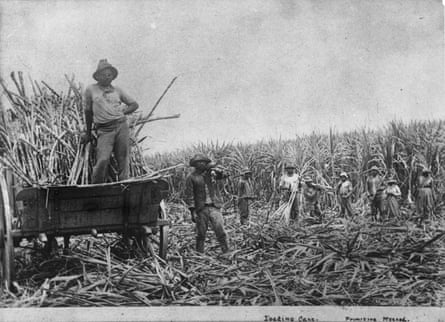
Author Ryan Butta, in his new book which sheds disturbing new light on upper-class colonial Sydney’s intense mercantile interests in the blackbirding trade (and wealth generation through the profits from CSR sugar production), describes Towns as “the founding father of Australian slavery”.
Indeed, read a little about Towns and it seems fair to wonder if Townsville might better be named Townsvillain!
I’m not recommending renaming any colonial city or town. Just as I’m opposed to removing most statues celebrating our more villainous colonists like Towns or the widely celebrated governor Lachlan Macquarie (who ordered the 1816 massacre of First Nations people at Appin, New South Wales, and the theft of their children).
But monuments and nomenclature dedicated to terrible people can and should be used as portals into the discovery of greater historical truths.
Much was known about Towns’ involvement in Pacific Islander blackbirding when his statue was unveiled in Townsville in 2005, just as Macquarie’s inhuman crimes were well established when one was dedicated to him in central Sydney in 2013.
Both carry benign inscriptions that make no mention of their misdeeds.
The statue of Towns (situated in the city’s Pioneer’s Walk) was vandalised in 2020 – the hands daubed in red paint to symbolise blood. I’d never endorse the vandalisation of public property. I’d far prefer to see an additional plaque placed permanently on or near such a statue dedicated to telling the terrible truth about Towns. Add to that the addition of statues in the same place of, for example, South Sea Islander Bonita Mabo – a lifelong activist for her own and Australian First Nations people.
Townsville has, it seems, often gone out if its way to protect the reputation of Towns, at one time insisting he had not “personally condoned or was involved in blackbirding”.
after newsletter promotion
This, of course, is simply unaligned with the facts, as Butta’s book, Blackbirding – A reckoning with the Australian slave trade, forensically documents.
But as I’ve pointed out elsewhere, this protection racket is pretty widespread.
Towns was notorious for the appalling state of his significant Sydney-berthed fleet of ships, some of which were used for blackbirding. Others were crewed by blackbirded Pacific Islanders. His own wharf, known in the day as Rotten Row, relied on blackbirded labour.
An official sign down at Towns Place Wharf (near Sydney’s Miller’s point) still fondly celebrates him today as a man who “imported and exported every commodity imaginable: sugar, rope, salt, sandalwood, horses and skins, sperm and black oil, and later wool”. This clearly demands a rethink.
So, too, the old sugar wharves – today a beautiful harbourside park that pays homage to the old CSR refinery, its product reliant on slave labour. It would be the perfect place for a monument to the tens of thousands of South Sea Islanders who were kidnapped and transported to Australia and upon whose forced labour the colonies thrived.
Incidentally, Towns died at 78 in his palatial Sydney mansion, Cranbrook – something of a citadel to his blackbirding profits – in Bellevue Hill. Cranbrook school was later established on the site in 1918. The school regards Towns as “a great Australian historical figure” whose “ghost … also remains” and has been “seen wandering the halls over the years” by boarders. A spirit besieged by a certain restlessness, it seems. As well it should be if we believe in such things.
KioskNews shows a cleaned-up reading view extracted from the publisher’s page — the original always lives on their site, not ours.