Drones To AI To Advanced Censors: How India Is Preparing For Future Wars
India's defence sector is changing fast. Drones, artificial intelligence, counter-drone systems, advanced sensors and electronic warfare are becoming an important part of modern warfare.
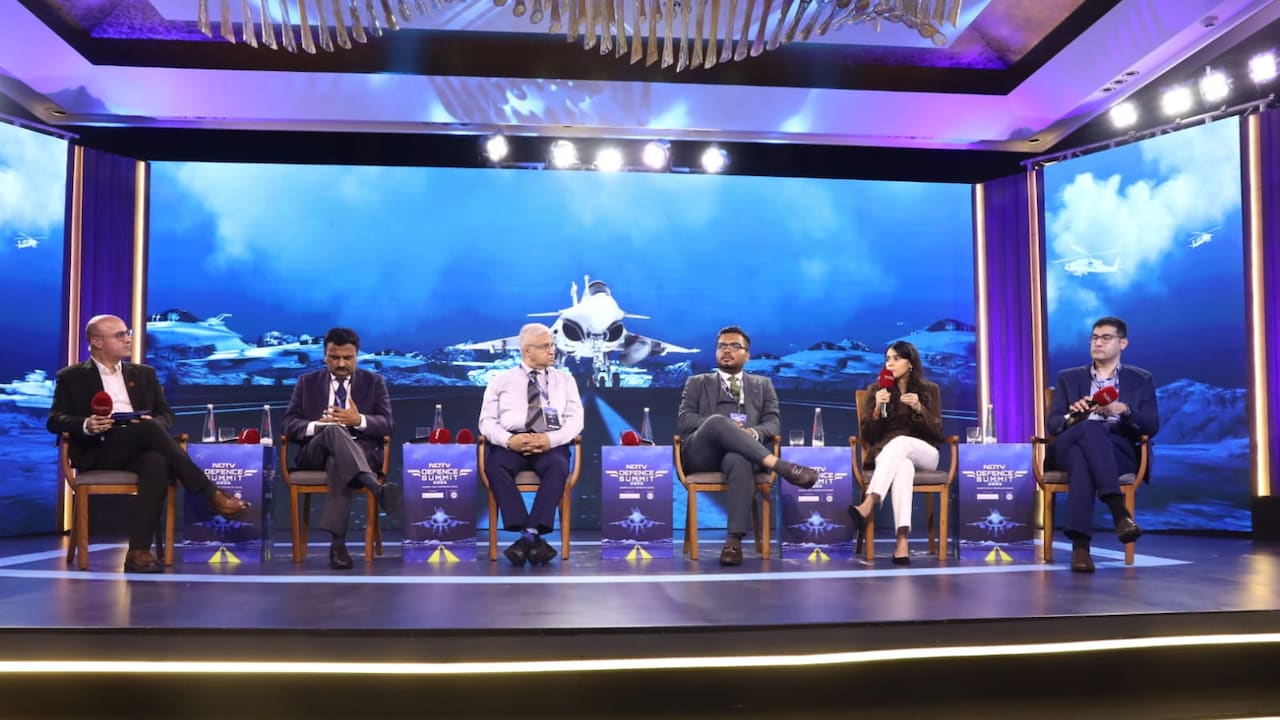
At the NDTV Defence Summit 2026, defence experts discussed how India can build these technologies at home and, more importantly, own the technology behind them. The discussion was held during a session titled "Building Bharat's Arsenal of Innovation: AI, Drones & Beyond".
#NDTVDefenceSummit2026 | Watch discussion on 'Building Bharat's Arsenal of Innovation: AI, Drones & Beyond' with NDTV's @AdityaRajKaul, Bodhisattwa Sanghapriya, Brigadier Devasheesh Chowdhury (Veteran), Veddika Dalmia, Rear Admiral R Sreenivas VSM (Retd.), and Arvind Lakshmikumar pic.twitter.com/4Hrm3snR7q
— NDTV (@ndtv) September 27, 2026
Bodhisattva Sanghapriya, who works in the drone and defence sector, said India has enough engineers, startups and money to build new defence technologies. But what India needs now is speed.
"India doesn't lack engineers, India doesn't lack startups," he said. According to him, the real problem is the speed at which new technologies are developed and put to use. He said drones have changed the way wars are fought.
Sanghapriya said Indian companies earlier focused more on surveillance drones and smaller tactical drones. But after the recent US-Iran war, the requirement is now moving towards drones that can travel much farther and carry out deep strikes.
He said IG Defence has started work on a drone with a range of around 1,000 km. The system is being designed to carry a 50-kg warhead and operate with autonomous capabilities. According to him, AI is no longer something the defence sector can choose to use or ignore. It is already becoming part of warfare.
Arvind Lakshmikumar of Tonbo Imaging said the technology inside military equipment also needs to change as weapons become smaller and cheaper. He explained that a large and expensive missile can carry a costly sensor. But the same sensor may not make sense on a much cheaper loitering munition.
He said companies need to build new technology for these smaller systems. Lakshmikumar said the focus should be on making these systems smaller, lighter, less power-hungry and cheaper.
The panel also discussed counter-drone systems. Brigadier Devasheesh Chowdhury, a veteran associated with ZEN Technologies, said developing a new technology is only the beginning. The real test is whether that technology can work again and again in a real military situation.
He said stopping an enemy drone once shows that the technology works. Doing it repeatedly shows that the armed forces have a proper capability. Chowdhury said drone warfare is changing very quickly. India therefore cannot keep waiting for new technology to arrive from other countries.
Another part of the discussion was about how military equipment can avoid being detected. Veddika Dalmia of Hyperscale said defence companies usually focus on helping militaries see the enemy better. But there is another side to the problem which is making sure the enemy cannot see you. She said camouflage today is not only about hiding from the human eye.
Military equipment can be detected by thermal cameras, infrared sensors and other systems. So modern camouflage also needs to protect against these sensors, she added.
Dalmia said Hyperscale is working on technology that can help control the different signals given out by military platforms. The technology can be used on moving as well as stationary platforms. This includes vehicles, bunkers and other military sites.
Rear Admiral R Sreenivas spoke about another important change which is Indian companies moving from making individual parts to developing complete defence systems. He said a company that makes only a component mainly looks at that particular part. But when it moves into making subsystems and complete systems, it needs to understand how the technology will actually be used.
Sreenivas said Bondada is working on technology that can connect satellite systems with platforms operating in the air.
He said a company cannot spend four years developing a product when technology and warfare are changing every few months. According to him, startups should not wait for a government tender before starting work.
He also pointed to the Russia-Ukraine war, where technology companies have worked closely with soldiers and made quick changes based on their feedback. He suggested that Indian companies could also send engineers closer to military users so that products can be tested and improved faster.
According to Lakshmikumar, being made in India should not be the only reason for buying an Indian product. The technology itself should be good enough to compete globally. He said Tonbo has invested close to Rs 500 crore over the last 10 years in basic research and development.
He added that investors in India are now more willing to put money into deep technology than they were 15 or 20 years ago.
KioskNews shows a cleaned-up reading view extracted from the publisher’s page — the original always lives on their site, not ours.