US terror case sheds light on RAF Fairford arrests mystery
When the US took custody of Mohammad Baqer Saad Dawood al-Saadi in May, investigators hoped the string of terror and arson attacks he was accused of promoting and directing against American and Jewish targets in the UK and Europe on behalf of Iran would stop. They were wrong.
An updated indictment, released on Tuesday by the US Department of Justice, describes some of what happened next. It reveals that al-Saadi has two allies, believed to be in Iran, also trying to provoke fear and chaos in the UK – one of whom is accused of orchestrating the September incident at RAF Fairford.
Al-Saadi described himself as “a prisoner of war” when he first appeared in a Manhattan courtroom in June, accused of being the man behind a new terror group called Harakat Ashab al-Yamin al-Islamia (Hayi) as well as a commander with Kata’ib Hezbollah, an Iraqi group backed by Iran’s Revolutionary Guard Corps.
Yet, as al-Saadi awaited trial from a jail in New York, he was nevertheless able to make calls to his family. During the calls, according to the 26-page indictment, al-Saadi sought to pass on “coded messages” to two associates in Iran. On or about 24 September, he asked after one of them, named Ali. Ali had been transferred to the “International Section”, family members said, as the FBI listened in.
Digesting this, al-Saadi gave an instruction – “Give him money so we can do it” – though it was not immediately obvious what he meant. In any event, Ali had already been busy, according to the US. Within days, Ali’s efforts had come together, directing the incident in a Cotswold village right next to RAF Fairford, the indictment says.
Andy Burnham, the prime minister, told MPs in mid-October that the IRGC was “almost certainly” behind Fairford. The home secretary, Shabana Mahmood, added: “Our assessment is that it is highly likely to have been co-ordinated by a known individual based in Iran, and almost certainly directed by Iran’s IRGC.”
A fortnight later, two Britons from London were charged by UK police. They await trial, accused of assisting Iranian intelligence in breach of the 2023 National Security Act, and are yet to plead.
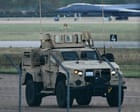
Last month Westminster magistrates court in London heard that the men in the vans had been directed to drive to Fairford by a handler called Ali.
But it was not until last night that Ali was given a full name by investigators. The US indictment said he was Mohammed Ali al-Hassani, a 35-year-old Iraqi who had lived in Britain – it is unclear for how long – and was now using contacts and associates “to carry out terrorist attacks in the UK”.
Al-Hassani was said to be one of two associates of al-Saadi in the low-level campaign conducted by Hayi in March and April, along with Mohsen Mohajeri. A video obtained by US prosecutors shows Mohajeri telling al-Hassani: “We need to get focused on London” on 6 April, as they look at a map of the capital on a laptop. Six attacks in the capital followed shortly after.
In one case, all three men are accused of directing an individual in real time to attack a premises linked to an educational charity called Jewish Futures in Hendon, north London, on 17 April. Late that Friday, a man lit a plastic bag containing bottles of fluid outside the front of the building before fleeing.
Video evidence recovered by US prosecutors shows the three are linked to the individual via a FaceTime video call, its image projected on a large screen against the Hayi logo. During the call, al-Hassani appears to direct the perpetrator’s actions, telling them to take a lighter and “light one in your hand”, “light it” and “throw the fourth one”, according to the US.
after newsletter promotion
The arson attack was basic, but the string of Hayi-linked arson attacks in London in March and April, on synagogues and other Jewish community sites, had a wider impact.
Roger Macmillan, a former head of security at Iran International, an independent London-based TV channel, whose staff have been the focus of threats and harassment from Tehran, argues it matters less whether Iran has the capability to kill or hurt people because “terrorism is not always about massive attacks, it is about instilling fear”.
Al-Saadi was arrested in Turkey in May, and extradited to the US within a couple of weeks. But al-Hassani and Mohajeri remained at liberty – and in August al-Hassani was back, this time accused by the US of orchestrating the preparations of the alleged plot against RAF Fairford.
It will be for the British courts to determine what happened at Fairford, but what the US indictment does demonstrate is that there remain other IRGC-linked individuals interested in orchestrating sabotage and terror plots in the UK.
Britain’s role in the US-led bombing of Iran may have been limited to allowing the US to use its airbases, but the UK has become a theatre of the now simmering conflict, a psychological arena in a war that started by Donald Trump.
KioskNews shows a cleaned-up reading view extracted from the publisher’s page — the original always lives on their site, not ours.