Korea in talks to inject $10 billion into US nuclear reactor project this year despite still reviewing viability
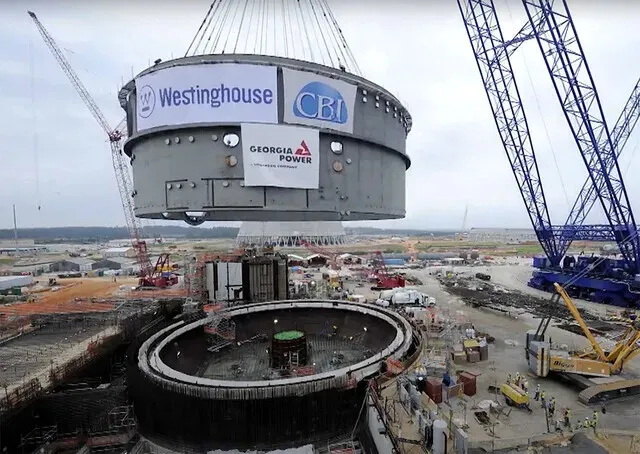
Westinghouse constructs a reactor at the Alvin W. Vogtle Electric Generating Plant near Waynesboro, Georgia, in 2014. (via Westinghouse)
The joint plan to implement Korean investment in the US announced Thursday included an agreement on a bilateral framework for building eight large-scale nuclear power plants in the US, known as “Project Power.”
This venture’s seed capital of US$120 billion comprises 60% of the US$200 billion earmarked for such investment. The Korea Electric Power Corp., Korea Hydro & Nuclear Power, and the American nuclear power corporation Westinghouse will take part in the construction of the first Korean-style nuclear reactor on US soil.
Under a bilateral agreement, Korea will build two of its domestically developed reactors (APR1400, 1.4-gigawatt class) in the US, which originally transferred nuclear technology to Korea in 1978. This will be the first foreign facility of its kind to be built in America.
Westinghouse has long claimed intellectual property rights over this know-how, citing its role in the original technology transfer.
A bilateral deal reached last year included a ban on independent entry into the North American market and payment of technology royalties worth around 1 trillion won per exported reactor.
Minister of Trade, Industry and Resources Kim Jung-kwan announced at briefings on Sept. 22 and Thursday that the agreement was revised to allow construction of two Korean-designed plants in the US, with changes to the royalties possible. This was not a permanent amendment but it allowed “exceptional entry into the North American market” only for the project that invests Korean funds in the US.
Seoul and Washington also agreed on the sequence of plant construction. The first task is to start building two Westinghouse reactors (AP1000, 1.1-gigawatt class), followed within six months by efforts to sign contracts on putting up two Korean- and two American-designed units.
Afterward, two more AP1000 plants will be built. Because of high uncertainty, construction of the Korean plants was prioritized as early as possible in the schedule.
“We deliberated over the order for quite some time, but the Korean model comes first in the sequence,” Kim said.
US Secretary of Commerce Howard Lutnick added that the plants will be built in Ohio, Tennessee, South Carolina and Kentucky.
The key issue is construction cost. In the US, which has suffered the erosion of skilled labor and supply chains, the price tag for building a nuclear plant is over three times higher than in Korea. Construction schedules are sometimes delayed for several years, so this is why US$20 billion of the US$120 billion in seed capital from Korea was set aside as a contingency fund.
For each pair of reactors, the two countries allocated US$30 billion — US$25 billion for construction and US$5 billion in contingency reserves.
“The contingency fund is intended to cover cost overruns,” Kim said. “Even if the money isn’t spent, it counts toward the total investment amount in the US under the agreement.”
But considering factors such as inflation and potential construction delays, use of the contingency fund appears inevitable.
Seoul said this announcement “does not necessarily indicate the immediate launch of the nuclear power project.” While this implies the need for further review of commercial feasibility, the plan to make an advance payment of up to US$10 billion as announced earlier this year suggests the de facto confirmation of the investment decision.
Fears have also been raised over sending such a massive sum before feasibility studies are completed.
To this, the Ministry of Trade, Industry and Resources said, “Given the nature of nuclear power projects requiring long lead times to manufacture major equipment, we’re discussing a plan to first disburse up to US$10 billion by year’s end to proactively secure long-lead items, subject to domestic legal requirements such as commercial feasibility studies and a report to the National Assembly.”
Long-lead components such as reactor vessels (54 months), steam generators (57), and reactor coolant pumps and motors (65) need several years to complete from design to manufacturing and delivery. In these areas, Doosan Enerbility of Korea holds a competitive edge in both technology and manufacturing.
On the acquisition of a stake in Westinghouse, a plan is under consideration to buy 5%-10%, though this is insufficient to secure a board seat.
KioskNews shows a cleaned-up reading view extracted from the publisher’s page — the original always lives on their site, not ours.