Monitoring rules ‘unreasonable,’ officers say
By Wang Kuan-jen and Fion Khan / Staff reporter, with staff writer


A number of police officials have described the rules requiring commanders to monitor officers on unpaid leave as “unreasonable” following a case in which an officer was fired for allegedly working as a male escort while on unpaid leave.
The man, surnamed Chuang (莊), who worked as a male escort at a host club while on unpaid leave, was fired after being accused of defrauding a female customer of NT$1 million (US$31,395) and leaking police information to another client after returning to duty.
Chuang was indicted over the allegations, given two major demerits and dismissed from the police force.
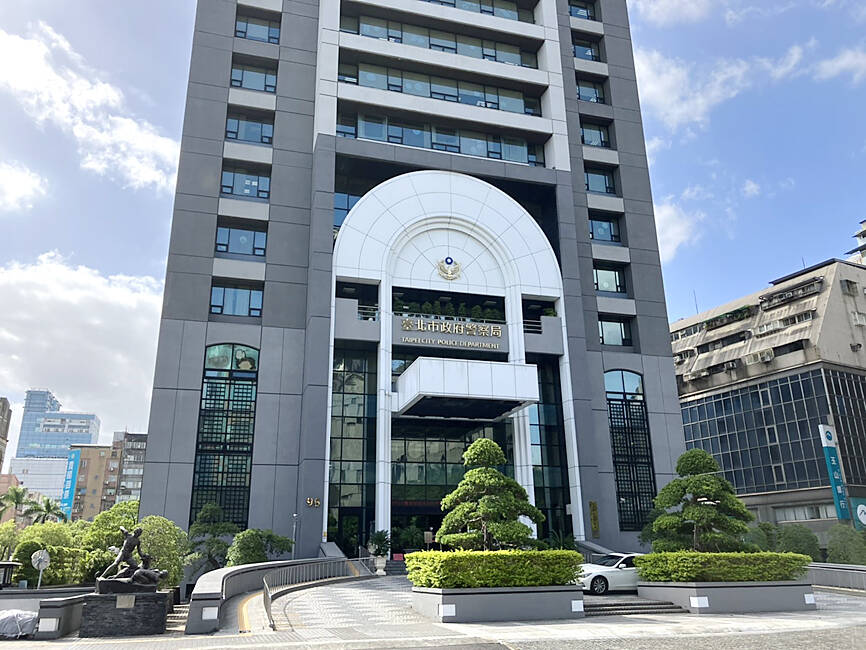
The Taipei Police Department headquarters is pictured in an undated photograph.
Photo: Taipei Times
Commanders at all levels are responsible for monitoring serving officers, suspended officers and those on unpaid leave, including keeping a close watch on their work, personal lives, conduct and behavior, according to the Regulations Governing Police Discipline (端正警察風紀實施規定).
When reached for comment, a number of senior police officers have criticized the requirement as impractical, saying that supervisors already struggle to oversee active-duty officers, let alone those on extended leave.
Supervisors could at most make telephone inquiries, and they have no way of verifying the truth if the person gives evasive answers, they said.
Given the heavy workload of police duties, requiring supervisors to conduct home visits would increase administrative burdens without guaranteeing results, they said.
There have been cases in which off-duty officers became involved in alcohol-fueled disputes and fights that made headlines, a precinct chief said.
Supervisors are not babysitters and cannot follow personnel around 24 hours a day, he said.
Supervisors are typically held accountable when officers under their command commit misconduct and face disciplinary action, a police inspector said.
However, the Code of Conduct for Police Personnel (警察人員獎懲標準) also stipulate that supervisors could be exempt from disciplinary responsibility when officers are objectively beyond effective supervision for more than one month due to training, study, leave, suspension or unpaid leave.
While the supervisor in Chuang’s case was exempt from disciplinary action, the scandal has allegedly prompted police departments nationwide to order local unit heads to increase outreach and lifestyle monitoring for personnel on leave.
Many disciplinary rules originated from a longstanding practice of collective responsibility inherited from the military, police officials said.
As officers have become increasingly conscious of their rights, calls are growing to update these regulations and eliminate the provisions.
Officers on unpaid leave remain civil servants and while taking part-time work is not entirely prohibited, they must comply with the Civil Servant Service Act (公務員服務法), and cannot engage in work that could damage the reputation of civil servants or the government, or contravene rules prohibiting them from running businesses, a police inspector said.
If an officer takes unpaid leave to care for a newborn, they could use their free time to work part-time at a convenience store, make deliveries, run an online business or do programming from home, the police inspector said.
However, they cannot take on a full-time job or work such long hours that they are unable to care for their child, nor can they engage in work that could damage the image of civil servants, such as working at a casino, hostess club or arcade, he added.
KioskNews shows a cleaned-up reading view extracted from the publisher’s page — the original always lives on their site, not ours.