NATO downs drone over Lithuania
‘INCREASINGLY RECKLESS’: A Russian frigate also shot flares toward a Danish helicopter, which the Danish prime minister said was part of Russia’s efforts ‘to sow fear and discord’
NATO fighter jets shot down a drone that entered Lithuanian airspace overnight, officials said yesterday, less than a day after NATO Secretary-General Mark Rutte said that strikes close to the alliance’s territory would drive the organization to increase its support for Kyiv.
The drone was downed near the village of Pratknai in the Kaiiadorys District, about 100km west of the country’s capital, Vilnius, and near the Kaunas Reservoir, the Lithuanian National Crisis Management Center said.
Lithuania’s military said the incident marked the first time that a drone had been shot down in the country’s airspace.
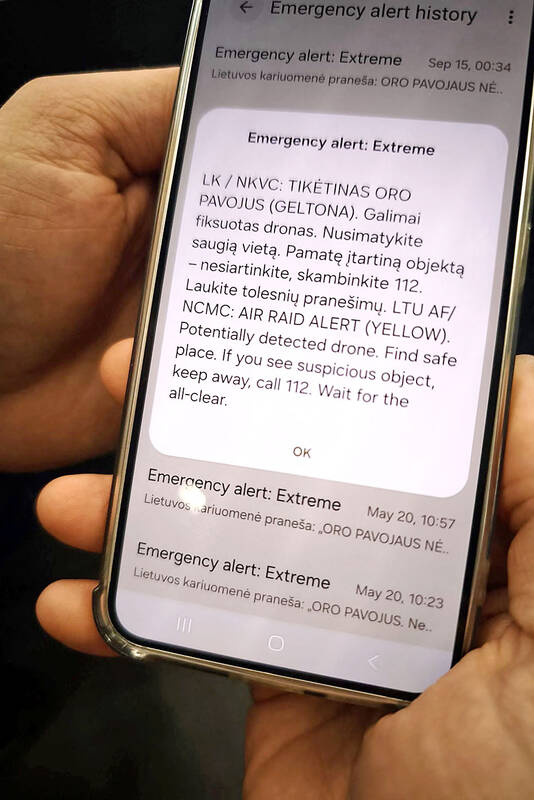
A person holds a phone displaying an alert message sent to the public, warning about a possible drone attack, in Vilnius yesterday.
Photo: AFP
Authorities did not comment on the drone’s origin or purpose, saying the incident needed further investigation.
The incursion follows a speech by Rutte on Monday at NATO headquarters in Brussels, where he said that strikes “close to NATO territory” showed that Russian President Vladimir Putin’s “desperation and also his desire to sow fear and terror.”
“Russia is growing increasingly reckless as it continues its terrible war against Ukraine,” Rutte said.
He also pledged to bolster the 32-nation alliance’s own defenses along its long eastern border with Russia.
The menace of drones has repeatedly loomed over the skies of Lithuania, which shares borders with Belarus, a key ally of Moscow, and the Russian exclave of Kaliningrad.
Lithuanian Air Force Commander Colonel Antanas said that the wreckage had been found, and the drone “likely” was carrying explosives.
Vilmantas Vitkauskas, head of the crisis center, told Lithuanian public broadcaster LRT that the drone most likely entered from Belarus.
It remained in Lithuanian airspace for about 30 minutes and flew along the outskirts of populated areas before being intercepted, he said.
In a separate incident, a Russian frigate on Monday fired two flares toward a Danish military helicopter in international waters off Denmark, narrowly missing the aircraft, the Nordic NATO member’s military said.
The Fennec military helicopter had been on a routine mission to photograph the Russian frigate, the Danish Defence Command said in a statement.
One of the flares — pyrotechnics usually used as a warning signal at sea — flew close to the helicopter, the command said.
The Russian embassy did not immediately respond to a request for comment.
Danish Prime Minister Mette Frederiksen said the incident was serious, but not surprising, calling it part of a pattern in which an increasingly aggressive Russia has intensified its hybrid warfare against Europe and is testing NATO.
“Russia wants to sow fear and discord. Our answer is to stand closer together and strengthen the defense of Denmark and Europe,” she said in a statement.
Meanwhile, Russian drone strikes continued across Ukraine following a social media post from US President Donald Trump on Monday that Russia and Ukraine had agreed “not to hit” each other’s energy infrastructure.
Trump did not offer further details on the purported agreement, and Russia did not immediately comment on Trump’s post. Previous efforts to broker even a partial ceasefire have repeatedly fallen apart within hours, with both sides accusing each other of violations.
Ukrainian President Volodymyr Zelenskiy late on Monday said that Kyiv was “ready to support de-escalation.”
“We see that the Russians feel the pressure from our precise strikes on Russia’s war economy, and so far, no one has seen any genuine desire on Russia’s part to move toward ending the war,” he said. “But if our American partners can ensure that Russia is genuinely ready to stop this war aimed at destroying life — and to do so for real and for the long term — Ukraine will take its own de-escalatory steps.”
KioskNews shows a cleaned-up reading view extracted from the publisher’s page — the original always lives on their site, not ours.