More than 1 million bats emerge from lava tubes on Ted Turner's ranch
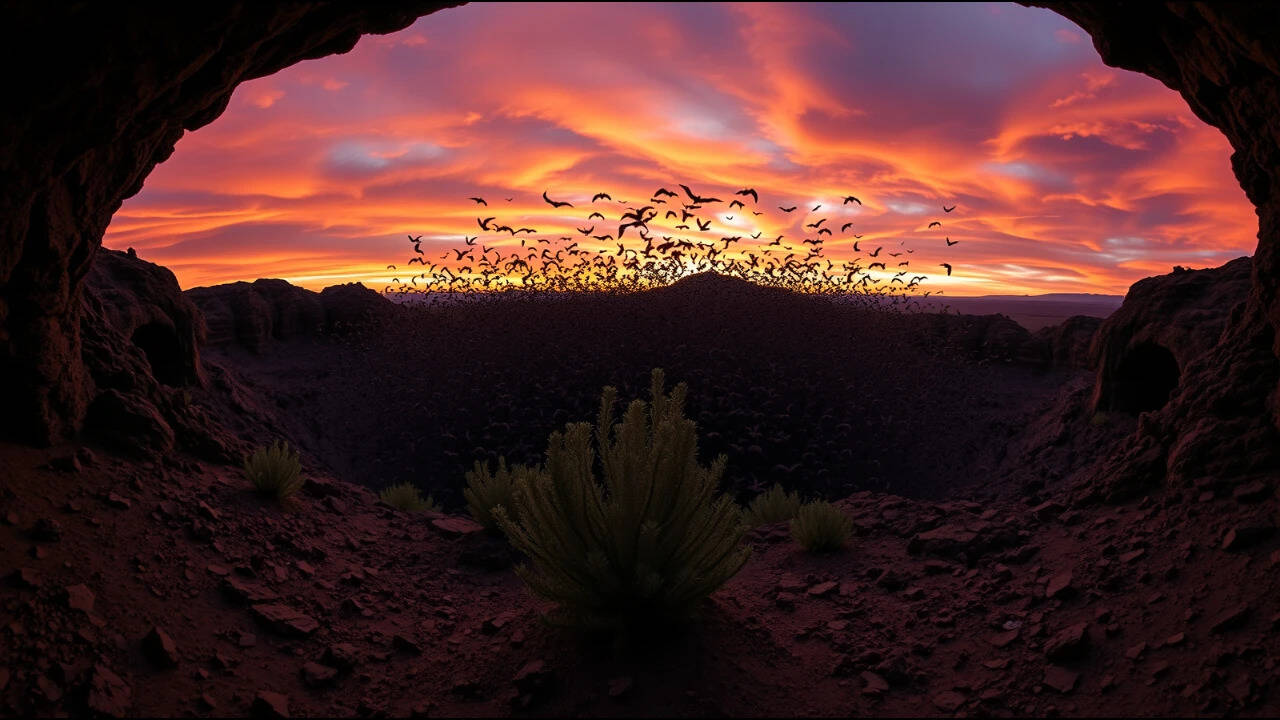
Representative Image of Mexican free-tailed bats emerging from ancient lava tubes at Armendaris Ranch during a breathtaking sunset (AI Generated I
Every summer evening, more than 1 million Mexican free-tailed bats can emerge from ancient lava tubes on a New Mexico ranch, streaming into the desert sky as they begin their nightly search for insects.
The spectacle takes place at Armendaris Ranch, a 362,885-acre property in south-central New Mexico along the Rio Grande that was owned by the late Ted Turner. Turner Enterprises describes the Jornada lava field's tubes as the summer home of one of the largest bat populations in North America, while the current Ted Turner Reserves experience says over 1 million bats can rush from the caves at sunset. The Nature Conservancy, which has worked for decades to protect the site, provides a more specific breakdown, describing a maternal colony of well over 100,000 Mexican free-tailed bats and noting that millions of migratory bats use the caves as a warm-season stopover.
Armendaris Ranch and the Jornada Bat Caves: a major bat site in New Mexico
The Jornada Bat Caves are a network of long lava tubes formed by the Jornada lava flow. The caves intersect one another and extend for hundreds of feet, creating underground roosting spaces for bats on the northern end of Armendaris Ranch. The Nature Conservancy says Mexican free-tailed bats occupy the caves from March through October, with a protected maternal colony numbering well over 100,000. It also says only about five cave complexes in the United States host larger populations of Mexican free-tailed bats, with Texas's Eckert James River Bat Cave being the largest.
Mexican free-tailed bats are not the only species recorded at the site. The Nature Conservancy says seven other bat species have been identified at the Jornada caves, bringing the total to eight species. These include Allen's big-eared bat and the spotted bat. The site therefore supports both a large seasonal population of Mexican free-tailed bats and a broader assemblage of bat species using the lava tubes. The numbers associated with the caves can vary depending on what is being counted.
The Nature Conservancy refers to the resident maternal colony as numbering well over 100,000 and separately says millions of migratory bats use the caves as a stopover during the warm season. Turner Enterprises and its tourism operation, meanwhile, promote the evening emergence as a spectacle in which more than 1 million Mexican free-tailed bats leave the caves. These figures should not be treated as competing estimates of a single permanent colony.
From guano mining to bat conservation
The caves were not always managed primarily as a wildlife habitat. According to the Nature Conservancy, bat guano was mined there from the late 19th century and continued to be removed well into the 1980s for use as fertiliser. Miners blasted openings into the ceilings of the lava tubes to make it easier to extract the guano. The resulting shafts allowed light into parts of the caves, reducing the amount of suitable roosting habitat available to bats.The Nature Conservancy began working to protect the site decades ago. In the late 1980s, it approached Tenneco, the Houston-based company that held mineral rights in the area, about protecting the caves. In 1993, Tenneco donated mineral rights associated with 5,175 acres, including the Jornada Bat Caves, to the conservation organisation. Ted Turner subsequently acquired the property as part of his purchase of the Armendaris Ranch.
The Nature Conservancy says Turner worked with the organisation and the University of New Mexico on efforts to restore the caves for bats. Ranch staff have since taken steps to restrict access and protect the site from disturbance, while conservation work has included repairing the openings created by earlier mining activity.
Watching the Mexican free-tailed bats emerge at dusk
The bat emergence has also become one of the wildlife experiences associated with Armendaris. Ted Turner Reserves currently offers an Armendaris Bat Flight Expedition, which operates during the summer and allows guests to watch the bats emerge from the caves at sunset.
The company says the experience runs from June through August and describes more than 1 million Mexican free-tailed bats taking flight along the Rio Grande.The experience is part of a broader conservation-focused tourism operation connected with Turner's New Mexico properties. Ted Turner Reserves describes its hospitality business as being built around conservation and says guest stays help generate revenue for conservation projects.
At Armendaris itself, the property supports a range of wildlife beyond the bats, including bison, pronghorn, desert mule deer, mountain lions, javelina and oryx.
The ranch is also involved in conservation programmes for species including desert bighorn sheep and the Bolson tortoise. Turner Enterprises says the Fra Cristobal Mountains on Armendaris are home to a successfully reintroduced desert bighorn sheep population, while the Turner Endangered Species Fund is involved in Bolson tortoise recovery work.
A living part of Ted Turner's conservation legacy
Turner died on May 6, 2026, at the age of 87, his family announced through Turner Enterprises. The company credited him with decades of conservation work, including efforts involving endangered and imperilled species and the preservation of more than two million acres of land. The Jornada Bat Caves remain under protection on the private Armendaris Ranch, and the Nature Conservancy currently lists the caves as closed to the general public outside authorised access.
For visitors taking part in the organised bat experience, however, the summer emergence offers a rare view of the scale of wildlife supported by the desert landscape. As dusk settles over the ranch, the bats pour from the lava tubes and disappear across the Rio Grande valley, continuing a seasonal cycle that has made the Jornada caves one of New Mexico's most notable bat sites.
KioskNews shows a cleaned-up reading view extracted from the publisher’s page — the original always lives on their site, not ours.