Could China’s 100-channel single-photon detector enable broadband quantum internet?

Chinese scientists have developed a 100-channel single-photon detector, a breakthrough promising to pave the way for broadband quantum networks.
State-of-the-art single-photon detectors – essential components underpinning photonic quantum technologies – could previously support a maximum of 32 detection channels for photon signals.
Now, a newly developed interconnect scheme by a Shanghai-based team has broken this bottleneck, supporting more than 100 detection channels while maintaining accurate and stable operation.
“This work establishes a robust and scalable infrastructure, paving the way for large-scale quantum photonic applications,” the authors said in their paper.
Achieved by researchers at the Shanghai Institute of Microsystem and Information Technology (SIMIT) under the Chinese Academy of Sciences, the breakthrough was published in the peer-reviewed journal Laser & Photonics Reviews in late September.
Advances in photonic quantum technologies are accelerating their transition from laboratory demonstrations to practical applications in fields such as quantum computing, communications and metrology.
The scaling of these systems urgently requires large-scale, parallel single-photon detection capabilities.
Superconducting nanowire single-photon detectors (SNSPDs) – high-end optoelectronic devices that use the extreme sensitivity of superconducting materials to detect individual photons – represent the most advanced technology available, boasting a detection efficiency approaching 100 per cent, the paper said.
Owing to advantages including high detection efficiency, fast response speeds and high time resolution, they are widely used as core components in photonic quantum technologies, light detection and ranging (lidar), and single-photon imaging.
However, scaling these systems up has long been a technical headache.
Temperature poses a major challenge. Such detectors rely on cooling an ultra-thin superconducting nanowire film to a cryogenic environment approaching absolute zero. A cable is then used to connect it to a room-temperature environment to transmit the detected signals externally.
Coaxial cables are traditionally used and relatively thick, and their metal materials are highly thermally conductive. Heat from the room-temperature end continuously conducts down the cables into the cryogenic chamber, a phenomenon known as thermal load.
When the number of detection channels – independent, dedicated informational routes for receiving, processing and outputting photon signals – expands to dozens or hundreds, the massive bundle of cables introduces a heavy thermal load to the cryogenic environment.
This dramatically increases the system’s size and cooling power consumption. Previously, standard set-ups could only support about 32 channels.
05:04
China creates analogue AI chip said to be 1,000 times faster than Nvidia GPU
To overcome this, the Shanghai team undertook a comprehensive redesign. They developed ultra-thin, specialised flexible materials known as “high-density multi-core microstrip lines”.
The new material and structure are highly thermally insulating. According to the team, the heat leaked into the system is just one twenty-first of that generated by traditional thick cables.
The researchers also achieved stability and miniaturisation for this large-scale parallel design through a series of architectural innovations.
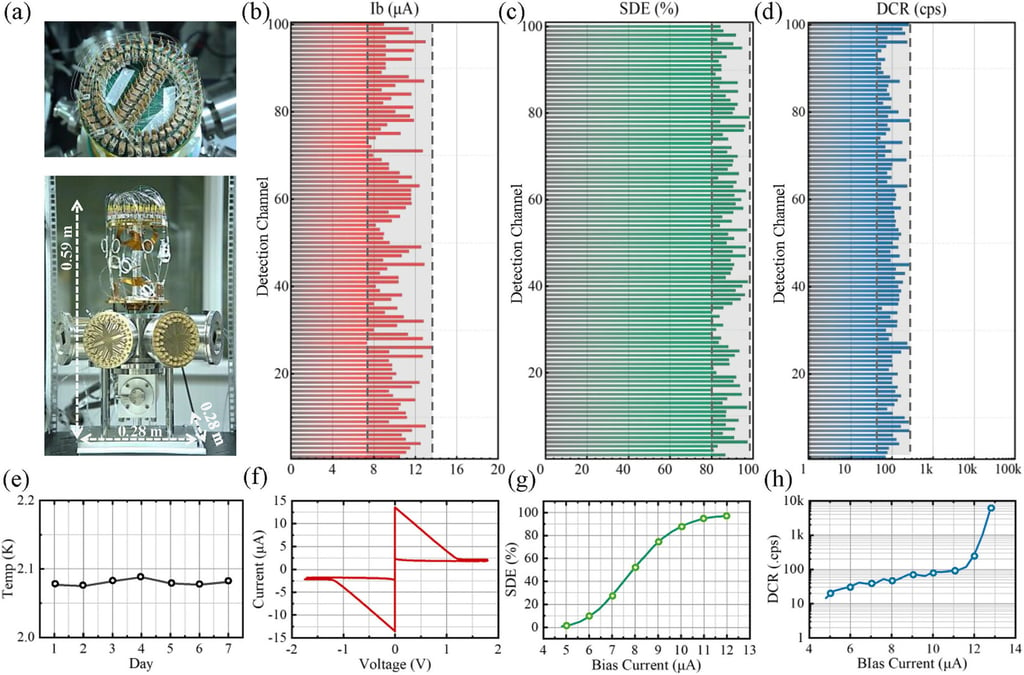
Under typical cooling power, the system comfortably supports more than 100 independent detection channels while maintaining long-term stability.
During a continuous seven-day 24-hour test, the cryogenic platform’s temperature remained steadily below 2.1K – an extreme low temperature extraordinarily close to the physical limit of “absolute zero” (0K, or -273.15 degrees Celsius).
Test results also showed that all channels achieved a system detection efficiency exceeding 80 per cent, coupled with incredibly low signal false alarm rates.
To prove the platform’s capabilities in real-world scenarios, the team built a five-user, fully connected quantum entanglement distribution network.
The set-up formed 10 two-way quantum links among the five users, with each user receiving entangled photons via the newly developed channels.
Test results revealed that the communication fidelity – how well a quantum channel preserves information – exceeded 90 per cent across all 10 links.
KioskNews shows a cleaned-up reading view extracted from the publisher’s page — the original always lives on their site, not ours.