Israel's Syria strike risked scrambling Turkish jets, military escalation, US envoy tells 'Post'

US envoy Tom Barrack warned that Israel's strike on Abu al-Duhur airbase, near Idlib, Syria, could have led to a rapid escalation into a direct military confrontation, possibly including Turkey.
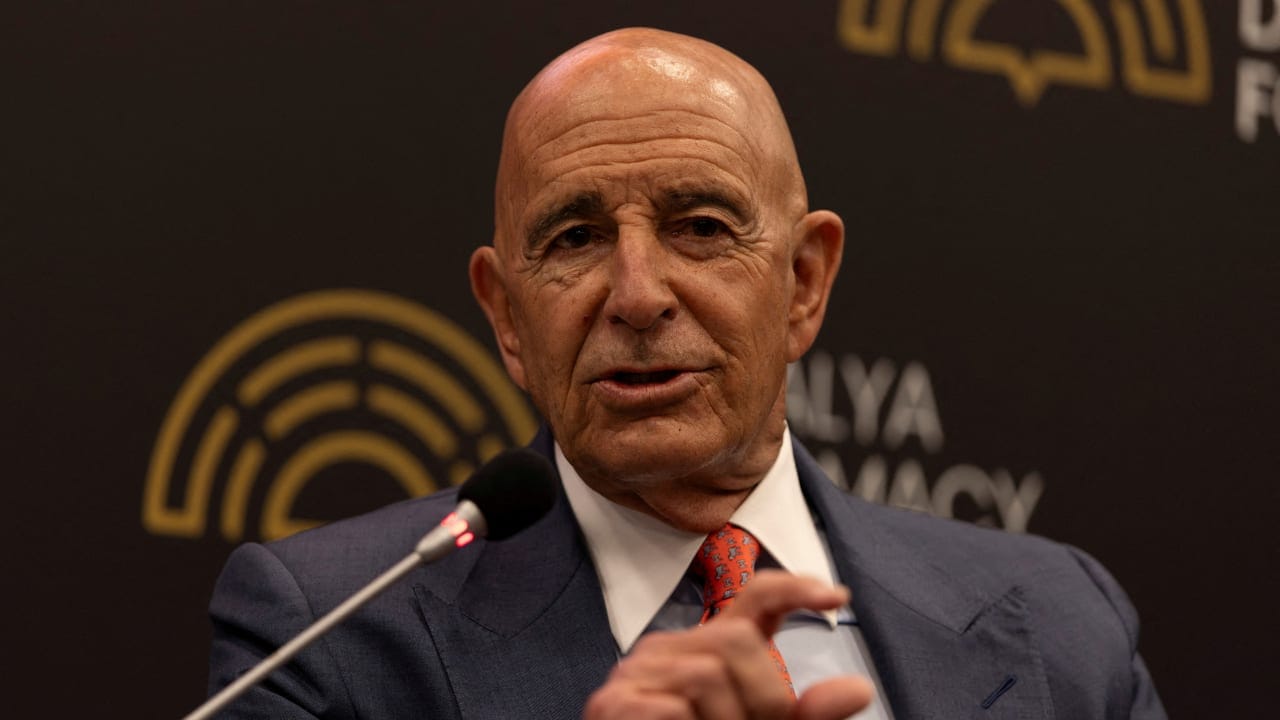
On Tuesday evening, the Prime Minister's Office took credit for a strike on Abu al-Duhur airbase in Idlib, Syria. US Ambassador to Turkey and the Trump administration's special envoy to Syria, Tom Barrack, said that the strike “carried a real risk of rapid escalation into a direct military confrontation between Israel and Turkey as well as Syria.”
“Turkish forces were not aware that the Israeli aircraft were en route to that specific Syrian base, nor of their intended purpose, and therefore could potentially have been inclined to scramble their own jets in the belief that they themselves were under attack,” Barrack said in a Wednesday interview with The Jerusalem Post.
“The events of yesterday were serious and worrisome. However, we are relieved that no human life was harmed and that the situation did not escalate,” he added.
Syria said on Tuesday that Israel had carried out eight airstrikes on the runway and storage facilities at Abu al-Duhur, about 70 kilometers east of the Turkish border.
The Prime Minister's Office said late Tuesday that Syria was on the “verge” of violating a “status quo agreed with Israel on security matters” by allowing Turkish troops to deploy at the airbase.

“Israel repeatedly warned Syria that such a deployment would pose a threat to Israel’s security. Syria chose to ignore these warnings,” the PMO said.
Barrack told the Post that the lack of clear communication channels could have made the situation “much worse,” and that this needs to change.
Barrack: Discussions ongoing about relaunching Israel-Syria deconfliction cell
“We are currently engaged in quiet discussions with all the relevant parties about relaunching a deconfliction cell between Israel and Syria. Turkey can be invited to be a direct or indirect participant,” Barrack said.
“There would be clear value in placing such an arrangement on a standing, full-time basis, with a fusion cell staffed around the clock by personnel fluent in Hebrew, Arabic, English and Turkish, whether through a formal structure or a more flexible, informal channel. Reliable communication remains essential," he added.
The Trump envoy said that the absence of dependable communication channels itself creates unnecessary risk.
“There is no inherent obstacle preventing these parties from maintaining open lines of communication. Diplomatic discourse is the best prevention to kinetic interactions,” he said.
In recent years, Barrack has hosted several rounds of discussions between Syrian President Ahmed al-Sharaa's government and senior Israeli officials in an attempt to reach a border agreement between the countries, advance normalization and de-escalate tensions. During the most recent round of talks, the sides even agreed to advance joint economic projects and establish a deconfliction mechanism between the countries, based in Jordan.
“Meaningful progress was achieved in clarifying the concerns of both parties, and in light of recent developments, there is clear value in revisiting these talks at the earliest opportunity,” Barrack told the Post, adding that the Sharaa government has made clear that it harbors no predatory intentions toward Israel and seeks only to protect its own sovereignty.
“Syria has demonstrated itself to be a responsible and stable sovereign neighbor, and a carefully structured de-escalation arrangement would contribute significantly to greater calm and predictability across the region,” Barrack said.
Israeli concerns over Turkish military equipment close to Syria-Israeli border remains sticking point
One of the sticking points during the talks was Israel’s concern that Turkish military personnel or equipment could be deployed at Syrian bases, some of them close to the Israeli border.
In January, the Post reported that the deployment of an advanced Turkish HTRS-100 radar system at Damascus International Airport was viewed in Israel as “extremely troubling.”
Israeli officials feared that a Turkish military installation capable of tracking aerial targets within a 150–200-kilometer range could significantly restrict the Israel Air Force’s freedom of movement in Syrian airspace.
Barrack said that, in the US view, the civilian infrastructure does not pose a security threat to Israel.
“Syria’s ability to maintain safe and reliable domestic aviation depends on functioning civilian radar coverage. We remain convinced that this technical requirement need not pose a security concern, and that further conversations can help clarify the matter to everyone’s satisfaction,” he told the Post.
Barrack added that the US’s immediate priority must be to help lower tensions between Ankara and Jerusalem and prevent any unintended escalation that could prove difficult to reverse.
“All parties should work patiently toward a durable resolution of this highly complex situation. Türkiye and Israel have, at various points over the past three decades, enjoyed periods of constructive and productive relations. President Trump’s plan offers a viable path that can succeed if given the necessary space and support,” he said.
KioskNews shows a cleaned-up reading view extracted from the publisher’s page — the original always lives on their site, not ours.