US stresses backing for Asian allies
CALL: US, Japanese and South Korean foreign ministers expressed support for Taiwan’s meaningful participation in appropriate international organizations
The US on Monday reiterated its commitment to the defense of key Asian allies Japan and South Korea, and the three nations expressed support for Taiwan ahead of a summit this week between US President Donald Trump and Chinese President Xi Jinping (習近平).
Analysts say the US allies are anxious that Trump might offer concessions to Xi including over Taiwan and trade in return for an economic win with Beijing when he hosts the Chinese president at the White House in Washington tomorrow.
Officials say Japanese Prime Minister Sanae Takaichi and South Korean President Lee Jae-myung are keen to see the US president during the UN General Assembly in New York, where all three were scheduled to speak yesterday.
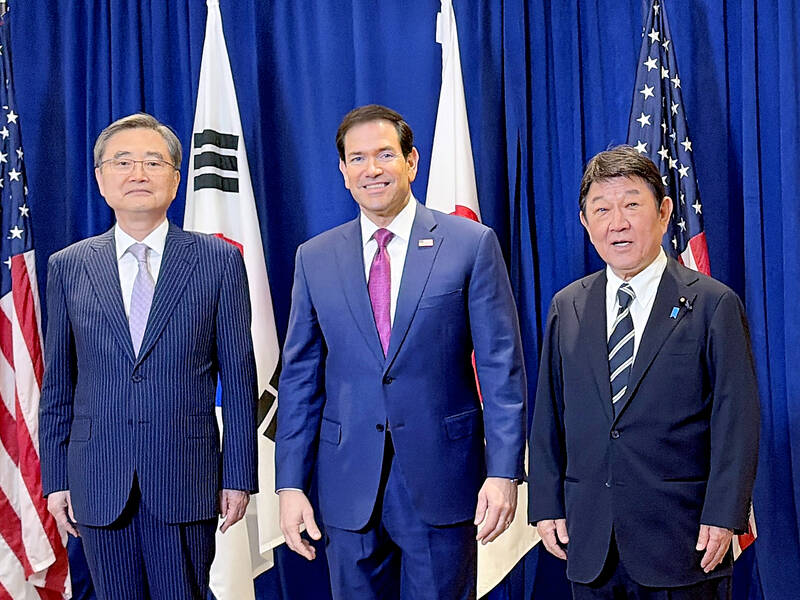
From left, South Korean Minister of Foreign Affairs Cho Hyun, US Secretary of State Marco Rubio and Japanese Minister of Foreign Affairs Toshimitsu Motegi pose for a photograph ahead of their talks in New York on Monday.
Photo: EPA
US Secretary of State Marco Rubio on Monday met with his South Korean counterpart Cho Hyun and Japanese Minister of Foreign Affairs Toshimitsu Motegi in New York. They issued a joint statement vowing, in apparent reference to China, to stand firm “against economic coercion and non-market policies and practices” and “arbitrary export restrictions that disrupt supply chains.”
They also welcomed the launch of a new trilateral consultation mechanism on economic security, part of broader efforts to strengthen supply chains and cooperation on critical technologies.
The statement said the US “reiterated its ironclad commitments to the defense of Japan and the ROK [Republic of Korea], backed by America’s unmatched military strength, including its nuclear capabilities, and reaffirmed its extended deterrence commitments to Japan and the ROK,” referring to South Korea’s official name.
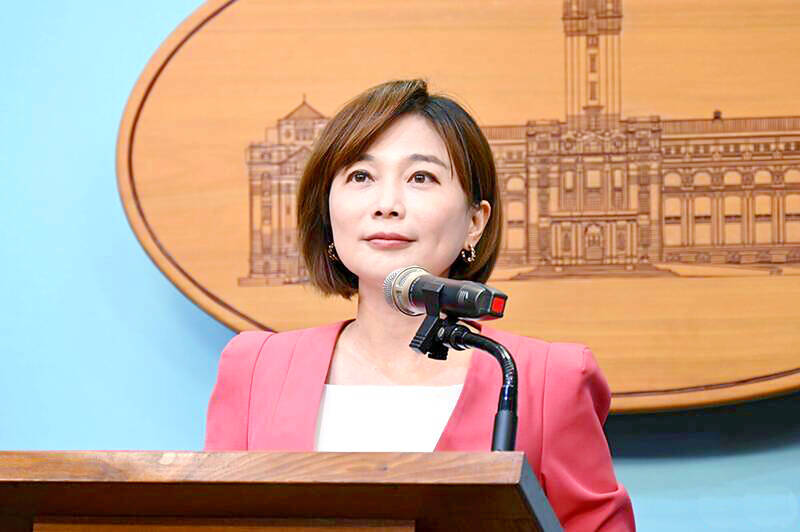
Presidential Office spokeswoman Karen Kuo speaks at a news conference in an undated photograph.
Photo: Taipei Times
The statement said the ministers emphasized their commitment to robust security cooperation and the importance of maintaining peace and stability across the Taiwan Strait. It “expressed support for Taiwan’s meaningful participation in appropriate international organizations.”
Referring to North Korea, the ministers “reaffirmed their resolute commitment to the complete denuclearization of the Democratic People’s Republic of Korea” and called on it to resume dialogue.
In Taipei, Presidential Office spokeswoman Karen Kuo (郭雅慧) yesterday said that peace and stability across the Taiwan Strait and the broader region represent a firm global consensus and an essential pillar of world security and prosperity, directly impacting shared international interests.
The Presidential Office welcomed and appreciated the three foreign ministers’ concrete actions demonstrating an unwavering commitment to regional stability, she added.
Amid a rapidly shifting geopolitical landscape, democratic partners must stand together to uphold the rules-based international order, Kuo said.
As a frontline defender of global democracy, Taiwan remains determined to maintain regional peace and stability as a responsible international actor, she said.
“Peace and stability across the Taiwan Strait are not only critical to the security and prosperity of the Indo-Pacific, but also closely tied to the stability of the global economy and supply chains,” Ministry of Foreign Affairs spokesman Hsiao Kuang-wei (蕭光偉) said separately yesterday.
The US, Japan and South Korea’s reaffirmation of the significance of maintaining peace and stability in the Taiwan Strait fully demonstrates that security across the Strait has become a strong consensus within the international community, he said.
Facing ongoing regional challenges, Taiwan will continue to strengthen its self-defense resilience and resolutely maintain the “status quo” across the Taiwan Strait, he said.
Taiwan will also deepen cooperation with the US, Japan and South Korea, as well as other democratic partners, to jointly safeguard peace, stability and prosperity in the Indo-Pacific region, he said.
KioskNews shows a cleaned-up reading view extracted from the publisher’s page — the original always lives on their site, not ours.