Institute touts DNA sampler module’s work under the sea
By Jonathan Chin / Staff writer, with CNA


Scientists have invented a DNA sampler module to collect residual deep-sea genetic material for biological surveys and long-term maritime ecology monitoring, the Taiwan Oceanic Research Institute said in a statement yesterday.
A test of the module identified 365 species in waters southwest of Taiwan proper, the institute said.
The deep-sea high-flow environmental DNA module — a suitcase-sized machine when deployed with its dedicated platform — is a boon to deep oceanic research, as it could sample trace amounts of genetic material from cells, tissue fragments and excretions, it said.
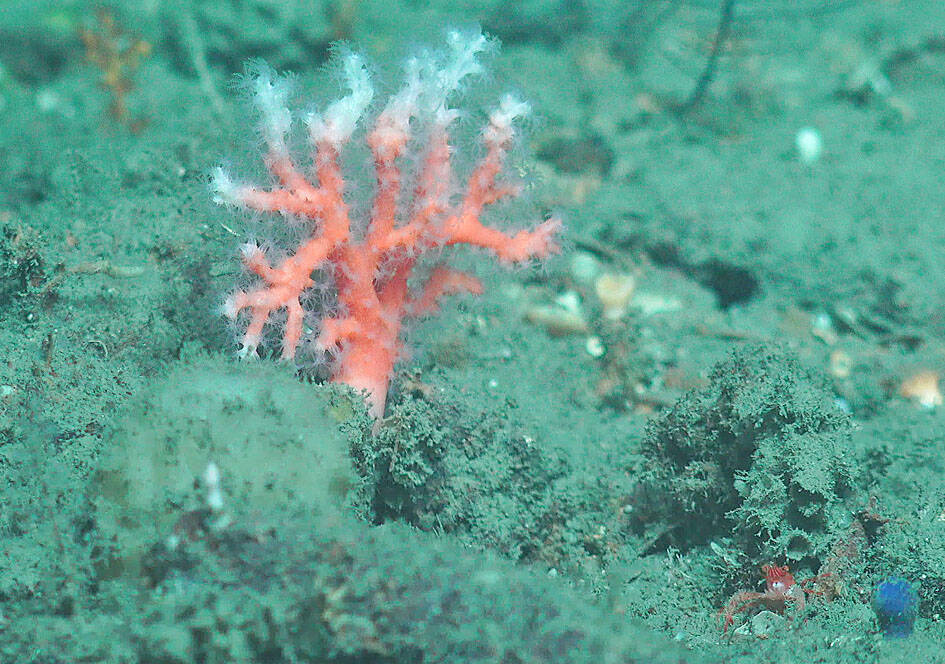
Aka coral is pictured in waters off southwestern Taiwan in an undated photograph.
Photo courtesy of the National Applied Research Laboratories
Deep-sea exploration poses steep challenges stemming from high pressures, low temperatures and low bio-density, the institute said.
Trawling nets could be deployed to collect samples, but they are inefficient and disruptive to the fragile ecology of the deep sea, which makes the module a valuable scientific tool, it said.
The module consists of a pressure-resistant motor, a peristaltic pump — which allows precision and keeps the risk of pollution low — and a filter that can be adjusted to the size of the targeted sample, it said.
It can filter more than 100 liters of seawater per hour, it can be programmed to collect samples at scheduled times and can be retrieved with a near-zero environmental footprint, the institute said.
The module uses third-generation genetic sequencing technology, doing away with the inaccuracies arising from polymerase chain reaction amplification, it said.
The module tested its capabilities during the trial, in which it collected 22 million DNA sequences and enabled the identification of hundreds of species of fish, mollusks, crustaceans, corals, sea stars and sea urchins during the trial, the institute said.
The institute said that it plans to deploy more of the modules to conduct biodiversity research, ocean environmental conservation, fisheries resource management and long-term ecological observation.
KioskNews shows a cleaned-up reading view extracted from the publisher’s page — the original always lives on their site, not ours.