Amy’s childhood home was a converted aircraft hangar. Now she’s taking over a remote island paradise
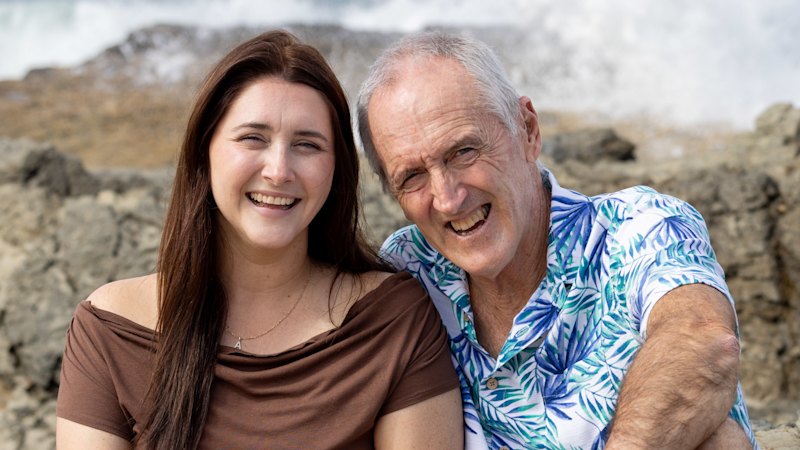
For 21 years, pilot and aircraft engineer Peter Gash, 67, has been the custodian of Lady Elliot Island, a 45-hectare coral cay on the Great Barrier Reef. Now his daughter, Amy, 34, also works on the island and is determined to continue his conservation efforts.
PETER: Amy was born two-and-a-half months premature in July 1992. She was so beautiful, so tiny in my hands. I only got to hold her for a few minutes before she had to go into a humidity crib. After 28 days, we brought her home, which was, and still is, a converted aircraft hangar on the Gold Coast [Peter and his wife, Julie, own Seair Pacific, an aviation charter company that has operated all flights to Lady Elliot and other islands for 30 years]. She hit the rush of our lives and, before we knew it, she was sitting in an airplane with us wearing a headset. At night, I’d lie in bed and read her stories, and we’d both fall asleep. Julie would wake me and I’d sneak downstairs to work on the planes.
I came from a broken family; my parents split acrimoniously and I went to 12 schools in 12 years. I grew up under some pretty strong-willed people – “It’s my way or the highway” – and, because of this, I’ve always tried to listen to Amy.
When she was very young, I remember sitting next to her bed one night, talking to her about visualisation. I used to be a professional motocross racer, and I’d sit in a chair and ride the racetrack in my head. When I learnt to fly, I did the same thing. So I told her, “Visualise what you’re going to do, what you’re going to see.” You are what you visualise.
She’s never been frightened to have a go. When she was 14, she had to do a night dive for an open-water dive course. There wasn’t a star in the sky: you couldn’t see anything. I jumped in, looked up and thought, “No way she’s doing this”. But then she jumped – “All right, Dad” – and down we went. She’s cautious, but she trusts the training.
I’ve always been a conservation person. I first visited Lady Elliot in my 20s and realised that flying people to the reef could fund its restoration. [The island had been devastated by guano mining.] In 2005, we took over the 45-year lease of the island, including its 44-room eco resort, from the Commonwealth and set to work restoring its native vegetation.
It’s challenging work and I recognise I can’t keep doing it forever. Amy and I share the same vision to restore this beautiful island, but I’ve never wanted her to feel she has to take it on. But it’s the road she’s chosen, and I’m really proud.
Amy’s considered, measured, whereas I’m just go, go, go. She’s always saying, “Slow down, mate.” She makes me think.
Six years ago, we were walking along the short, disused runway on the island and Amy said, “Dad, why don’t we plant this out with trees?” I was like, of course, why not? It seemed so logical, but it had never entered my head. We’ve now planted hundreds and hundreds of trees, including pisonia plants, casuarina trees and octopus bush.
I have my down days. I had some pretty good injuries racing motorbikes and, sometimes, it’s raining, your bloody leg is aching and everything gets to you. Amy sees it: “Come on, Dad, let’s make some scones; let’s go snorkel over there.” Next thing, you’re up and away again. When she’s having her down days, I try to help her out of it, too. Together is better than alone.
AMY: Dad has always been 100 miles an hour. He’s an action man, and I have a bit of that in me as well. Growing up, I didn’t realise that I had a unique childhood. Once, for a family holiday, we did almost half a lap of Australia in three weeks, flying into Mount Isa, Darwin, the Kimberley, Uluru and Coober Pedy. [Seair also operates fly-in, fly-out charters for the resources sector.] When Dad does something, he does it 100 per cent.
He has this amazing way of making you feel like you can do anything. When I got my pilot’s licence 10 years ago, I had to overcome a lot of fear about flying solo. He helped me slow my breathing down and trust myself. I could hear him in my head saying, “You know what you’ve learnt; you’ll be right.”
‘Looking at each other underwater, we knew we were witnessing one of the worst things we’d ever seen.’
Amy Gash
When I was young, the island was our second home [the family has a residence in the heritage-listed lighthouse-keeper’s cottage]. On long weekends and school holidays, we’d go there and have these incredibly rare experiences that felt completely normal to me: going out at night to watch turtles coming onto the beach to nest; snorkelling with manta rays; swimming with humpbacks. Dad was always teaching me about the reef.
I’d walk around with Dad and he’d say, “Let’s make a path here and remove these invasive species from there.” We’d get plants out of our little nursery and dig holes in the coral rubble to plant pisonia cuttings, hoping they’d grow – and some did. Twenty years later, his commitment to conservation hasn’t wavered. That’s inspired me: when you believe in something, don’t be afraid to commit to it.
I started working full-time on Lady Elliot in 2014. I never felt pressure; I just couldn’t imagine working anywhere else. At work, I call Dad “PG” because I don’t like walking around saying, “Hey, Dad.” He’s still 100 miles an hour, while I’m usually one step behind saying, “Whoa, let’s just think it through.”
Last year, I became executive GM of the resort and I’m starting to understand the challenges Dad shielded us from growing up: the periods of low occupancy, the financial pressures of running a business on a remote island.
A couple of years ago, Dad and I returned to the island after three weeks away to find some of the corals turning white. We’ve spent thousands of hours in the water together, but that day, when we went snorkelling, the change was shocking. Looking at each other underwater, we knew we were witnessing one of the worst things we’d ever seen. Dad talked about it openly with guests: he believes people can only judge what’s going on if they have the full picture.
Dad stepped back from daily resort operations about five years ago, but he still wears his Lady Elliot Island shirt; he even wears it to dinner. He still loves talking to guests, hearing their stories, telling them where they can find the red-tailed tropicbird. And when he’s back on the Gold Coast, he’s at the hangar early nearly every day, waving guests off as they fly to the island.
Read more from Good Weekend magazine:
- ‘Never seen so many grown men cry’: The everyday Aussies who can’t afford another disaster
- I thought my seventh trip to Antarctica would be my last. But then ...
- ‘Are we playing God?’ Researchers fast-track evolution in fight to save the reef
- A giant manta ray and Bubbles the dolphin: The movie making couple bringing wildlife to the world
KioskNews shows a cleaned-up reading view extracted from the publisher’s page — the original always lives on their site, not ours.