ASEAN seeks Myanmar engagement
SEA DEAL DOUBTFUL: Hopes of achieving a Code of Conduct in the South China Sea between ASEAN states and China during the summit were unlikely, a diplomat said
ASEAN leaders yesterday agreed on pursuing a “calibrated engagement” with Myanmar’s post-coup government, according to a joint statement, as the regional bloc seeks a path toward normalization.
Myanmar is still a member of ASEAN, but it has been frozen out of high-level meetings since a military junta seized power in a coup in 2021.
Thailand has been leading efforts to normalize relations with Myanmar since coup leader Min Aung Hlaing was installed as civilian president this year following elections dismissed by monitors as a charade.
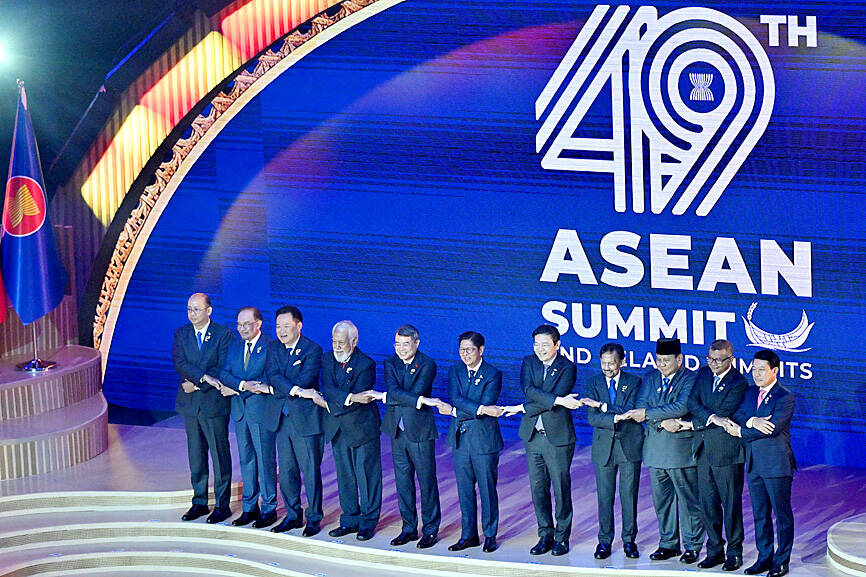
Leaders of the ASEAN members link hands during the opening of the ASEAN Summit in Manila yesterday.
Photo: Reuters
Bangkok has called for a “calibrated engagement” with Myanmar in an effort to implement ASEAN’s “five-point consensus” plan aimed at ending the war between the military and a coalition of pro-democracy rebels and ethnic minority armed groups.
ASEAN leaders meeting in Manila adopted that language in calling for the pursuit of “a calibrated engagement with Myanmar through a phased and progress-based approach, taking into account developments on the ground,” according to the joint statement.
The five-point plan has yielded little in the half-decade since it was agreed to, with Philippine President Ferdinand Marcos Jr conceding at a May summit he had not seen “any progress in Myanmar.”
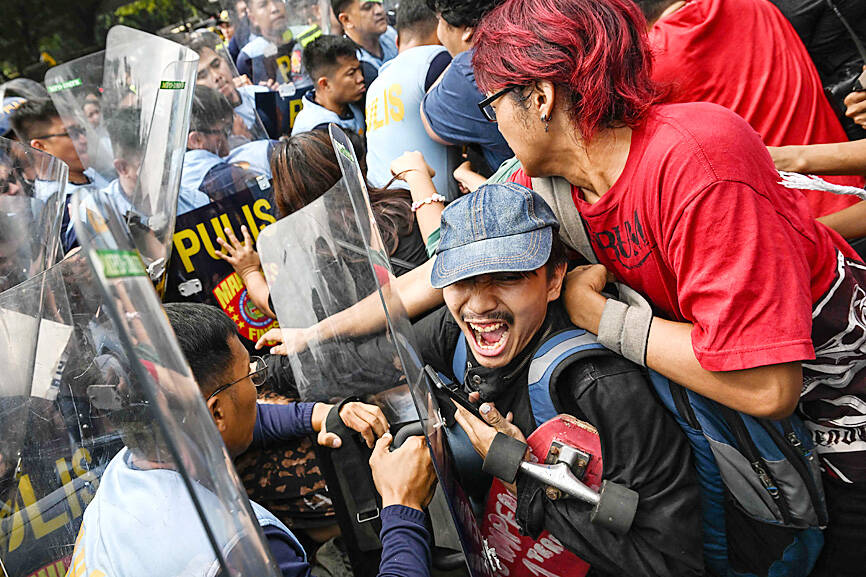
Protesters clash with police officers during a demonstration that coincided with the ASEAN Summit in Manila yesterday.
Photo: AFP
In opening remarks at an ASEAN leaders’ retreat in Manila yesterday, he repeated a question he had posed to the group six months earlier: “What more can we do for Myanmar?”
“I hope our session leads to practical and forward-looking discussions on how we can further advance the implementation of the five-point consensus, make our efforts more responsive to the realities on the ground, and support a peaceful, inclusive, Myanmar-owned and Myanmar-led process,” he said.
The ASEAN bloc’s rotating chair would pass at the end of this year from the Philippines to Singapore, which analysts say opposes normalizing ties with Myanmar.
Meanwhile, hopes of achieving a so-called Code of Conduct in the disputed South China Sea between ASEAN states and China during Manila’s year in the chair have flagged.
A Southeast Asian diplomat involved in summit preparations said he did not expect a code to be signed at the summit.
Philippine Secretary of Foreign Affairs Maria Theresa Lazaro indicated as much on Saturday, saying negotiations were “80 percent” complete.
“If it happens, then it’s a small miracle,” said Siew Mun Tang (鄧秀明), former head of the ASEAN Studies Centre at Singapore’s ISEAS-Yusof Ishak Institute.
Beijing claims most of the South China Sea despite an international ruling that its assertion has no legal basis, and its coast guard has clashed repeatedly with that of the Philippines.
US President Donald Trump is scheduled to arrive tomorrow, near the summit’s conclusion, a visit that would include a meeting with the leaders of his fellow Quadrilateral Security Dialogue countries India, Japan and Australia — the first such sit-down of his second term.
Nearly 20,000 police officers have been deployed around Metro Manila for the summit, with progressive groups predicting a turnout of thousands tomorrow for an anti-Trump march on the summit site.
KioskNews shows a cleaned-up reading view extracted from the publisher’s page — the original always lives on their site, not ours.