WAR ON DRUGS: Springboks hit by drug-testing scrutiny — despite no evidence of cheating

During the Rugby’s Greatest Rivalry (RGR) series between the Springboks and All Blacks, played in August and September, players were not subjected to any match-day dope testing.
That is the major news that broke this week, just days before the All Blacks met England for third place (Saturday, 28 November) and the Springboks play France in the Nations Championship final (Sunday, 29 November).
On the face of it, it appears to be a worrying situation. It was certainly enough for various British news publications to pile on the Springboks in particular, especially considering the reduced dope testing numbers in South Africa (SA).

When Daily Maverick last examined these claims, in March, the latest figure available was Wada’s count of 127 rugby tests by the South African Institute for Drug-Free Sport (Saids) in 2024.
The Saids annual report currently shows 225 tests in the year to March 2026, up from 166 the year before. That is still a fraction of a decade ago, but the decline has turned.
Saids, which undertakes and manages anti-doping in SA, told Daily Maverick that the three Tests played on South African soil “were not part of our testing strategy”.
It chose instead to test Springboks out of competition before the series. That testing produced an adverse finding for an anabolic steroid against under-20 prop Kai Pratt.
Saids, given its budget constraints, is of the view that out-of-competition (OOC) testing is more effective.
“The relationship between a national anti-doping organisation such as Saids and the international federation such as World Rugby is a collaborative one as it pertains to testing a national team such as the Springboks,” Saids chief executive Khalid Galant told Daily Maverick.
“We chose to focus our testing resources on OOC testing on the Springboks for that period.
“Kai Pratt was caught during this testing period. Testing at this level is a strategy utilising various factors and variables to minimise a predictable testing pattern.”
British press focus
Yet some of the headlines and reporting in the British press, not for the first time this year, hinted at some sort of systemic doping programme in South African rugby.
While some of the criticism is grounded in fact – a reduction in the number of dope tests undertaken by Saids after SA’s only accredited anti-doping laboratory in Bloemfontein lost its licence – there were several omissions from the coverage.

Boks part of RWC testing pool
World Rugby operates an annual risk-based testing programme, whereby players are subject to no-notice testing in and out of competition.
The organisation says every player in its Rugby World Cup testing pool “will be tested annually via no-notice, out-of-competition testing”, in addition to the programmes run by national agencies, including in the countries where many Springboks play club rugby.
These tests are further supported by extensive pre-event testing in the lead-up to major tournaments such as Rugby World Cups (RWC) – and Daily Maverick understands that pre-RWC testing is well underway.
The Nations Championship testing is run by World Rugby, and there have been numerous cases of testing during November.
Several Springbok players were asked to provide samples on Wednesday at their London hotel, while France’s players have complained about how many times they’ve been tested in this window.
In some cases, players endured two dope tests in a day.
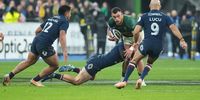
Pressure during Bok build-up week
The Times broke the drug-testing story with due care, noting that no rules had been broken and nothing untoward was indicated, although its tone was critical of the overall system and its lack of consistent application.
The Telegraph, returning to a theme it raised in March, again set falling testing numbers beside the Springboks’ back-to-back World Cups (the inference, whether intentional or not, was clear).
The article said testing continued to lag behind, although one new figure it reported showed Saids’ rugby testing had risen by 36%.
Both things can be true of course. SA’s anti-doping system is under-resourced and choices are being made that leave gaps. And some of the coverage of the system has implied more than the evidence actually shows.
Decrease in testing
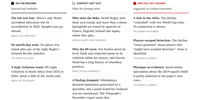
Saids carried out 225 rugby dope tests in the year to March 2026. That’s less than a third of the 753 it managed a decade earlier.
Africa’s only Wada-accredited laboratory, in Bloemfontein, lost its accreditation in 2025.
Saids now sends samples to Doha, Gent and Barcelona at about 45% higher cost, most of it in transport. According to Wada, SA recorded 89 rugby doping violations between 2015 and 2024, about a fifth of the global game’s total.
These are legitimate concerns.
The trouble lies in what the numbers are made to suggest. In March, The Telegraph had tenuously linked the decline in testing to the Springboks’ World Cup wins.
They wrote that it “raises questions about whether any players might have avoided detection”. They named no one who had.
The reporting also revived social-media speculation about the physiques of the 2019 squad. This week’s follow-up repeated that the decline “coincided” with Springbok dominance – the inference is obvious.
They listed Asenathi Ntlabakanye among players suspended for a prohibited substance. That’s accurate as far as it goes, but it omits that a tribunal panel found that Ntlabakanye’s violation was not intentional.
It found there was no “direct” or “indirect” intent, and there was “no significant negligence” on his part, but there was some negligence. He consequently received an 18-month suspension for a sanction that normally carries a four-year ban.
Ntlabakanye was prescribed medicine containing a banned substance by a specialist and declared it on a form. It’s one of the saddest and seemingly unfair cases, due to poor medical advice rather than intent.
Saru called it human error by one individual and sees “no impetus for any other interventions”. But a national union whose own medical structures produced a doping violation should probably be asking more of itself than that.
The Telegraph’s comparison of Saids with UK Anti-Doping (Ukad) figures of testing of England, Scotland and Wales players that “grew from 982 to 1,295 players” had no budgets to give them scale.
The South African doping violations mentioned in the article are not broken down by level either – age, sex, and amateur or professional status don’t seem to feature.
Saids said names redacted in the violation tables of its annual reports belong to minors. There is a long history of repeated schoolboy positives at Craven Week.
A schoolboy failing a dope test is a serious issue, but it is not evidence that the Springboks are systemic doping violators. Linking those two by lumping all doping violations in one group, is a stretch.
Saids works on a government grant of a little over R32-million a year, with small annual increases.
Saru contributes R150,000 a year towards testing, a figure the union confirmed to Daily Maverick.
Saids says the University of the Free State has given no sign it will seek to restore the Bloemfontein laboratory, so higher costs look to be permanent.
Transparency
Saids’ published figures do not show how often Springboks are tested. World Rugby runs its own year-round programme of blood and urine testing, biological passports and long-term storage of samples for reanalysis.
It was engaged to run testing at the Nations Championship. Springboks who play club rugby abroad are also tested by those countries’ agencies.
Every recent positive Springbok doping case the British media coverage cites was caught by testing.
Aphiwe Dyantyi, Elton Jantjies and Ntlabakanye by Saids, and S’busiso Nkosi by World Rugby.
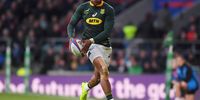
Saids’ decision not to test at three home RGR Tests in such a high-profile series is not a good look.
It may be a necessary strategy under current budget constraints, and it does send a negative message.
But an essential fact is that all players participating at RGR are part of World Rugby’s registered testing pool. They can be tested at no notice, anywhere, including between matches. The teams and players are aware of this possibility.
“World Rugby operates a risk-based no-notice anti-doping programme in line with the World Anti-Doping Agency Code,” a World Rugby spokesperson told Daily Maverick.
“All qualified men’s and women’s Rugby World Cup team players are included within a dedicated out-of-competition testing pool which is not competition-specific.
“This means that all these players are subject to testing on a no-notice, any-location basis throughout the calendar year, including within international competition windows.
“This means that over the course of the year, both teams are tested in and out of competition in line with World Rugby’s programme and are also subject to testing undertaken by the respective national anti-doping agencies at both the international and domestic/cross-border club levels.”
World Rugby’s spokesperson did not answer questions about the number of Springbok dope tests or whether they believed there was a systemic doping programme in South African rugby. DM
KioskNews shows a cleaned-up reading view extracted from the publisher’s page — the original always lives on their site, not ours.