NAB profit falls to $6.1 billion as recession risk rises; shares slump
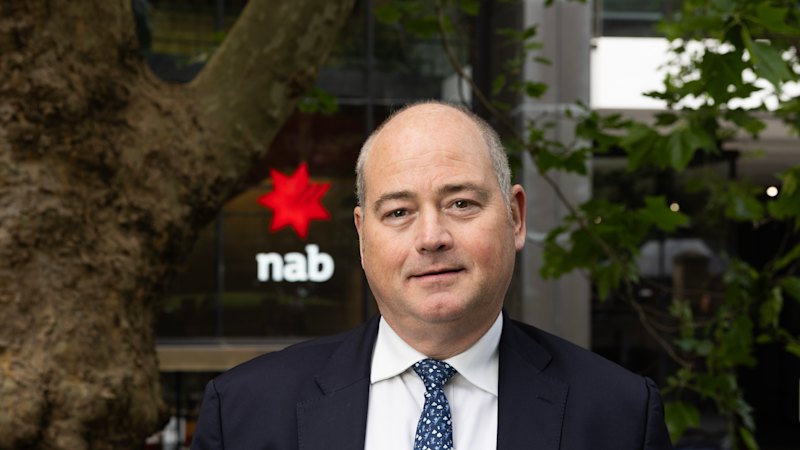
National Australia Bank chief executive Andrew Irvine says the risks of a recession have increased as the bank posted a $6.14 billion profit and flagged that overdue home loan repayments have ticked up.
On Thursday, the bank announced its annual profit was 9 per cent lower than last year but that its net interest margin – a key measure of profitability – increased by 6 basis points to 1.8 per cent.
Shares in NAB slumped 5.6 per cent shortly after markets opened on Thursday.
Irvine told reporters on a media call that the bank expected economic growth to slow next year to about 1 per cent, and that while a recession wasn’t “the most likely scenario”, the chances of one occurring had probably increased.
“We don’t yet know how the full impact of the five base rate changes will impact customers,” he said, referring to the Reserve Bank’s five interest rate hikes this year. “Most customers have been able to absorb the changes and are showing resilience, but clearly there are pockets of challenge.”
On Tuesday, the Reserve Bank raised interest rates to the highest level in 18 years in a bid to dampen price pressures. NAB has said it will pass the 25 basis point rate rise on to its customers in full – as have the other Big Four banks – increasing the pressure on its home loan customers.
‘NAB’s canary is deeper into the proverbial coalmine, and it may have stopped singing.’
Jarden analyst Matthew Wilson
NAB, the country’s biggest lender to businesses, grew its market share in business loans, with balances growing 9.8 per cent over the year.
Irvine said while some retailers, such as those with especially strong value propositions or those focused on luxury were doing well, others – such as those “stuck in no-man’s land ... with either a legacy business model or a proposition that doesn’t quite hit the mark” were under “very significant pressure”.
Irvine also noted there was unevenness in the economy geographically, with parts of the country including Western Australia and Queensland doing better than Victoria and NSW.
The bank said household savings buffers remained strong, with a low number of home loan borrowers in negative equity and an 11 per cent increase in offset balances over the year. However, arrears had deteriorated across the second half of the year, with loan repayments 30-days or more overdue climbing 11 basis points to 1.69 per cent between March and September this year.
“It probably is a fair assertion that some of our small business customers are under a little bit more cash flow pressure,” Irvine said.
Overall, however, Irvine said the level of stress in Australian mortgages generally was “still very low” compared to historical measures and global benchmarks.
Jarden head of financials research Matthew Wilson said NAB’s soft result was largely driven by higher bad and doubtful debts.
“NAB’s canary is deeper into the proverbial coalmine, and it may have stopped singing,” Wilson said.
Citi head of Australian banks research Thomas Strong also described NAB’s numbers as “overall a soft result”, with the market’s wariness around asset quality proving itself justified.
NAB’s credit impairment charge was $1.5 billion compared to $833 million last year, reflecting “a more challenging economic outlook”, growth in the volume of loans, asset quality deterioration in business lending and the impact of house price declines on its Australian mortgage portfolio.
The bank said the economic outlook remained uncertain as global events were weighing on business and consumer confidence.
“Australians continue to show resilience in a slowing environment caused by higher inflation, five cash rate rises, rising living costs including fuel, and heightened global uncertainty,” Irvine said. Tax settings also needed adjustment, including in the housing market, he added. “Taken together, all these factors have weighed on customer confidence and on business conditions.”
The bank said household consumption growth was expected to slow in the months ahead, cost pressures would continue to pose a material risk to the economy, and the downturn in the housing market posed “additional downside risk to growth.”
In October, NAB axed 2500 jobs in a move aimed at making the bank more efficient and responding to a tougher economy. Irvine said while it was a difficult decision, it was necessary to respond to rising stronger competition and a rapidly changing technological environment.
The bank left dividends for the full-year unchanged at $1.70 a share.
The Business Briefing newsletter delivers major stories, exclusive coverage and expert opinion. Sign up to get it every weekday morning.
KioskNews shows a cleaned-up reading view extracted from the publisher’s page — the original always lives on their site, not ours.