As fears over Western finance grow, could Hong Kong and Singapore win the world’s gold?
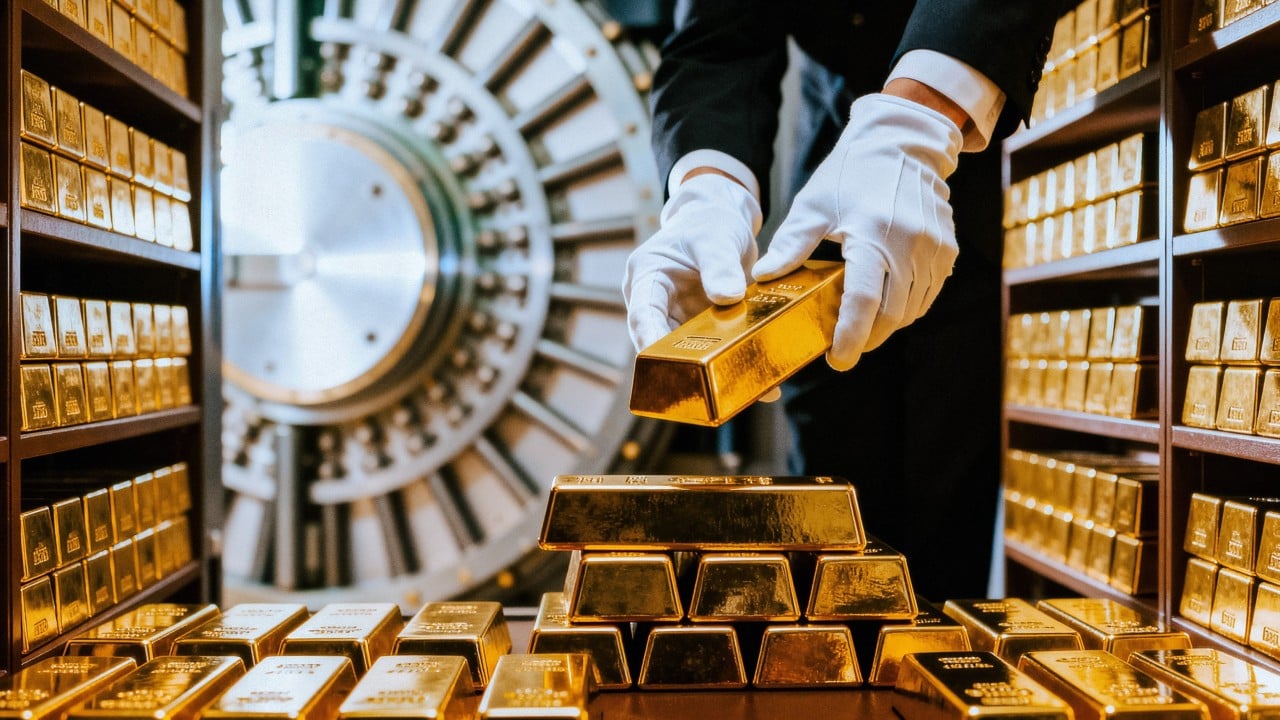
Global ultra-rich investors should diversify their physical gold holdings into Asian vault centres such as Hong Kong and Singapore to hedge against risks in Western financial markets, according to Jupiter Asset Management.
Ned Naylor-Leyland, investment manager of gold and silver at the London-based firm, said the United States and other Western markets risked losing their privileged position at the centre of the global financial system amid geopolitical tensions and persistent inflation. Jupiter managed £75.9 billion (US$100 billion) in assets as of September.
Naylor-Leyland pointed to Russian Treasury holdings and sovereign assets that the US and European Union froze between 2022 to 2025.
“This told Asia and other places that it’s not a good idea to rely on that system,” he said in a recent interview with the South China Morning Post. “If I were a billionaire with lots and lots of physical gold, I would always seek diversification.”
Trusted Asian financial centres, given their reputation, would be a natural destination for Western investors looking to move some bullion out of the West, Naylor-Leyland said.
For decades, global billionaires and financial institutions have stored physical gold mainly in Western countries.
It was widely reported in September that the Dutch central bank relocated some 86 tonnes of gold from North America to London earlier this year, citing increasing political unrest.
The US remained the world’s largest holder of gold with over 8,100 tonnes in the July-September quarter, according to data from the World Gold Council (WGC).
Asian markets, meanwhile, are seeking to establish themselves as the dominant gold hubs in the East, with Hong Kong and Singapore locked in a race to expand their storage and custody capabilities.
06:53
‘Hong Kong speed’: treasury chief details city’s gold and yuan ambitions
After Hong Kong announced plans in July to expand local gold storage capacity to more than 2,000 tonnes within three years, the Monetary Authority of Singapore, the city state’s central bank, opened its gold custody services to eligible central banks, international financial institutions and sovereign entities. MAS’ existing storage capacity stands at 500 tonnes.
Despite sluggish gold price performance in the second half of the year, global demand for gold bars and coins continued to rise to 1,053 tonnes during the first nine months, 11 per cent higher than a year earlier, according to the WGC.
By comparison, total gold demand, which includes jewellery and physically backed gold exchange-traded funds, shrank 12.5 per cent year on year to 3,185 tonnes over the same period.
Naylor-Leyland said gold remained the primary risk-free asset against the depreciation of trade currencies, even as investment banks differed widely in their forecasts for bullion prices next year, ranging from Goldman Sachs’ US$4,800 an ounce to JPMorgan’s US$6,300.
He added that gold prices in US dollar terms had likely bottomed and could climb above the record of US$5,600 an ounce reached in January, with interest rates nearing their peak and pressure easing on US Treasury bonds and the refinancing of artificial intelligence companies.
“When we get to about US$5,600, a lot of investment capital that has not taken part in gold in any way – either in bullion or in mining companies – will start to rotate,” Naylor-Leyland said. “And I think that will have an accelerating effect on prices.”
KioskNews shows a cleaned-up reading view extracted from the publisher’s page — the original always lives on their site, not ours.