TSMC careful about use of AI in sensitive research
By Lisa Wang / Staff Reporter


Taiwan Semiconductor Manufacturing Co (TSMC, 台積電) remains conservative about utilizing artificial intelligence (AI) to process sensitive data, aiming to mitigate leakage and subsequent damage given the technology’s capabilities, TSMC co-chief operating officer Y.J. Mii (米玉傑) said at a forum in Taipei yesterday.
TSMC exercises caution and prudence when deploying AI to process sensitive information, particularly about research and development, given risks of data leakage and data corruption if AI was not properly used, Mii said.
His remarks came after Anthropic PBC CEO Dario Amodei called on AI companies to slow the development of the most advanced AI models amid growing concern over serious risks. OpenAI CEO Sam Altman and xAI boss Elon Musk voiced a rare agreement with Amodei, backing calls to slow down frontier AI development for safety.
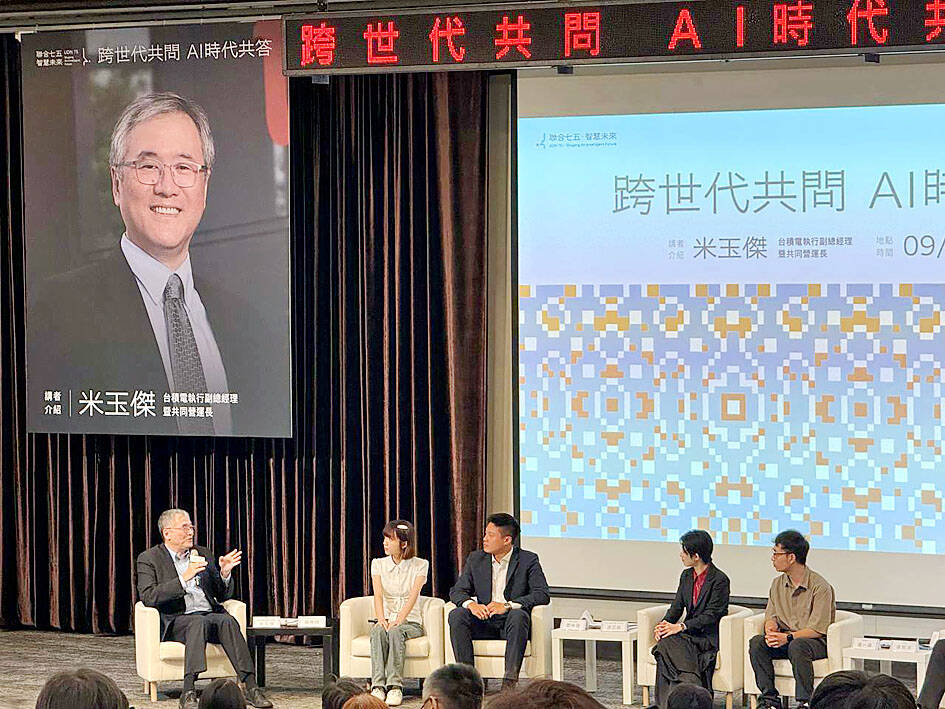
Taiwan Semiconductor Manufacturing Co co-chief operating officer Y.J. Mii, left, speaks during a forum at National Taiwan University in Taipei yesterday.
Photo: Lin Yi-ju, Taipei Times
Mii called AI a “three-year-old superman,” which is immensely powerful, yet completely unaware of the damage it can cause and has no inherent sense of right and wrong.
To mitigate risk, safe and prudent deployment of AI is critical, he said.
AI excels at gathering large amounts of information, but falls short in making critical decisions for humans or solving advanced technological challenges, which require navigating “unknown” territory at least over the next few years, Mii said. Though AI offers vast amounts of data and advice, humans always have the final call, he said.
At TSMC, engineers are encouraged to leverage AI’s capabilities in designing electronic design automation systems, as microprocessors containing hundreds of billions of transistors are required to be optimized, where AI can be brought into full play, Mii said.
AI’s utility remains less useful in developing next-gen technology, such as A14 or A10 technology, which requires navigating “many unknown” challenges, he said.
As the semiconductor industry advances beyond 7 nanometers, it can no longer rely on technologies based on Moore’s Law and instead requires innovation, he added.
As an enterprise, TSMC must ensure its investment yields sufficient commercial value before fully committing to next-generation technologies, Mii said.
It usually takes about 30 minute discussions to make a decision, leveraging the research team’s collective intelligence, he said. That is a vital factor behind the company’s success, he added.
Asked about a scenario where TSMC ceases to exist, Mii said it would pose risks for the world as countless high-tech applications fundamentally rely on TSMC’s advanced process technologies.
Without TSMC, Taiwan would likely develop an alternative, yet equally critical, high-value sector, even if its market value is smaller, he said.
KioskNews shows a cleaned-up reading view extracted from the publisher’s page — the original always lives on their site, not ours.