Colby Cosh: The Globe in shambles over losing right to bike lanes
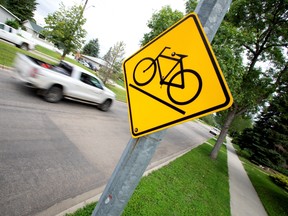
National Post contributor Ben Woodfinden has already given our readers a terrific summary of the Ontario Court of Appeal’s exasperated overturning of last summer’s grotesque bike-lane ruling in Cycle Toronto v. Ontario. Most of you probably don’t need a recap of the litigation, but we’ll zip through one: in November 2024 the Ontario government decided to rip some bike lanes out of congested roads in Toronto, and passed a law allowing it to do so. Cycling advocates sued on Charter of Rights grounds, claiming that the removal of the lanes would expose them arbitrarily to “grossly disproportionate” risk of injury and death.
Sign In or Create an Account
Superior Court Justice Paul Schabas conducted an extensive review of policy evidence and decided that the threatened bike lanes were, in fact, irremovable by the state. Nearly all legal commentators saw this as an unprecedented Charter entrenchment of a positive benefit provided and maintained in the first place by the state — the permanent sacralization of some specific pieces of public infrastructure.

The National Post newsletter that doesn’t hold back, giving readers the unvarnished truth on media, politics and culture.
By signing up, you consent to receive the above newsletter from Postmedia Network Inc.
A welcome email is on its way. If you don't see it, please check your junk folder.
The next issue of Right? will soon be in your inbox.
We encountered an issue signing you up. Please try again
Nearly, you say? A bold, perhaps lone exception was the Globe and Mail’s Andrew Coyne, who supported the Schabas decision all along and has weighed in Wednesday morning with a half-hearted grumble about the appeal court’s reversal. Coyne is angry at the multitude of lawyers and amateur analysts like me who complained that Schabas was creating a “right to bike lanes.”
Schabas, claims Coyne, has been wronged. The cyclists who brought the case merely had a right to have a judge assess evidence of the likely effects of the bike-lane removal, use his superior utilitarian calculus to make a final policy decision superseding that of the legislature, and give it the force of law. It’s not a right to bike lanes at all, though it may establish the existence and good repair of some bike lanes as an implication of rights in the Charter. No wonder everyone’s confused: it’s all very subtle.
Like Woodfinden, I’ll invite the reader to compare the quality of Coyne’s arguments to the ones in the Ontario Court of Appeal decision itself. What I’ll point out is Coyne’s stumble down a slope that he would ordinarily be capable of avoiding: he shamelessly makes a dinner out of the fact that the Ontario Court of Appeal ruling was written by a Conservative (Harper) appointee to the court, Justice Grant Huscroft. He frowns at Huscroft’s “long lecture on the perils of judicial activism … full of ringing phrases just begging to be quoted.” Not at all like us selfless newspaper columnists …
It seems to me that the Coynean political tendency in favour of more judicial activism against those obnoxious provincial governments probably is a bit underrepresented in the popular press; the Globe’s own editorial board, after all, opposed the original Schabas ruling. The question for those who support the Right to Some Bike Lanes Under Some Circumstances is this. Why were two Liberal appointees to the Ontario Court of Appeal perfectly content to apply their bare signatures to Huscroft’s resounding manifesto?
These fellow-travellers, Justices Michal Fairburn and Benjamin Zarnett, had the chance to write their own opinions, which could have been concurring ones, if they had some objection to Huscroft’s logic or phraseology. If we adopt the American habit of sticking partisan labels on judges with super glue, as Coyne has, the only conclusion we can reach is that even good red-dyed Liberals might easily think that Schabas went too far and that judges should want no part of detailed policymaking and personal weighing of social-science evidence. Since the whole thing’s probably going to the Supreme Court, that’s worth remembering.
National Post
Join the Conversation
This website uses cookies to personalize your content (including ads), and allows us to analyze our traffic. Read more about cookies here. By continuing to use our site, you agree to our Terms of Use and Privacy Policy.
KioskNews shows a cleaned-up reading view extracted from the publisher’s page — the original always lives on their site, not ours.