Korean conglomerates shift overseas operations from China to US
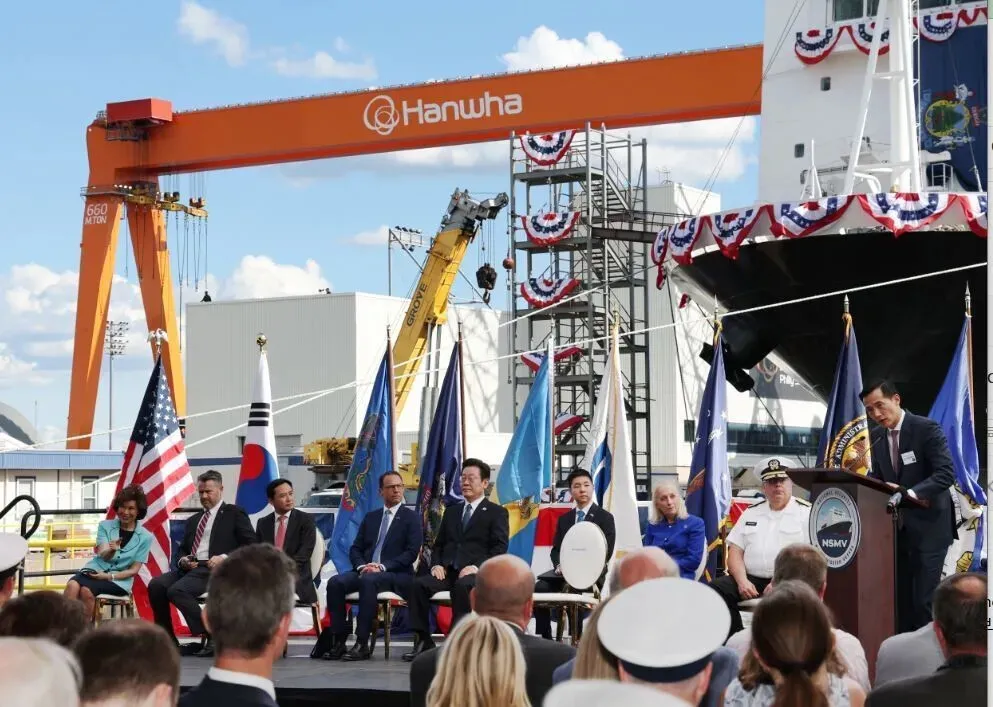
South Korean President Lee Jae Myung (seated, center) attends the christening ceremony of the State of Maine at the Hanwha Philly Shipyard on Aug. 26, 2025. (courtesy of the Hanwha Group)
Korean conglomerates are rapidly shifting global business operations from China to the US.
Just a decade ago, China was the country with the biggest share of overseas affiliates belonging to Korea’s top 30 business groups. But the US has since emerged as their primary overseas base of operations because of US-China trade tensions and Washington’s tariff policies and drive to restructure supply chains.
On Wednesday, corporate data research firm CEO Score published a survey of the locations of overseas affiliates belonging to 28 of Korea’s 30 largest business groups. HMM and Coupang were excluded due to a lack of comparable data.
The 28 groups had a combined 4,935 overseas affiliates at the end of June, an increase of 1,906, or 62.9%, from 3,029 in June 2016.
The US accounted for the largest share, with 1,308 affiliates, or 26.5% of the total. That count more than tripled over the past decade, increasing by 914 from 394 in 2016.
China, meanwhile, fell to second place as the number of overseas affiliates there fell from 700 to 529, accounting for 10.7% of the total.

This shift appears to be linked to growing Korean investment in the US.
Trends in greenfield investment by Korean companies were analyzed in a study titled “Policy Tasks for Restructuring Korea’s Global Production Networks” published in February by the Korea Institute for International Economic Policy (KIEP).
Greenfield investment is a form of foreign direct investment in which a company setting up business in another country builds its own facilities there, including factories and other worksites.
From 2017 to 2020, South Korea’s greenfield investment was heavily concentrated in China, which drew US$44 billion, compared with just US$15 billion for the US.
But as the US-China trade war intensified and Washington moved to rebuild supply chains around its own economy, the pattern reversed. From 2021 to 2024, Korean investment in the US soared to US$155 billion, while investment in China plunged to US$8 billion.
Lotte sharply scaled back its business in China amid the fallout from the 2017 deployment of the Terminal High Altitude Area Defense (THAAD) system, cutting its Chinese affiliates by 67, from 80 to 13. LG Group’s affiliates in China likewise fell from 85 to 50.
After the US and China, the most common bases for large Korean companies’ overseas operations were Vietnam (221 affiliates), Japan (197), France (189) and Singapore (181). The number of affiliates in Vietnam nearly doubled over the past decade, rising from 114 to 221. The increase appears to reflect Korean companies relocating production from China to Southeast Asia and other regions with lower labor costs, which has added to the number of local manufacturing subsidiaries.
By group, Hanwha Group had the most overseas affiliates, with 889. Its US affiliates alone jumped by 311, from 63 in 2016 to 374 in 2026. Samsung had a total of 677 overseas affiliates, while SK Group had 555.
KioskNews shows a cleaned-up reading view extracted from the publisher’s page — the original always lives on their site, not ours.