Homes Q&A: What a new Brampton community reveals about solar power
We independently select everything we recommend. Buying through us may earn us a commission, which supports our work.
Solar panels are a familiar sight on individual homes, but integrating solar generation across an entire residential community remains relatively uncommon in Canada. A recently completed project in Brampton, however, offers a glimpse of how that could change.
Sign In or Create an Account
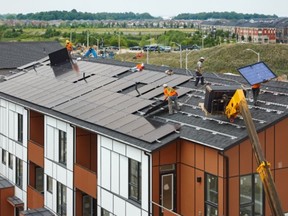
The Daniels Corporation, a Toronto-based housing developer, recently completed a 615-kilowatt DC solar photovoltaic (PV) system at MPV2, a year-old condo townhouse community at Bovaird Drive West and Mississauga Road. The system is owned by AltCrest Energy under an energy-as-a-service model — keep reading for more on that — while Otter Energy handled its engineering, design and construction. The copper-coloured solar panels crown MPV2’s six townhome blocks, which sit next to a pair of condo towers rising 11 and 14 storeys.
Here, Meghan Wilson, Daniels’ senior manager of sustainability, discusses the economics of residential solar, why low- and mid-rise housing is particularly well suited to it, and what developers can do today to prepare homes for a solar-powered future.
This interview has been edited for length and clarity.
What are the biggest advantages of incorporating solar power into a new residential development?
The big benefit — and really the origin of the solar system at MPV2 — is about enabling homes to be net zero, which means producing as much electricity as you consume. Solar provides that renewable generation.
There’s also a broader benefit to generating electricity on site. As we bring more all-electric communities online, that puts more pressure on the electrical grid. Pairing electrification with on-site solar creates a synergy. You’re helping reduce demand on the grid while also potentially insulating residents against large increases in utility costs over time.
If there are clear benefits, why isn’t community-scale solar more common?
For condos, one of the biggest challenges is the upfront cost. From a developer’s perspective, you typically aren’t maintaining ownership of the solar asset over its entire lifespan, so you don’t necessarily receive the long-term payback that you might under another ownership model.
That’s where the structure we used at MPV2 becomes important. AltCrest owns and operates the solar infrastructure and sells electricity back to the community under a long-term power purchase agreement. Residents benefit from renewable energy, and are protected against rising grid rates, without the condo corporation having to bear the full upfront capital cost.
Are homebuyers actually looking for sustainability features such as solar?
Buyers today are more sophisticated than they were even five years ago, particularly when it comes to specific technologies, sustainability features and available incentives.
But they’re generally looking for outcomes rather than simply a sustainability label. They want lower operating costs and a better experience. That can include improved thermal comfort, greater energy efficiency or better noise isolation through features such as triple-glazed windows.
In a challenging housing market, buyers are paying close attention to value. Delivering a community that goes beyond the basic specification can provide a real advantage.

What made MPV2 particularly well suited to solar?
Sustainability and decarbonization were baked into the vision for the community from the outset. That intentionality made an enormous difference.
For example, we were able to design the rooflines to maximize the number of solar panels. On a retrofit project you might have dormers, irregular roof shapes or other obstructions that make panel placement difficult.
We also coordinated details such as plumbing vents and roof penetrations very early in the design process. That allowed us to maximize solar production and simplify installation for Otter Energy. It helped with everything from the number of panels we could accommodate to where the electrical components would be located.
How does building type impact the viability of solar?
A high-rise has a relatively small roof compared with the number of homes and the overall energy demand of the building. Even if you cover that roof with solar panels, you may only generate a small fraction of the electricity the building consumes. There are also issues such as wind conditions at greater heights.
That’s why high-rise developments may focus more heavily on technologies such as geothermal and on reducing overall energy demand through efficiency measures. With low-rise housing, you generally have much more roof area relative to the building’s energy consumption, so the cost-benefit equation for solar is often stronger.
What does the future of solar in residential development look like?
At Daniels, our minimum standard is increasingly to make future townhomes solar ready.
That doesn’t necessarily mean installing panels on every house immediately. It means designing the home so that adding solar later is straightforward. The most important piece is providing a conduit from the roof to the area where the future electrical equipment would be located.
It’s similar to preparing a garage for future EV charging. Putting the conduit in during construction is relatively simple. Trying to retrofit it afterward can mean surface-mounted wiring, additional waterproofing and considerably more work.
The key is foresight. If we know homeowners are likely to want these technologies in the future, there’s a strong argument for making homes ready for them today. MPV2 now provides a real-world test of that approach that we’ll closely monitor to see how the system performs economically.
Join the Conversation
This website uses cookies to personalize your content (including ads), and allows us to analyze our traffic. Read more about cookies here. By continuing to use our site, you agree to our Terms of Use and Privacy Policy.
KioskNews shows a cleaned-up reading view extracted from the publisher’s page — the original always lives on their site, not ours.