More researched urged to get ‘full picture’ on WA’s shark situation
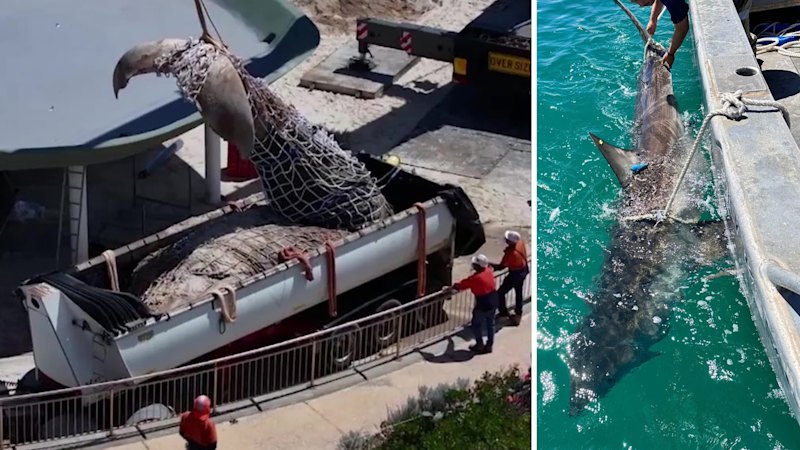
Western Australia’s famed beaches “have to be safe for people to enjoy”, Opposition Leader Basil Zempilas says, as debate continues over the response to a whale carcass that washed ashore at City Beach last week.
The dead humpback whale washed ashore on Monday, but was spotted in the days before floating between the mainland and Rottnest Island, with sharks feeding on the carcass.
Heavy machinery was eventually brought in to take the whale to the Red Hill tip on Thursday after an excavator at the scene the day before was unable to safely lift the carcass.
While the dead whale drew crowds to the City Beach shore for a selfie, its “scent” also attracted hordes of sharks, with a 3.7-metre great white tagged within hours of a drum line being set off Floreat Groyne on Tuesday.
Regular beach swimmers, already anxious after a horror fatal attack at Sorrento Beach just two weeks earlier, were confronted by regular shark sightings along the metropolitan coast all week.
Zempilas said the state government’s shark mitigation strategy should be reviewed to get a “full picture” of the current situation.
“We need all of that data in front of us, it needs to be presented to everybody to make informed and considered decisions,” he said.
“We trumpet our great outdoor lifestyle, we trumpet what an amazing place Western Australia is to visit.
“A big selling point is our coastline and our beaches, but they have to be safe for people to enjoy, and we need to know all of the facts to be able to make our beaches safe.”
Shadow Treasurer and Cottesloe MLA Sandra Brewer said the nippers junior surf life saving season was about to begin, and parents were worried about shark activity along the state’s coast.
“I’ve definitely heard from local swimmers that they are frustrated that people knew that whale was going to wash up on a metropolitan beach, I’m told, for three days in advance,” she said.
“Now, at that time, there should be a comprehensive response from Fisheries, potentially to drag that whale 30 kilometres beyond Rottnest.”
On Tuesday, WA Fisheries Minister Jackie Jarvis said the decision to take the whale carcass to a tip was made out of concern it would break up and attract more sharks to the area if it were towed out to sea.
Retired Fisheries scientist Dr Jim Penn weighed into the debate on the weekend, calling for a reassessment of the white shark population, which he believed had risen significantly since the species was given federal protection in 1997.
Penn said the best current estimate was there were as many as 10,000 white sharks off the WA coast.
With only a couple of hundred sharks tagged, Penn said there was only a one or two per cent chance of knowing there was a shark off the coast.
“Well, originally, when when first looking at it, the only data we had was coming from the fishery, shark net fishery for small sharks, the ones we eat, gummy sharks and dusky whalers,” he said.
“That that information was used to come together with an estimate, and the best estimate at the time, which was back in the 2010-15 period was about 3000, but it was a very airy number.”
Now, Penn said, better research brought the number closer to 10,000.
“The primary thing that I think needs to happen is the effective maintaining the population at a reasonable level in Western Australia, which was occurring because we had a shark gill net fishermen, which incidentally caught them,” he said.
“So it was culling by a different angle, and that needs to be reintroduced. Very recently, that was when the decision to phase out more of that, which is actually adding to the risk.
“If you go back in history, for the 30 years prior to them being protected, there was one shark attack in Western Australia.
“In the 30 years since, there’s been now 22, so a 22-fold increase. But that’s been ignored, if you like, for reasons of political correctness.”
WA Premier Roger Cook said the government would “continue to be guided by the experts” in relation to shark strategy.
“CSIRO in particular have got a key role to play in providing us with the data so that our experts can continue to provide us with advice,” he said.
“Firstly, around conservation measures, but also around mitigation of any sort of impacts on local populations as well.”
KioskNews shows a cleaned-up reading view extracted from the publisher’s page — the original always lives on their site, not ours.