Notes from Central Taiwan: Taiwan’s history has no inevitable destination
From Japanese porcelain to Indian textiles, Taiwan’s maritime past reveals a world of connections that challenges Beijing’s claims of historical destiny
By Michael Turton / Contributing Reporter


In his witty and magisterial 2011 monograph, historian Dahpon David Ho observes of the Manchu (Qing) Empire’s coastal depopulation of coastal China during the 17th century: “The coastal depopulation, which lasted from 1661-1683, began as a series of localized island deportations and grew in scale.” Astonishingly, he writes, there appears to be no extant official edict ordering this catastrophe to occur.
Nevertheless, a few surviving public notices describe the orders of the Kangxi emperor. Villages within between 5km and 25km of the coast were evacuated, any individuals who remained behind were considered rebels and subject to execution and a wall was constructed along the new line. The evacuations and killings took place at different times in different places, but by 1665 it had largely been completed.
Populations were divided into those inside the line and under Manchu control and those outside of it. Hundreds of thousands were displaced; many died through killing, starvation and disease. All this occurred because the Manchus wanted to suppress the power of the statelet of Cheng Cheng-kung (鄭成功, also known as Koxinga) on Taiwan, which drew heavily on the resources of Fujian Province and other coastal areas.
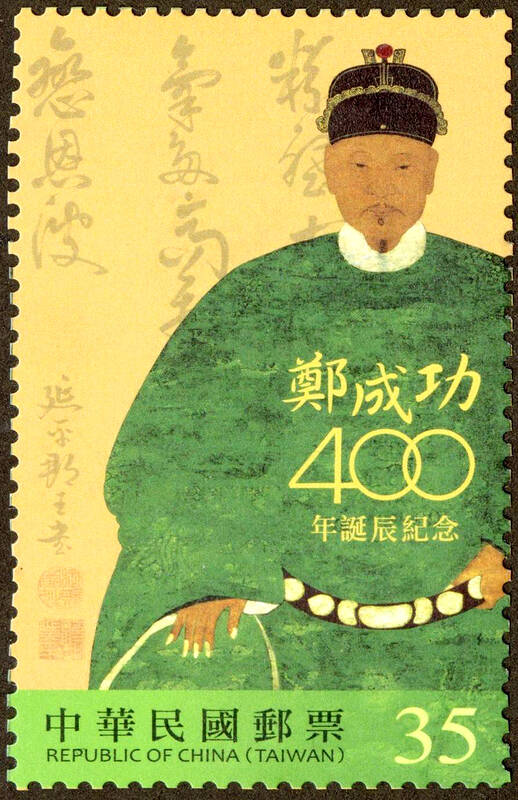
A stamp commemorating Ming Dynasty warlord Cheng Cheng-kung.
Photo courtesy of Chunghwa Post
PORCELAIN
The consequent sharp drop in porcelains from China led to a rise in porcelains from Japan, which had just learned to produce them after Toyotomi Hideyoshi captured Korean artisans in his invasions of Korea in the late 16th century. Archeologist Takenori Nogami writes in the Bulletin of the Indo-Pacific Prehistory Association of the Cheng state on Taiwan: “After the export of Chinese porcelain almost stopped, Zheng began to deal in Hizen porcelain because he could not get access to Chinese porcelain.”
The Cheng regime was part of a global network of porcelain exports that came to be dominated by Hizen ware, of which there are plentiful remains at the Cheng capital in Tainan (along with Hizen stoneware) and the Cheng naval base in Kaohsiung’s Zuoying District (左營).
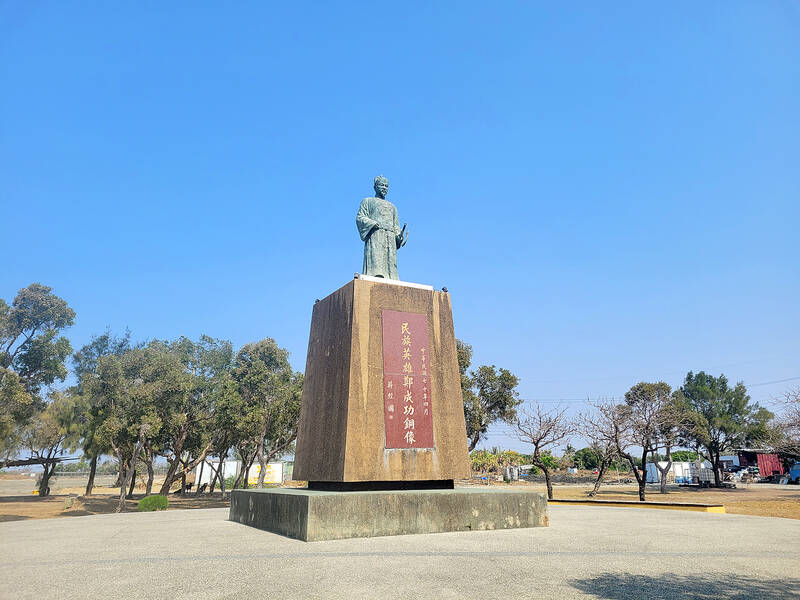
A statue of Cheng Cheng-kung is pictured last year at the Orthodox Luermen Shengmu Temple in Tainan.
Photo courtesy of Orthodox Luermen Shengmu Temple
How did Hizen ware get around? Scholars suggest it traveled on Chinese ships from Japan, where production massively expanded after the Manchus shut down the China coast, passed through Taiwan and from there to places all over southeast Asia. Archeologist Takashi Sakai argues in “Taiwan in the Perspectives of Asian Ceramic Trade — Concentrations of Ceramic Shards found at Archaeological Sites of the 17th and 18th Centuries” that the center of ceramic trade was the Sultanate of Banten in western Java. Porcelains arrived there, from the Cheng state on Taiwan, in exchange for pepper and other spices coming from the nearby islands. A European visitor to the Sultanate of Banten wrote in 1598 that it was a place where people from Portugal, Arabia, Turkey, China, Malaya, Bengal, Gujarat, the Malabar Coast, Abyssinia and everywhere in the Indies mingled.
Sakai argues that Chinese shippers had to be moving the bulk of the porcelains because wares from places the Dutch did little trade with have appeared in Taiwan. The Hizen stoneware found in Tainan is not found in archaeological sites in Europe and Asia where the porcelains were transported on Dutch bottoms. A ceramic from Myanmar was found in Penghu, likely shipped up from Banten, where there was a large Chinese community. A stoneware jar from Thailand is also known from a Taiwan site.
Of course, Chinese ceramics from the time of the Manchu depopulation of the China coast are still found across southeast Asia. Obviously, trade items leaked. For example, Japanese scholars cited in Sakai showed that on average 10 Chinese junks sailed annually from Fujian to Nagasaki. Consumer demand for Chinese porcelains remain unchanged, but most of it was serviced by Hizen ware, since the Hizen ware artisans mimicked popular Chinese export porcelains.
Taiwan was important to the Hizen ware trade because Nagasaki was closed to Spanish ships, while Japanese ships could not trade abroad. Hence, Chinese ships brought it down to Taiwan (or the China coast, which closed after 1661) and thence to Manila, where the Spanish took it to North America. Archeologist Nogami last year writes in the essay “Hizen porcelain exported to Americas” that Hizen ware is known from sites in Mexico and South America. Some of it even found its way to Spain, crossing the Atlantic.
However, the Cheng state was not a mere way station on the way from Nagasaki to Manila. Scholars have shown that his control of Chinese coastal islands and Taiwan enabled the Cheng state to amass considerable wealth at the expense of Spain’s galleon trade with Manila. Only after the Manchus wiped out the Cheng statelet did the Spanish galleon trade recover somewhat.
TEXTILES
The Dutch and the Cheng state on Taiwan also dealt in high quality cottons from India and lower quality cottons from China. Historian Weichung Cheng (鄭維中) writes in “Indian Cotton Textiles in East Asia Maritime Trade: The Case of Taiwan, 1630s-1650s” that when Cheng Cheng-gong took Fort Zeelandia in 1662 there were 20,000 pieces of Indian cotton in storage. The flow of cotton from India and China to Taiwan was cut off by the Ming-Manchu fighting and Cheng Cheng-gong’s 1656 embargo on cottons from China, and again by the Manchu coastal depopulation after 1661.
Cheng Jing (鄭經), Cheng Cheng-gong’s son, then turned to Banten in Java in 1672 to restart the trade in Indian cottons, which were still in demand among Taiwan’s indigenous people. Indeed, when the Dutch occupied Keelung between 1664 and 1668, they immediately began trading Indian cottons to the locals.
As they had in Europe, embroidered Indian textiles had a profound cultural effect in Taiwan.
“The local preference for decorating cloth with embroidery was likely strongly influenced by Indian textiles in the mid-17th century,” Weichung Cheng writes.
An “eight-petaled flower” motif appears across Indigenous communities in western Taiwan, among the Pazeh, and in the Siraya, Paiwan and Rukai communities.
“Based on the evidence,” Cheng writes, “it is clear that the ‘eight-petaled flower’ embroidery motif was adapted from the Indian Kasuti ‘lotus’ motif,” as were contemporary European and Indonesian embroidery motifs.
PRC PROPAGANDA
Propaganda from the People’s Republic of China (PRC) struggles constantly to position Taiwan as an object in the Sinosphere, where trade with China is inevitable.
Just this week PRC leader Xi Jinping (習近平) said that Taiwan’s annexation was inevitable as history cannot be stopped. But Taiwan’s history flips that script. The trade focus on China after 1683 is not an inevitability of history but an artifact of Manchu political domination and indigenous political weakness. The world before the Manchu conquest saw Indian textiles influencing indigenous societies while local statelets traded goods that had been obtained in Japan or Europe with Chinese settlers in Taiwan and Sultanates in Java. They did that while the empire across the water sealed its borders and destroyed its coastal populations.
None of that was inevitable, either. Despite the PRC’s dreams, history is not iron, but plastic.
Notes from Central Taiwan is a column written by long-term resident Michael Turton, who provides incisive commentary informed by three decades of living in and writing about his adoptive country. The views expressed here are his own.
KioskNews shows a cleaned-up reading view extracted from the publisher’s page — the original always lives on their site, not ours.