Mandarin teacher wins award for overseas educators
By Chang Ling-chu and Fion Khan / Staff reporter, with staff writer


The Overseas Compatriot Culture and Education Foundation has named 10 educators for the seventh Overseas Teachers Awards, recognizing the outstanding performance of overseas teachers, with Michelle Lin (林婕芸), principal of Elite Mandarin School who began teaching Mandarin in Canada in 2005 and founded the language school in 2010, the only award recipient from Canada.
Only three Mandarin teachers or principals in Canada have previously received the honor, making Lin the fourth Canadian Mandarin educator to win the award.
Lin said she was surprised and honored to receive the award, adding that this year marks her 20th year in Mandarin education.
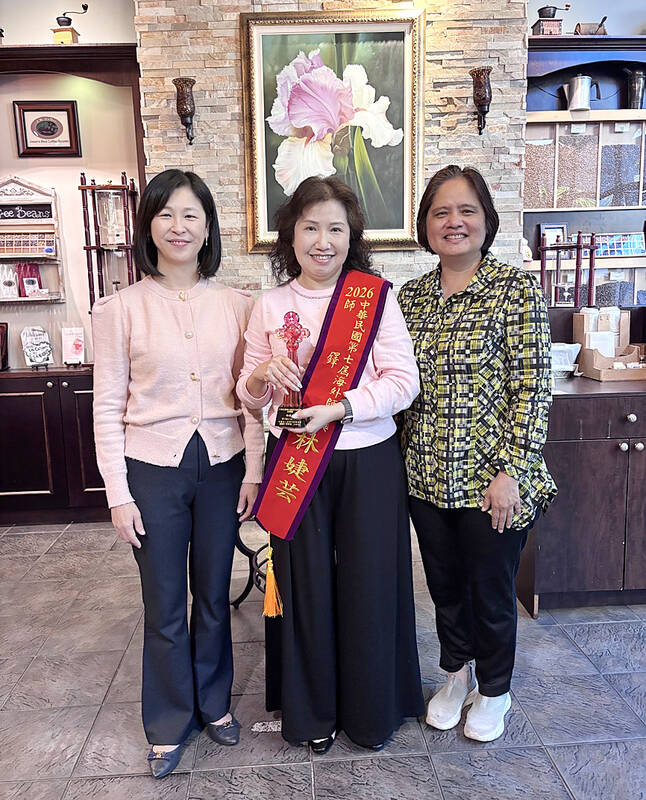
Elite Mandarin School principal Michelle Lin, center, poses with Vancouver’s expatriate division head at the Taipei Economic and Cultural Office Kuo Shu-chen, left, and secretary Lin Mei-ling in an undated photograph.
Photo: Chang Ling-chu, Taipei Times
When she first started as a Mandarin teacher, she taught at a school that used Taiwanese teaching materials, teaching students the Zhuyin Fuhao (注音符號) system and traditional Chinese characters, she said.
When she later founded Elite Mandarin School in British Columbia, she insisted on teaching the Zhuyin Fuhao system and traditional Chinese as well as using textbooks from Taiwanese publishers, such as Kang Hsuan Educational Publishing Group (康軒) and Hanlin Publishing (翰林).
While many Chinese-language schools teach Hanyu pinyin and simplified Chinese, her school’s commitment to the Zhuyin Fuhao system and traditional Chinese made it a popular choice among Taiwanese immigrant families.
Some Hong Kong families also enroll their children to learn the Zhuyin Fuhao system due to concerns about their pronunciation, bringing the school’s current enrollment to more than 160 students.
Children in Canada typically attend Chinese-language classes only on weekends for three hours a week, she said.
Despite the limited time students can dedicate to learning Mandarin, teachers give their utmost effort, she added.
As long as students do not give up, teachers find ways to help them complete coursework equivalent to Taiwan’s sixth-grade Mandarin curriculum, which is an achievement often out of reach for many Taiwanese immigrant children in Canada due to the rarity of Mandarin-speaking contexts, she said.
To encourage children raised in an English-speaking environment to learn Chinese, Lin integrates new technology into her teaching to help students overcome language barriers and find joy in learning
She said she believes that teaching younger generations of Taiwanese living overseas to learn Chinese is not just about reading, writing, listening and speaking, but also about helping them understand and feel closer to Taiwan.
Kuo Shu-chen (郭淑貞), head of the Expatriate Division at the Taipei Economic and Cultural Office in Vancouver, congratulated Lin on the honor, praising her two decades of dedication to education in greater Vancouver.
Kuo commended Lin for her continuous breakthroughs in digital teaching and her willingness to share her instructional experience and digital tools with fellow educators.
KioskNews shows a cleaned-up reading view extracted from the publisher’s page — the original always lives on their site, not ours.