The Face of Horror review – a future cult classic delights with playful spin on Hammer horror
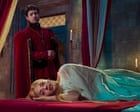
There’s over-the-top … and there’s this playfully bizarre new film from US indie film-maker and genre connoisseur Anna Biller, whose previous film The Love Witch first alerted me to her ecstatic love of style, surface and the A-pleasures of the B-movie. The Face of Horror is a deadpan homage to the garish Technicolor horror pictures of Britain’s Hammer Films in the Peter Cushing 1960s, with an extraordinary visual emphasis on red velvet, whose Freudian significance can only be guessed at. Perhaps it’s not accurate to call it pastiche – in any event, the advent of AI has arguably undermined the value of skilled pastiche in movies and literature. It is more an attempt simply to make another film in the same vein as Hammer, to continue in the same rackety tradition of melodrama, eroticism and black comedy – and to create a film that can be laughed at as well as laughed with, just as they were at the time.
The setting is a cod-medieval England, a land of courtly nobles, smudgy-faced peasants and ladies wearing floor-length gowns with rope-style belts – although Biller has taken as her starting point the classic Japanese ghost story Yotsuya Kaidan, which is also an inspiration to, among others, Takashi Miike and Hideo Nakata. Edward (Jonah Hauer-King) is a handsome, unscrupulous knight, suspected of robbing his former master, seen here in the opening scene riding through a sun-dappled forest with his similarly shifty squire Richard (Leo Suter). Edward wishes to marry the blond, beauteous Eleanor (Kristine Froseth), who appears in a separate scene demurely preparing a preposterously lavish meal with her equally blond sister Beatrice (Ellie Bamber) in one of the vast, oppressive wood-panelled halls that Hammer horror was known for.
Edward and Richard brutally murder the women’s father and brother, who disapprove of them – blaming their death on “brigands” – and then marry Eleanor and Beatrice. But it isn’t long before the caddish Edward has designs on another evilly smiling noblewoman, Lady Isabel (Bella Heathcote), whose court of lute-strumming, recorder-blowing ladies-in-waiting is pictured in the vivid colour of a Ladybird book illustration from the same era as Hammer. They plot murderously against poor Eleanor, who has become the sickly, exhausted mother to Edward’s infant son. (The child is rather forgotten about here, but Biller may want to bring him back in adult form for a sequel.) It is to lead to the horror of supernatural revenge.
The most uproarious part of the film is the memento mori Danse Macabre scene at Lady Isabel’s decadent court, something that Ken Russell might have enjoyed – or Roger Corman, whose version of Poe’s The Masque of the Red Death may be an influence on Biller. The stamina and consistency of tone is what makes the film amusing and fascinating – a cult midnight movie of the future.
KioskNews shows a cleaned-up reading view extracted from the publisher’s page — the original always lives on their site, not ours.