Coalition likely in vote in Philippines’ Bangsamoro region
Coalition talks might be needed to choose the first elected chief minister of the Muslim-dominated autonomous region in the southern Philippines, with unofficial results suggesting no single bloc is on course to dominate the new 80-member parliament.
The race has largely been shaped by rival camps that emerged from the Moro Islamic Liberation Front (MILF), the former separatist movement that negotiated autonomy with the Philippine government.
One is led by longtime MILF Chairman Al Haj Murad Ebrahim, while the other is led by Abdulraof Macacua, a former MILF commander appointed interim chief by Philippine President Ferdinand Marcos Jr last year.
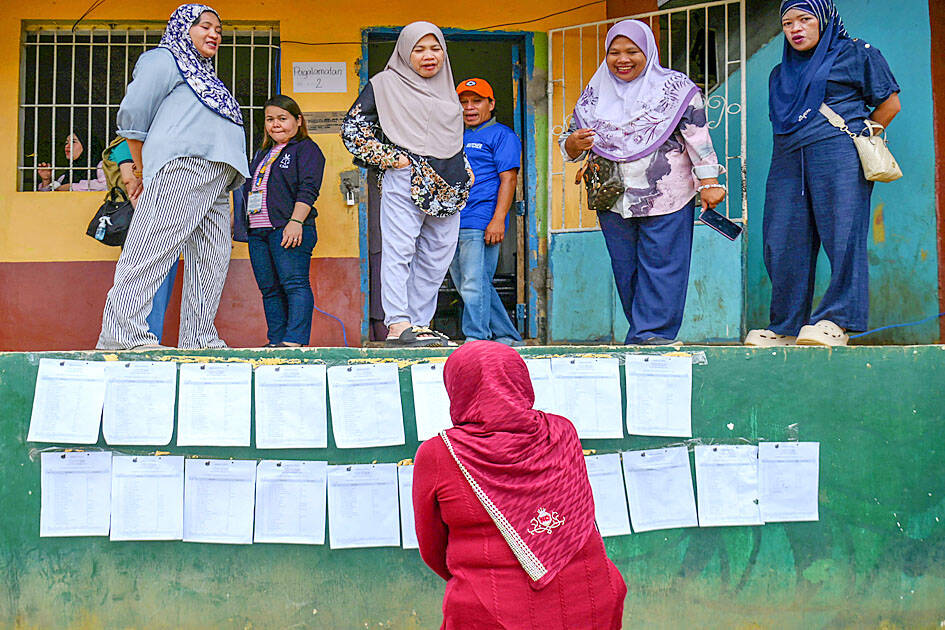
A person looks at precinct information posted on a wall of a school building in Saguiaran, Philippines, on Monday.
Photo: AFP
With 98.56 percent of votes counted in the party-list race, the camp aligned with Macacua led with 35.2 percent of votes, ahead of the bloc associated with Murad with 32.4 percent, according to partial and unofficial results from the Parish Pastoral Council for Responsible Voting, a church-backed election watchdog.
A third party, the Bangsamoro Autonomous Region in Muslim Mindanao (BARMM) Grand Coalition, has 20.5 percent so far and could hold the balance of power in coalition negotiations.
Institute for Autonomy and Governance executive director Benedicto Bacani said that neither camp appeared likely to secure the 41 seats needed for a majority, making coalition-building essential.
Cooperation between rival MILF factions would be the best outcome for Bangsamoro because it could strengthen peace and political stability, he said.
“The best scenario for me is the unification of the MILF,” he said.
The election drew about an 80 percent turnout, with about 1.8 million votes cast from 2.39 million registered voters, election officials said.
Voters elected party, district and sectoral representatives who would make up the 80-member parliament tasked with selecting the region’s first elected chief minister.
The vote is widely viewed as the most significant milestone since a 2014 peace agreement between Manila and the MILF paved the way for greater autonomy in the Muslim-majority south.
The agreement was intended to end a conflict that killed more than 120,000 people, displaced about 2 million and helped extremists gain a foothold in the region, concerns that came into sharp focus when Islamic State-linked militants laid siege to Marawi City for five months in 2017.
In one of the remote islands in the region, Tawi-Tawi, civil society leader Arlene Sevilla said she and her family made a point of voting in the landmark election, with all four of her children travelling home from Manila to cast their ballots.
“That is my right,” she said. “If my vote will make a difference to the lives of the Bangsamoro, then let us do it.”
The 60-year-old Sevilla said she voted because she wanted capable leaders who would improve the lives of Bangsamoro residents.
“I voted because I want BARMM to have good leaders for the benefit of the people,” she said.
KioskNews shows a cleaned-up reading view extracted from the publisher’s page — the original always lives on their site, not ours.