Chickens are synonymous with cowardice. Is it time to stick up for our feathered friends? | Adrian Chiles
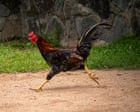
Chickens don’t have it easy. On top of living largely crap, short lives, they endure the ignominy of collectively being a byword for cowardice. The campaign group People for the Ethical Treatment of Animals (Peta) has written to the Oxford English Dictionary asking for this definition of “chicken” to be changed. Naturally enough, there are those who have been unafraid to holler “Woke nonsense!” as loud as cocks crowing.
For my part, I think Peta is right to stick up for chickens, but I’m not sure removing a definition – assuming definition-removal is a thing – would make any difference. Chicken, in this sense, is in common use as an adjective, a verb and a noun. It’s got deep roots that are going to take some shifting. And any such move could open up a right can of worms (sorry, worms). What about the vulture, rat, shark and sloth lobbies? Not to mention pigs, snakes, weasels, donkeys, sheep, dogs, parrots and all manner of creatures with whom we share this beleaguered planet.
Poor chickens, though. Who knows how they earned this label? They don’t seem particularly cowardly to me. And if they do seem a bit skittish at times, who can blame them, given that they’re at risk of mortal harm from man, fox and others?
If it’s any consolation to chickens, other languages don’t disrespect their courage to quite such an extent. The Spanish at least say hen rather than chicken, and the French, too, although in France to signify cowardice the poor hen needs to have been out in the rain – poule mouillée being a wet hen.
Elsewhere, Russians, Germans, Italians and Turks use hares and rabbits in this way. With other languages it gets more interesting. A Punjabi-speaking friend tells me she has heard jackals’ bravery called into question. Interesting. I’ve always thought of jackals being more on the front foot, as it were – somewhat fierce and snarly. Apparently, in Punjabi folklore, the jackal is the ultimate symbol of fear and timidity, routinely contrasted with the fearless lion or tiger. I’ll fortify myself with that thought next time I go nose to nose with a jackal. I’ll roar like a lion, so I will, and he, indeed a whole pack of them, will surely shrink away with a whimper.
In Polish the story gets even more fascinating. Here it’s tchórz, the polecat, but in this case the belief in the polecat’s cowardice is so deeply held that the word for coward is actually polecat. Again, I must say I didn’t have polecats down as particularly yellow-bellied. (Yellow-bellied!? What’s that all about? Let’s not go there.) This may be because I have in mind Michael Foot’s characterisation of Norman Tebbit as “a semi-house-trained polecat”. The Poles’ view of polecats references the animals’ defensive behaviour if frightened or cornered. At such times they release a foul smell from their anal glands. Depending on your politics, this may or may not be considered unfair on the late Lord Tebbit. The one time I met him, by the way, he was less polecat than pussy cat – until the microphone came on, at which point the polecat in him woke up and the pussy cat was absent until the interview concluded.
In a similar vein, the Welsh have put a couple of words together to make their word for coward: shit and dog, cachgi, invoking perhaps the image of a dog soiling itself in fright. Seems a bit harsh on the coward as well as the dog, to my mind, but each to their own.
I was deep in this rabbit hole (nice to use rabbit there non-pejoratively) before I thought to investigate the language closest to me after English. In Croatian, Serbian and Macedonian, the word for cuckoo – kukavica – is also the word for coward. My mum’s been calling me a kukavica all my life, in a whole variety of contexts. I’d always taken it as a term of endearment more than anything else. Now I know otherwise. I’m just a coward, plain and simple. Still, I’d rather be a cuckoo than a polecat.
Adrian Chiles is a broadcaster, writer and Guardian columnist
KioskNews shows a cleaned-up reading view extracted from the publisher’s page — the original always lives on their site, not ours.