A US scholar’s take on how shifts in US-China relations are felt in a Tsinghua classroom
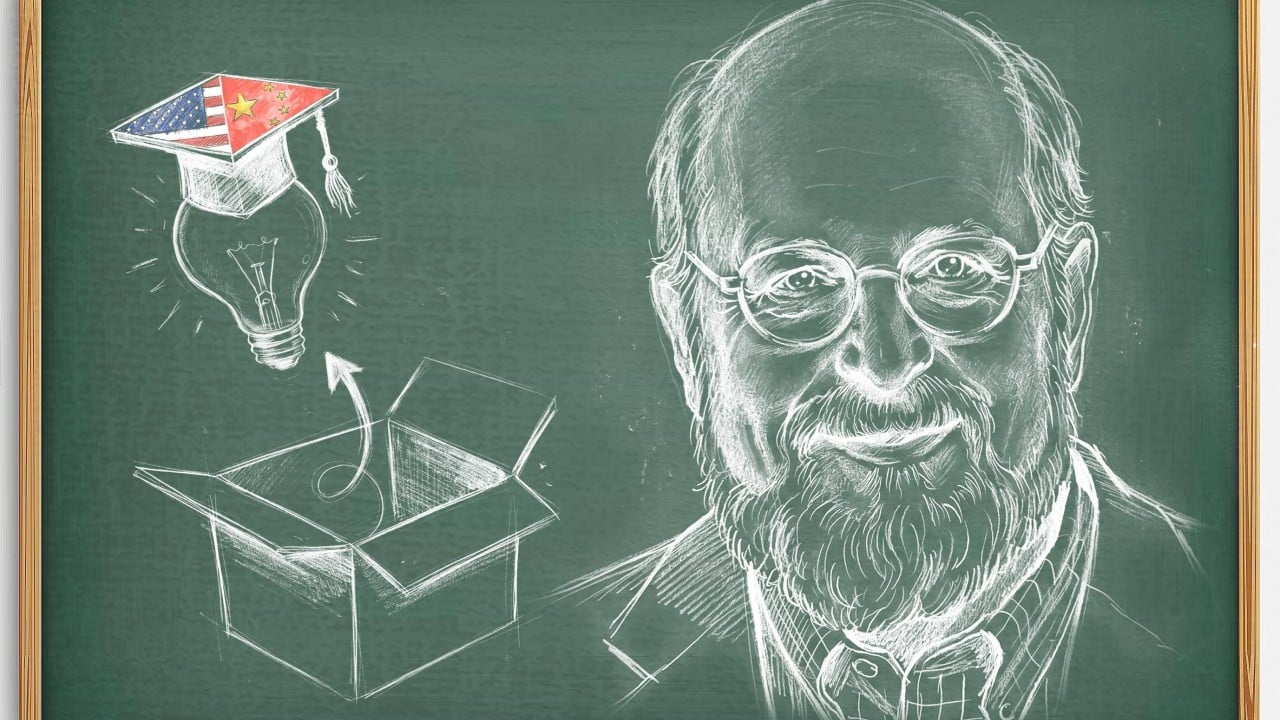
It is a question Denis Simon is confronting in the classroom.
A veteran US-China technology and higher-education strategist and former executive vice-chancellor of Duke Kunshan University, Simon is now teaching at Schwarzman College at Tsinghua University.
The residential college and its Schwarzman Scholars programme were founded by Blackstone chief executive Stephen Schwarzman with the aim of bringing together future leaders from around the world.
The programme, which celebrated its 10th anniversary last year, is described by some observers as one of the crown jewels in the bilateral relationship.
Simon’s course focuses on China’s science and technology policy and innovation strategy, but the country’s relationship with the US will not stay in the background.
“That’s a kind of very interesting coincidence of time that gives the course a booster shot,” he said in an interview from Beijing. “The students are aware of both meetings. They’re much more informed about what’s going on.”
Trump rejects working with China on AI despite Xi’s recent visit
His students are studying a relationship that has become deeply contradictory: Washington and Beijing are rebuilding channels of communication even as they narrow the space for technological and scientific links.
SCMP Plus is a new premium news platform that gives you an
all-inclusive edge to stay ahead on China news.
To access our exclusive content you’ll need to subscribe.
Already a subscriber?
LOG IN
The summits have not resolved that, but they have changed the atmosphere in the classroom.
“These leadership meetings really created a much more positive environment,” Simon said.
Before May, when the two sides were not talking, things were “topsy-turvy”, he said, adding that neither the Beijing visit nor the Washington trip was “a resounding big deal”. But what registered was simpler: the fact that the two leaders were talking and had met twice within six months.
However, Simon said the “biggest change” was that some students “have become seemingly somewhat more cautious about revealing where they actually stand”.
For example, an argument about export controls can sound like an argument about America, while a criticism of Chinese technology policy can become a political declaration. Even defending academic exchanges may raise questions about political loyalties.
“They have become much better at distinguishing what they think from what they believe they ought to say in terms of political correctness,” he said.
“That distinction matters enormously in a classroom. A good seminar depends upon intellectual risk-taking.”
Over the past three years, the discussions have, in several respects, become more sophisticated even as students have become a bit more restrained.
That is partly because while 40 per cent of students are American and 20 per cent Chinese, the others come from all over the world and are asking why they should have to choose between the two superpowers.
“They are not merely referees,” Simon said. “They have their own interests.”
He said they wanted American technology and capital, and they wanted Chinese markets, manufacturing capacity, infrastructure and technology.
But they did not necessarily see technological alignment with either Washington or Beijing as inevitable, or desirable.
In some ways, the students who are not American or Chinese are the ones who make the classroom genuinely international
“In some ways, the students who are not American or Chinese are the ones who make the classroom genuinely international,” Simon said.
Their presence has also pushed Simon to modify the course, including replacing older readings with newer ones that reflect what has happened since the leaders’ meetings.
He no longer sees the technology relationship as a straightforward story of engagement followed by competition. Technology, economics, national security, industrial policy, scientific research and geopolitics have become too deeply entangled.
The old idea of separating economic and security issues has largely disappeared. But Simon is equally wary of the opposite assumption: that everything involving China and technology should now be treated as a security issue.
His students study semiconductors, export controls, AI, data governance, supply-chain resilience and industrial subsidies and are also asked some fundamental questions: where should the two countries compete, where should they put guardrails in place and where should they deliberately remain connected?
Simon uses a red-yellow-green framework to assess the security situation, with red – covering areas where national security is at stake – being relatively straightforward.

The same applies to low-risk green areas, including basic science and ordinary educational exchanges, but Simon added that yellow was the “really difficult category”, which meant proceeding with “conditions, transparency, safeguards or limits”.
His concern is that Washington increasingly has a tendency to turn yellow into red.
“Once that happens, the burden of proof shifts,” Simon said. “Instead of asking, ‘Why should this be restricted?’ we begin asking, ‘Can anyone prove that it is completely safe?’”
That, he added, was not a sustainable basis for technology policy.
The same tension is visible in the emerging AI channel between Washington and Beijing. Simon argued there was value in the new mechanisms for communication, but warned “communication” and “governance” were not the same thing.
A hotline can provide a way to communicate after an accident or during a crisis, while dialogue can make contact habitual, but neither of these things settles questions such as who gets access to advanced chips, how frontier AI should be developed or what happens when the two sides disagree about the rules.
He added: “Great-power relationships often advance in very small increments. The existence of a channel may look insignificant until the day you desperately need the channel.”
The question is whether those channels become durable institutions or remain dependent on the political mood of the moment.
Simon said that concern extended to the academic sphere, with universities are being increasingly being forced to “price geopolitical risk” into their calculations given the cost of being caught up in a political controversy.
His recent experience at Duke University in the US sharpened these concerns where a China science and technology graduate seminar he had taught for several years was dropped even though funding was available.
“What it told me is that the issue is no longer simply whether there is money to teach a course,” Simon said. “The institution is also asking: what is the reputational and political risk of teaching it?
“If American universities stop teaching about China’s innovation system because the China issue has become politically difficult, we will create an extraordinary paradox: we will become less capable of competing with a country precisely because we have become less willing to study it.”
Inside Schwarzman College, that question takes on another dimension. Students are watching China’s transformation from the “factory of the world” into an innovation power in electric vehicles, batteries, robotics, clean energy and AI.
To many observers, this change appears sudden, but Simon, who has followed China’s development for 40 years, sees something different.
“It really is part of a gestation period over time over the last 30-plus years in which China has steadily moved to make itself into an innovation-driven nation. So when people seem to be shocked, it’s that they haven’t been following this for 40 years, like I have.”
For Chinese students, he said, this was not simply a story of national technological achievement but the economy where they had to find jobs.
01:52
Xi says China and US have responsibility to ‘manage AI for good’
Many had assumed the factory era was behind them and that innovation was the next place to stand, but robotics and AI have complicated that assumption.
They may be headed back into the factory, but not the one their parents left.
Meanwhile, international students are confronting a different reality: China’s technological rise will shape the competitive environment in which they build their own careers.
The question, Simon said, was no longer simply whether China could innovate, but “how China’s innovation trajectory will alter international S&T [science and technology] affairs, including the once dominant role of the US”.
He said that ultimately that was what he wanted his students to understand, saying they should not expect a return to the US-China relationship of the 1990s or 2000s, while technological competition could not be wished away.
The objective, instead, was to build enough “connective tissue” around the new relationship that competition remained competition without becoming continuous conflict.
That is the wager behind institutions like Schwarzman College, NYU Shanghai and Duke Kunshan: not that they can eliminate strategic competition, but that they can continue putting people who might disagree in the same room, and teach them how to keep talking when agreement is no longer possible.
“Cooperation does not have to mean agreement, technological sharing, or slowing down,” he said. “Cooperation can mean simply agreeing on what happens when we disagree.”
KioskNews shows a cleaned-up reading view extracted from the publisher’s page — the original always lives on their site, not ours.