The 10 Best Modern Spaghetti Westerns, Ranked

Jeremy has more than 2800 published articles on Collider to his name, and has been writing for the site since February 2022. He's an omnivore when it comes to his movie-watching diet, so will gladly watch and write about almost anything, from old Godzilla films to gangster flicks to samurai movies to classic musicals to the French New Wave to the MCU... well, maybe not the Disney+ shows.
His favorite directors include Martin Scorsese, Sergio Leone, Akira Kurosawa, Quentin Tarantino, Werner Herzog, John Woo, Bob Fosse, Fritz Lang, Guillermo del Toro, and Yoji Yamada. He's also very proud of the fact that he's seen every single Nicolas Cage movie released before 2022, even though doing so often felt like a tremendous waste of time. He's plagued by the question of whether or not The Room is genuinely terrible or some kind of accidental masterpiece, and has been for more than 12 years (and a similar number of viewings).
When he's not writing lists - and the occasional feature article - for Collider, he also likes to upload film reviews to his Letterboxd profile (username: Jeremy Urquhart) and Instagram account.
He has achieved his 2025 goal of reading all 13,467 novels written by Stephen King, and plans to spend the next year or two getting through the author's 82,756 short stories and 105,433 novellas.
Sign in to your Collider account
Spaghetti Westerns are a little like movies that belong to the film noir genre in the sense that for something to be a true film belonging to either (otherwise very different) genre, they need to have come out at a certain time. The classic/true era of noir was the 1940s and 1950s, with noir-related movies after that point (like Chinatown and L.A. Confidential) being neo-noir films, and with spaghetti Westerns, that period’s heyday was the 1960s and somewhat into the 1970s, too.
Movies that have that spaghetti Western feel made after that point might not be true spaghetti Westerns, and further, the ones below weren’t even made in Italy, so they lose that essential Italian (or at least European) feel all the true spaghetti Westerns have. But these films still retain qualities of spaghetti Westerns, and work as more modern homages to that genre, with “modern” here being used admittedly loosely, with some of these movies being released as far back as the 1990s. Whoops.
10 'Sukiyaki Western Django' (2007)

If you're talking about modern spaghetti Westerns, it’s going to be unavoidable to avoid mentioning a few directed by Quentin Tarantino, but Sukiyaki Western Django is not one of them. So, why mention ol’ QT? Well, he’s part of the cast here, and as per usual, he’s not great in front of the camera, at least not in the way he so often is behind the camera.
Sukiyaki Western Django sees Takashi Miike behind the camera instead, and he’s done some great work situated there before as well, but he’s potentially even more prolific a director than Stephen King is a writer, and so not every Miike film is great. Sukiyaki Western Django is a lesser effort from him, but isn't 100% lacking, and it’s worth mentioning here just because it really goes for a spaghetti Western thing, stylistically and then with that title, too, because sukiyaki (rather than spaghetti) is a kind of food, and Django, of course, was the name of a certain film from 1966 that’s one of the most iconic spaghetti Westerns of all time.
9 'Once Upon a Time in Mexico' (2003)

Robert Rodriguez directed three movies that have that spaghetti Western sort of energy, and they make up his Mexico trilogy. Of the bunch, the third, Once Upon a Time in Mexico, definitely has the most by way of flaws, but it’s still a pretty good time overall (unsurprisingly, the other two movies will be mentioned/covered a little later on).
The Good, the Bad and the Ugly was an influence, and you can see it in the sense that Once Upon a Time in Mexico goes bigger than its two predecessors, all the while having aspirations of being an epic, but The Good, the Bad and the Ugly is a true epic, and it also goes big without ever feeling convoluted or cluttered. Once Upon a Time in Mexico is messy, and there’s just too much stuff crammed into a relatively short movie, but some sequences are fun, and the ambition on offer here can be admired, at least to some extent.
8 'Rango' (2011)

Image via Paramount Pictures
Rango is an animated movie, sure, but it’s still a Western at heart, and maybe the best animated Western ever? It’s a little hard to think of too many others off the top of one’s head, to be honest, but faint praise aside, Rango is fun, and also extremely creative with how it looks stylistically. It’s not afraid to get weird and grotesque with its story about a chameleon becoming the unlikely sheriff of a small town populated by other animals.
Technically, Rango is appropriate for all ages, but you'd probably forgive a kid for finding it all a bit confounding, and there are lots of references to movies you'd hope kids haven’t seen (like Fear and Loathing in Las Vegas and the Man with No Name/Dollars trilogy). Nothing wrong with a bit of strangeness, though, and it makes it pretty clear why Rango is something of a modern cult classic.
7 'The Hateful Eight' (2015)

Quentin Tarantino was mentioned before as an essential and unavoidable name worth bringing up while talking about spaghetti Western-influenced movies, and so here’s The Hateful Eight, which is probably the least spaghettified of all his films that are part of (either directly or indirectly) the Western genre. It’s about people trapped inside a cabin while a blizzard rages outside.
So, it’s a lot colder than your average Western, and it’s also a great deal more claustrophobic, with some landscape shots early on that make expected use of the wide-screen The Hateful Eight was shot in, and then the same aspect ratio is used unusually to depict the confined main setting of the film. Oh, and everyone in the cabin is violent and/or untrustworthy, which ensures things eventually get bloody in that way apparently all Quentin Tarantino movies that aren’t Jackie Brown have to do.
6 'The Quick and the Dead' (1995)

The Quick and the Dead is a pretty good time, and it’s clearly going for entertainment over anything else (nothing deep here, in other words), and that’s okay. For what it is, it’s mostly great. It also has to squeeze in here, being more than 30 years old, and therefore not really “modern” in the traditional sense, and then the spaghetti Western influences are also more subdued than is the case with various other examples being mentioned here.
It’s got more of a premise than a plot/narrative, being about various unusual characters who take part in a dueling competition in a small town. There is lots of shooting, quite a bit by way of dying, and then there’s quick drawing (of course) alongside pacing that feels pretty quick, too. It’s like an updated spaghetti Western that’s also highly caffeinated, so if that sounds like your kind of thing, it’s well worth unearthing.
5 'El Mariachi' (1992)

If El Mariachi hadn’t been particularly great, there’s still a chance it would be remembered, just for how much it tried to do with a famously tiny budget. Thankfully, it’s also really good as an action/Western movie, even without taking into account the fact it was produced for a little over $7000 (some additional polish came in post-production, to make it presentable as a theatrical release, but everything filmed initially was done for close to nothing).
Thankfully, it’s also really good as an action/Western movie, even without taking into account the fact it was produced for a little over $7000.
The basics of El Mariachi are that it involves a musician being mistaken for a criminal, which forces him to go on the run, and then his life starts to fall apart in ways that are built upon/explored further in the next two films in the Mexico trilogy. In those, Antonio Banderas plays the main character, but the important thing is it’s still the same character, even though he’s played by Carlos Gallardo in this first film.
4 'Desperado' (1995)
So, El Mariachi showed what Robert Rodriguez could do with a few thousand dollars, while Once Upon a Time in Mexico showed what he could do with close to $30 million. Appropriately, Desperado, the second (and best) film of the trilogy, had a budget somewhere in the middle, and did indeed show that Rodriguez could also do a lot with about $7 million.
There’s a nice middle ground achieved here as well between the relatively gritty and personal El Mariachi and the bombast of Once Upon a Time in Mexico. Desperado isn't complicated, and it is also the right level of extravagant and stylish when it comes to all the action… and there is a lot of action, making this more of an action film than a true Western, but it is another film that fittingly showcases Rodriguez’s unique take on the latter genre.
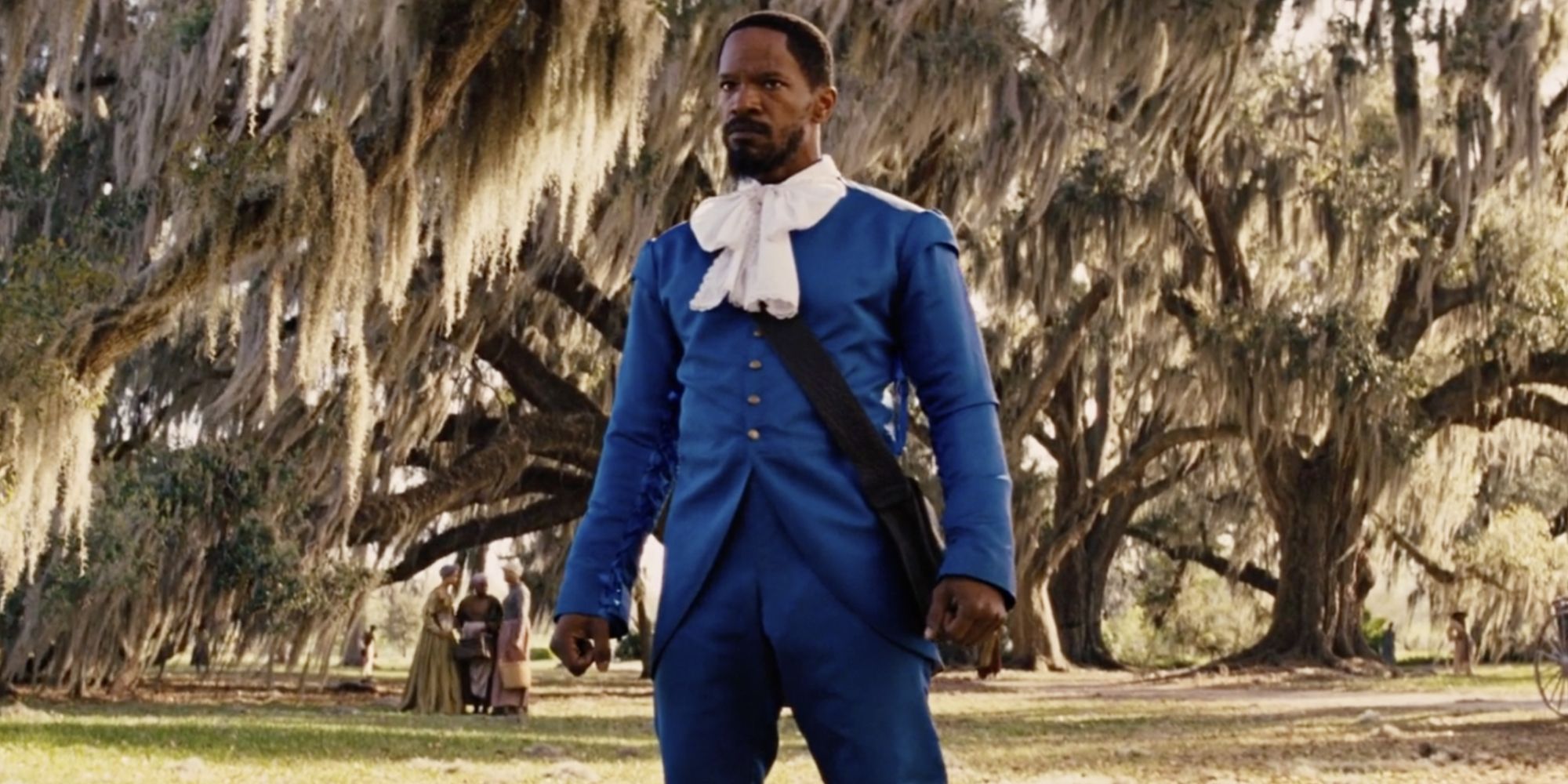
3 'Django Unchained' (2012)

There’s the title referencing Django, and also Franco Nero, from that movie, has a cameo in Django Unchained, but this isn't any kind of sequel or reboot, instead functioning as a homage to spaghetti Westerns. Sure, Sukiyaki Western Django beat it by a few years, but Django Unchained was quite a bit better, and so long as you're not too squeamish, it also functions as a great gateway film to the spaghetti Western sub-genre overall.
If there’s one thing wrong with Django Unchained, it’s probably that it doesn’t fully earn its lengthy runtime, with the story here – about revenge and a rescue – not really needing nearly three hours to be told. Tarantino gets a bit self-indulgent toward the end, especially after something climactic happens and then the film keeps limping on for another half-hour or so, but when Django Unchained is working (which is most of the time, and definitely for the first two and a bit hours), it is great.
2 'The Good, the Bad, the Weird' (2008)

Another movie referenced by The Good, the Bad and the Ugly, it’s particularly obvious when it comes to The Good, the Bad, the Weird, largely thanks to that title. Also, the core premise is pretty much the same in both movies, because the two involve a trio of characters racing each other to find some kind of fortune in the desert.
There’s more by way of action and broad comedy in The Good, the Bad, the Weird, though, and then you’ve got things like the setting and the ultimate climax diverging from the movie that most clearly inspired it, too. Anyway, there’s a ton offered here if you want sheer entertainment value, and it’s pretty effortlessly engaging for its entire runtime, not to mention one of the very best spaghetti Western homages ever made.
1 'Kill Bill: Vol. 2' (2004)

Before he made actual Westerns, Quentin Tarantino also directed Kill Bill: Vol. 2, which feels like enough of a neo-Western to count here. There’s music here taken from spaghetti Westerns, plus some visuals that feel linked to the whole sub-genre, and then a good chunk of Kill Bill: Vol. 2 takes place within desert areas, too, so it’s got that going for it if you want to argue it’s a Western.
Kill Bill: Vol. 1 is much more of a martial arts movie, on the other hand, though you get a few smaller/briefer fights found in Vol. 2, too, plus the training flashback that does feel extremely in line with martial arts cinema. The duology as a whole allowed Tarantino to reference and pay homage to a lot, and when it came to Vol. 2, spaghetti Western films were what he seemed keenest to pay tribute to.

Kill Bill: Vol. 2
- Release Date
- April 16, 2004
- Runtime
- 136 minutes
- Director
- Quentin Tarantino
- Writers
- Quentin Tarantino
-

Beatrix Kiddo / The Bride / 'Black Mamba' / Mommy
-

Bill 'Snake Charmer'
-

Elle Driver 'California Mountain Snake'
-

Michael Madsen
Budd 'Sidewinder'
KioskNews shows a cleaned-up reading view extracted from the publisher’s page — the original always lives on their site, not ours.