Scott Stinson: Despite Toronto’s persistent problems, Olivia Chow just smiles through the crisis
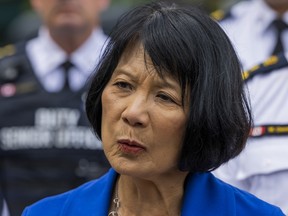
At one point in Tuesday night’s Toronto mayoral debate, Brad Bradford, the councillor running to unseat Olivia Chow, was decrying the city’s reluctance to uncover wasteful spending.
Sign In or Create an Account
City Hall, he said, is “defined by a culture of status quo.”
Well, yes. And that is basically the problem that Bradford must overcome.
It is hard to imagine that many Toronto voters would argue things are running along tickety-boo these days. Chow, the NDP stalwart, brought in steep property-tax increases in her first two years in office, but problems related to traffic, public transit and housing affordability remain severe. The municipal government doesn’t own any of those files on its own, but Chow had a habit on Tuesday of claiming victories on matters that were, at best, incomplete.
She crowed about vest-clad traffic agents — “they are so effective!” — in response to a question about the city’s perpetual gridlock, as though it were just a matter of hiring a few dozen more stewards to blow whistles and point fingers to ease the endless jams.

Columnist Jesse Kline keeps you up to date with what’s happening in Israel and the effects of antisemitism on life here in Canada. Friday mornings.
By signing up you consent to receive the above newsletter from Postmedia Network Inc.
A welcome email is on its way. If you don't see it, please check your junk folder.
The next issue of Channel Israel will soon be in your inbox.
We encountered an issue signing you up. Please try again
She talked up her proposed weekly fare cap on the TTC, an odd solution for a transit operator that is already facing a massive budget shortfall, and said city finances would be in better shape just as soon as she gets a new deal with Premier Doug Ford, who may or may not have endorsed her last week depending on your interpretation of events.
And in what might have been the best indication of her tendency to just smile through a crisis, she responded to a question about overcoming local resistance to new housing developments — a problem that is far from unique to Toronto — by explaining that it wasn’t really an issue at all.
“Neighbours are not the problem,” she said. “You can always work with them to find a solution.”
If there were any urban planners in the audience, it’s possible their heads exploded upon hearing the mayor declare that NIMBYism was, in fact, fake news.
Chow, though, is in a comfortable position in the race because she has that status-quo thing working for her. Bradford, the would-be “change” candidate who has been positioning himself for such a run for many months now, staking out conservative positions on issues like government spending and public safety, doesn’t have anything like Chow’s name recognition. He was also joined, late in the game, by former federal Conservative MP Chris Alexander, whose presence in the race remains somewhat mystifying.
Alexander, the former diplomat whose last act in politics was touting the proposed “barbaric cultural practices” hotline as immigration minister in the dying days of the Stephen Harper government, represented Ajax-Pickering federally until 2015 and had never shown any interest in Toronto politics until he was suddenly running to lead the city. It’s a little like John Tavares deciding he wants to play outfield for the Toronto Blue Jays.
Alexander’s performance on Tuesday night, at a debate hosted by the Board of Trade and the Toronto Star, was actually pretty decent. After Bradford finished a lengthy complaint about the city’s finances, Alexander noted he has been a councillor for eight years. He told Chow that her plan to cap TTC fares for frequent riders was, considering the state of its finances, “not remotely sound.” There’s an argument to be made that Alexander is the more credible “change” candidate since in political terms he’s arriving to City Hall like a visitor from another planet. But there were also times on Tuesday, as Chow and Bradford were debating their contrasting policies, where his presence seemed odd. You half-expected one of the other two to look over at him and say, “Sorry, why are you here again?”
And yet Alexander may yet play the kingmaker. Or queenmaker, as it were. A Liason Strategies poll released this week had Chow at 47 per cent support, with Bradford at 40 per cent and Alexander way back at 10 per cent. It doesn’t require a great deal of mathematical analysis to conclude that, absent Alexander’s presence in the race, Chow might be holding a within-the-margin-of-error type of lead. Bradford needs to make up a lot of ground quickly, which could explain his Tuesday promise to freeze property taxes for a year. It’s an attractive pledge to voters who have seen their tax bills spike, even if it is likely to just bring a larger hike in Year Two. (Bradford is staking his financial plan on would-be savings found by an independent budget review that he insists is long overdue. He might be right, but he also wouldn’t be the first politician to discover that great piles of cash are not, in fact, hiding in plain sight amid the budget’s many items.)
Chow may yet see her advantage dwindle, as we enter the business end of the race that will end on Oct. 26. But incumbency has its benefits, especially when two candidates are splitting the vote to oust her. She only has to ask her friend Doug Ford about that.
Join the Conversation
This website uses cookies to personalize your content (including ads), and allows us to analyze our traffic. Read more about cookies here. By continuing to use our site, you agree to our Terms of Use and Privacy Policy.
KioskNews shows a cleaned-up reading view extracted from the publisher’s page — the original always lives on their site, not ours.