Barbara Hines’s first local solo exhibition in Israel offers a fresh perspective on Jerusalem

Barbara Hines’s paintings invite a second look, at the very least. That’s not just because quite a few of them have a polychromatic, statuesque feel to them. There is a hazy quality to her works that suggests there is something more to them than meets the eye.
It also means you have to put in an extra half-yard or so to get a handle on exactly what is going on in the scene in question. That, naturally, draws the viewer into the thick of the artistic offering.
I got an eyeful, or two, of several dozen pieces of Hines’s output at the Moshe Castel Museum of Jewish Israeli Art in Ma’aleh Adumim, in her “Jerusalem in My Soul” exhibition, her first solo showing in this country.
When I asked her when she made aliyah, she smilingly shot back: “Last week.”
That may have been her official arrival date, but she has been to-ing and fro-ing between her various homes around the globe and her residence in the German Colony, in an old Templer house behind Emek Refaim Street, for around four years now.
That was about from the time her first husband died. But she is now – very recently – happily remarried to American-born longtime Israeli Rabbi Dr. Natan Ophir, brimming with vim and vigor, and getting on with her creative pursuit to telling effect.
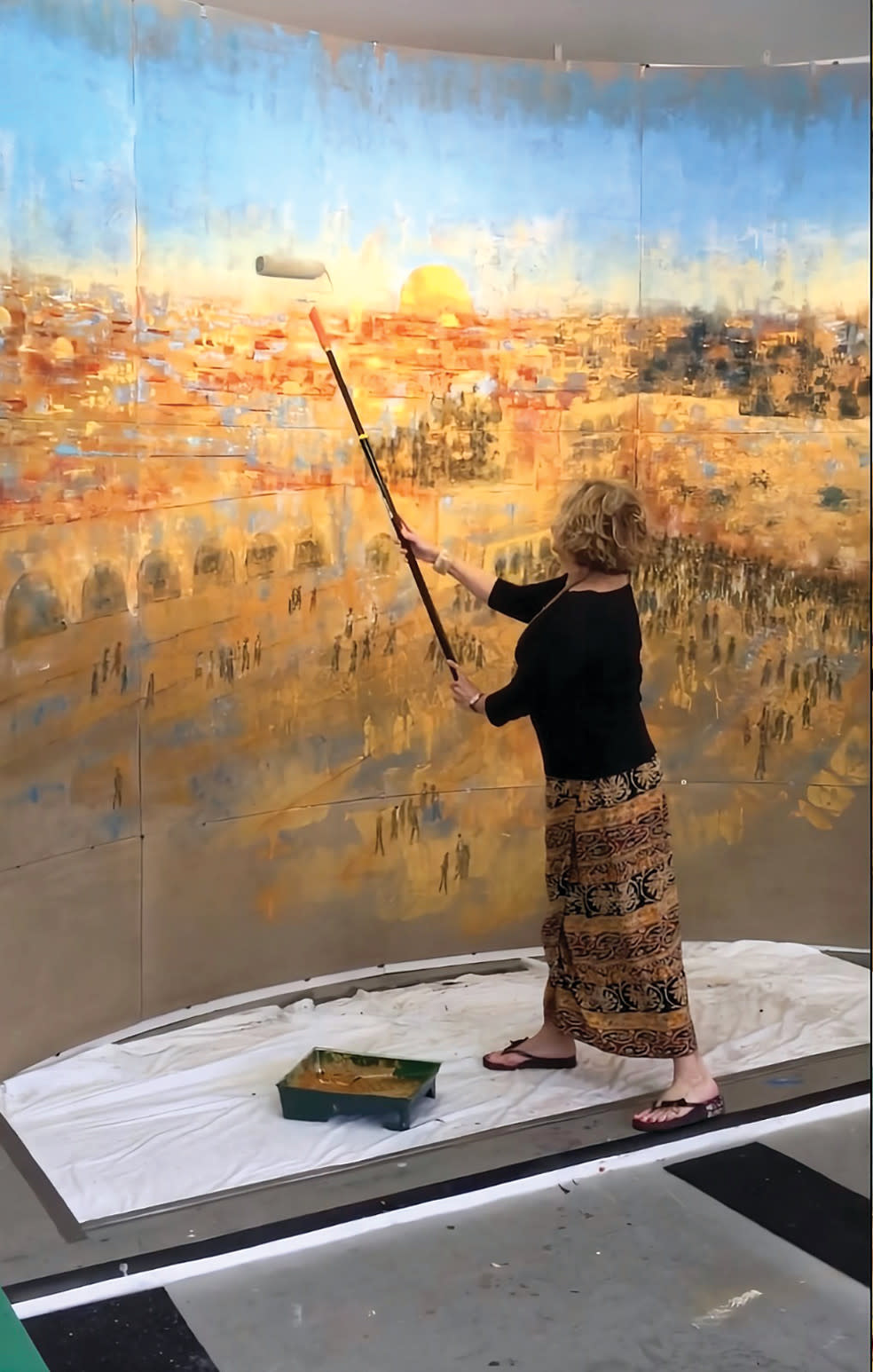
Perspectives on Jerusalem
Creating and appreciating art are, among other things, very much a matter of perspective. Hines has that in abundance, on a physical as well as a philosophical level. The majority of the exhibits actually predate Hines’s frequent forays over here.
“The museum curator [and artistic director, Dr.] Alek Epstein, got fired before I put this show on,” Hines notes. “He wanted this exhibition because [museum founder artist Moshe] Castel built the house next door and this museum to look at Jerusalem from the Judean Hills. So Alek thought it would be a very good fit for here, [looking at] Jerusalem from Ma’aleh Adumim.”
The public gets several visual vignettes of the capital inside the museum, with all sorts of takes – primarily – of the Western Wall. Hines is palpably drawn to the sacred site, as she is to the entire country.
Surprisingly, I learn that none of the portrayals of the city that Hines now calls home, betwixt flitting back to her place in the States, were actually created here.
That was partly down to the fact that her late husband had no interest in living in Israel, so Hines painted here from there. The idea of making aliyah was duly put on a back burner, but never stopped simmering.
The Israelward wheels kept on turning in Hines’s mind as she applied brush to canvas or paper. “I thought, while I was painting – which is a meditation form – I thought I was manifesting where I am now. I had this dream in my heart to be here one day. You can’t paint a city 50 different ways without a real connection with it.
Then again, there are advantages to the offshore logistical state of affairs. Many of the works on show in Ma’aleh Adumim are large, including a couple of triptychs, which could not have been made here.
“I have a massive studio in Florida and a teeny-tiny one here,” Hines laughs. “I could put two airplanes in my studio in Palm Beach; I have unlimited space there.” That’s quite a boon. “Here, I pay NIS 10,000 [monthly rent] for a studio the size of my kitchen.”
That must be frustrating. Or, possibly, it forces Hines to be ultra-focused on what she is producing.
“I have done small stuff since I came here,” she notes, a little superfluously. “If I want to go big, I’ll just go to Florida to do it.”
Taking the land with her
Hines wasn’t entirely detached from Israel and the land – literally – while she lived abroad. She regularly returned home from visits here with a handful or two of Israeli soil, which she then mixed into the paints she used.
She also had a supply line. “I would have people send soil to me, in FedEx envelopes, inside magazines.”
She’s still at it. “I also use sand, and I go down to Emek [Refaim Street] to collect some of the beautiful gold-colored sand there [unearthed by the ongoing work on the light rail there]. That will be mixed with my lighter colors.”
Incorporating corporeal elements from here helped Hines maintain her umbilical cord connection with Israel. As she notes in her catalog, “Simply painting this land didn’t feel like enough. I wanted the holy land to become part of my paintings.”
She also wanted to be part of this land herself. That is reflected not only in her decision to finally relocate here. She also lifts verses out of the Bible for the titles of many of her works. One reads “Let There Be Peace within Your Walls,” from Psalm 122. Then there’s “Renew Our Days As of Old,” from Lamentations, and “Our Feet Stand Firm within Your Gates” from the aforesaid psalm.
The latter work has Damascus Gate as its centerpiece, and the portal to the Old City pops up several times in the Castel Museum show.
One such work, which goes by the name of Bring Us Back to You God, measures close to 2 meters by 2 meters in size.
The evolving subject matter often dictates the eventual dimensions, and the works take on a life of their own.
“I start small, I sketch out my ideas with pastel, and then develop them. Some of the paintings want to be big. You want to be able to walk through the gate there,” she says, as we view the hefty canvas.
Rediscovered roots
Hines’s perspective on the new chapter in her life, in Israel, feeds off an extraordinary bio backdrop. She has a thing about religion, of various ilks.
She was born in Germany and grew up in Australia, in an ostensibly Christian family.

“We were Lutherans, but my parents sent me to a Methodist Sunday school because it was near our home, so I could walk there,” she recalls.
A religion of convenience? I suggest, tongue firmly planted in one cheek. “It was for my parents,” comes the sober riposte.
That may have been, as Hines puts it, her parents’ way of getting the kids out of the house, but the youngster was drawn to the study material. “I loved it,” she says.
Later she took that to another level. “In high school and university I studied comparative religion.”
She was on a roll, and expanded into other religious climes when she went to New York. “I saw someone stand on their head, and I asked him what he was doing. That’s how I got into yoga, and that led me into the Hindu practices. I went to India every year. Hinduism leads naturally into Buddhism. And there is Sufism, and I studied the Shabandi sect. I stayed with Buddhism for over 20 years.”
The spiritual element patently comes across in her work, but her religious leanings took an unexpected turn – actually a U-turn – when her then 14-year-old son, Trevor, came home one day from the prestigious Church of England school in London he was attending and announced he wanted to convert to Judaism.
“He was studying the roots of Christianity, and he said he saw some link that didn’t make sense to him. He went to the roots, and he said this is where I found the truth, and I want to become Jewish. I said that was fine, as long as it was connected to the Divine.”
A phone call to his maternal grandmother, in Australia, ensued, and Trevor found substantial familial collateral for his newfound ambition. She replied: “That’s interesting, dear, because my mother and grandmother were both Jewish.”
Hounded by the Holocaust
That wasn’t a complete surprise for Hines.
“I already knew my father had been Jewish because he was imprisoned during the war [World War II], and he escaped. He was dismissed from the Luftwaffe, and he was given a [discharge] certificate by the German government of the time,” she notes incredulously. “Can you imagine that? A certificate showing that he was half-Jewish. He told me that story.”
So the family’s Jewish past was not entirely kept under wraps. “That was the only story he told me. He wouldn’t tell me anything else about it.”
Hines’s parents took their daughter with them to Australia because they simply couldn’t emotionally carry on living in Germany. They may have left Germany behind, but the horrors of the Holocaust and Nazi barbarism continued to hound them.
“They kept their Jewish past a secret in Australia, too, because they were afraid it [the Holocaust] could happen again, even in Australia,” Hines explains. “They thought there could be another uprising [against the Jews], and if we [children] didn’t know about it [their Jewish past], we would be exempted from whatever was going to happen.”
In Nazi times, being just quarter-Jewish was enough to have you declared as non-Aryan, and you could find yourself packed into a cattle truck and shipped to a concentration camp, or be subjected to any of the other inhuman cruelties merrily meted out by German Nazis and their willing collaborators elsewhere around occupied Europe.
Hines’s father survived the Holocaust thanks to the protection of his non-Jewish father, who also defied Nazi orders to divorce his Jewish wife.
And so Hines and her offspring were reintroduced to their hereditary religion, which, many years later, led to the artist’s aliyah and, by extension, her debut solo showing in her new country.
She has enjoyed previous group exhibition slots here before, including in the recent Jerusalem Biennale. But having your own exclusive run-out is, naturally, a step up and one that augurs well for her continued artistic timeline in this country.
Rediscovering her Jewish roots naturally influenced Hines, not only as a person but as an artist, too. That is evident in “Jerusalem in My Soul” and its featured subjects.
Presumably, had Hines still been a practicing Buddhist or student of Hinduism, she might have focused on very different themes in her work. “Before that, I did portraits and flowers and landscapes,” she says.
There are a couple of the latter at the Castel Museum, including one of the Sea of Galilee, with a titular quote from Isaiah, with the outcrops of the Golan Heights shimmering, in turquoise-green, towering over the glistening waters of the lake. So it is not an exclusively Jerusalem-centric offering.
The somewhat out-of-focus scenes Hines creates evoke a sense of spirituality, of possibly a belief in some unseen being. They are all underlined by a powerful sense of color and light across a swath of guises.
Having noted that, I was not surprised to hear her cite Turner as a strong reference point. The 19th-century English painter is generally categorized as a Romantic artist, although casting a discerning eye over his full, vast oeuvre reveals all kinds of stylistic elements, including Impressionist leanings.
“I love Turner because he infuses everything with light,” Hines enthuses.
Light and vibrant colors appear to be mainstays of Hines’s line of thought and creative endeavor. She crafts her palette with deft attention to scale and intensity. There is an ethereal quality to her paintings and a deep personal understanding of form and space. Notwithstanding the fuzzy appearance, the artist’s intent comes through with razor-sharp clarity.
Jerusalem and specifically the Old City are portrayed with undisguised love, with some night scenes that have a psychedelic-like slant to them. That probably owes more to Hines’s strong bond with the place than any considered stylistic consideration.
“Jerusalem in My Soul” is an ode to a much beloved spot created by an artist with a fresh yet learned and immersive take on a copiously documented place.
The exhibition closes on December 21. For more information: castelmuseum.co.il/en
KioskNews shows a cleaned-up reading view extracted from the publisher’s page — the original always lives on their site, not ours.