‘The entire world belongs to Matthew Rhys, and we just live in it’: why the incredible actor broke Emmy records
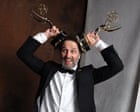
On Monday night, Matthew Rhys made history. He is now officially the first actor ever to win Emmy awards for lead roles in all three categories: drama, comedy and limited series. To make things even more extraordinary, he won two of those awards in a single night.
In the comedy category, Rhys won best lead for Widow’s Bay, the superlative Apple comedy horror where he stars as an indecisive mayor whose island suddenly plays host to a supernatural haunting. He also won best lead actor in a limited series or anthology for The Beast in Me, the Netflix drama about a property developer who may (or may not, no spoilers) have murdered his wife. Add this to his 2018 win for The Americans and the trifecta is complete. In other words, the entire world belongs to Matthew Rhys, and we’re all just living in it.
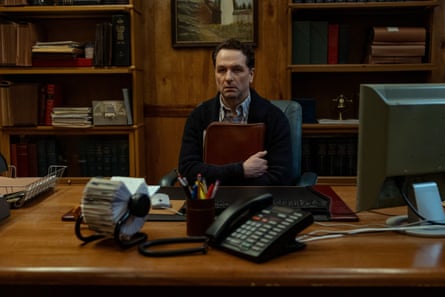
Obviously the remarkable thing here is the sheer range on display. In his two most recent shows, Rhys had to hit almost every single note that is available to an actor. The Beast in Me is possibly the most straightforward of these; it’s a pulpy thriller where he plays the antagonist, and he does so with relish. Widow’s Bay, on the other hand, seems like an incredibly difficult feat to pull off.
If you’ve seen it, you’ll know what I mean. Viewed through one lens, the series is an out-and-out horror, about the out-of-his-depth mayor of a small Martha’s Vineyard-esque island, whose tourist season is thrown into disarray when it becomes overrun by genuinely terrifying creatures. As such, Rhys has to nail all the familiar tropes of the genre: fear, uncertainty, heroism in the face of almost certain death.
But Widow’s Bay was also written by Katie Dippold, whose previous work has included Parks and Recreation. As such, folded into all this terror is a workplace comedy that isn’t afraid to be unashamedly goofy. If you watched the series week by week like I did, then you’ll know the exact moment Rhys won the Emmy. It happened during a reaction shot on a boat. In a moment of panic, the boat hits a giant wave and Rhys slides out of his seat. The face he pulls in that moment, even though it only lasts for a split second, is magisterial. His eyebrows shoot up to his hairline. His mouth widens as if he’s being possessed by the spirit of Wallace and Gromit. His neck goes slack. He’s surprised and resigned and perhaps a little bit giddy all at once. It is, without hyperbole, a perfect expression.
However, those of us who have been familiar with Rhys’s work for a while won’t be surprised by all this success. This is the 30th anniversary of his first screen credit, in the Welsh comedy film Bydd yn Wrol, and he has remained one of the industry’s most reliably great actors ever since. He played the lead in Peter Morgan’s ITV thriller Metropolis in 2000, and in the same year wowed audiences opposite Kathleen Turner in a stage run of The Graduate.
But it was in 2003, with his role as the antagonist in the final Columbo outing Columbo Likes the Nightlife, that things really moved up a gear. Within a few years he had secured a lead role on an American network drama, ABC’s Brothers and Sisters, which he augmented with roles in small but worthy films such as The Edge of Love (where he played Dylan Thomas) and the Welsh-Argentine drama Patagonia.
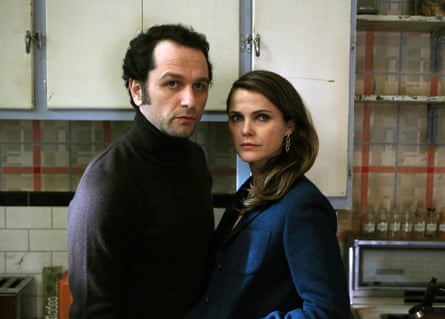
His career went up another notch with the debut of The Americans, a hard-boiled drama about two Russian agents living undercover in suburban Washington DC. The Americans was the golden age of television in microcosm: knotty, novelistic and steadfast in its refusal to spoon-feed viewers. Many of us who watched it said it was the best thing on television, and this was in no small part down to Rhys’s performance as Philip Jennings, a brutal KGB agent who slowly begins to doubt the cause. His performance was matched by Keri Russell, his onscreen wife who would become his real-life romantic partner.
The success of The Americans gave Rhys a blank cheque to do whatever he wanted, and he has taken this up in spades. In film he has worked with Steven Spielberg, and starred in Cocaine Bear. In television he has played the lead in a Perry Mason revival, and taken roles in Girls, BoJack Horseman and Family Guy. He has also presented a television show that was purely about how much he enjoys drinking wine.
This refusal to be pigeonholed is Rhys’s greatest asset. He is that rare actor – matched only perhaps by Bryan Cranston – who can do whatever he wants and be utterly credible. Matthew Rhys can do it all, and long may it continue.
KioskNews shows a cleaned-up reading view extracted from the publisher’s page — the original always lives on their site, not ours.