Trump slaps tariffs on Canadian ‘trash trucks.’ How much garbage is being sent to the U.S.?
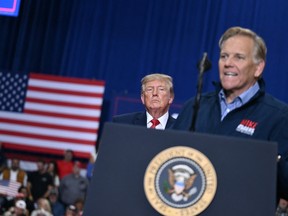
On Friday, U.S. President Donald Trump removed 50 per cent tariffs on 22 Canadian goods. But he added tariffs to 100 more, including municipal waste — meaning garbage from households and businesses.
Sign In or Create an Account
The move has been backed by Michigan Republican Senate candidate Mike Rogers, who has spent decades raising his concerns about Canadian garbage imports. Speaking on stage with Trump at a rally in Port Huron on Sunday, Rogers accused Canada of sending “truck after truck after truck loaded with their trash into our state.”
But how much Canadian garbage actually crosses the border into the U.S., and why is it being sent there?

Get a dash of perspective along with the trending news of the day in a very readable format.
By signing up you consent to receive the above newsletter from Postmedia Network Inc.
A welcome email is on its way. If you don't see it, please check your junk folder.
The next issue of NP Posted will soon be in your inbox.
We encountered an issue signing you up. Please try again
Canada is the largest source of waste imports to Michigan, accounting for 14 per cent of all waste disposed of in Michigan landfills in fiscal year 2025, according to a March report by the Michigan Department of Environment, Great Lakes, and Energy (EGLE).
Michigan’s proximity to Canada, combined with its relatively low landfill tipping fees (just 36 cents per tonne), makes it an appealing option for organizations in Canada responsible for disposing of waste.
Solid waste imports from Canada reached almost 3.2 million tonnes, down 8 per cent from FY 2024, when 3.5 million tonnes of solid waste was imported to Michigan from Canada.
Meanwhile, other U.S. states made up less than 4 per cent of waste disposed of in Michigan landfills in 2025. Waste that originated in Michigan made up 82 per cent.
Canada doesn’t track its own waste exports, according to a 2024 report from Environment and Climate Change Canada.
However, Waste to Resource Ontario (W2RO), which represents organizations in the waste, recycling, and resource management sector in the province, reports that, in 2024, 27 per cent (3.44 million tonnes) of waste that was generated in Ontario and sent to landfills was exported to the U.S.
The exported waste was sent primarily to Michigan, New York and Ohio.
Like Canada, the U.S. doesn’t consistently track shipments of municipal waste on a national level. However, a 2003 Canadian government report on imports and exports of non-hazardous waste suggests that far less garbage enters Canada from the U.S. than in the opposite direction.
It estimated that Canada imported approximately 35,000 tonnes of non-hazardous waste from the U.S. for landfill disposal in 2003, compared to the 3 million tonnes exported from Canada to the U.S. in the same year.
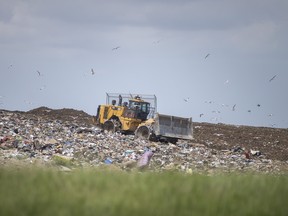
According to the WR2O report, Ontario is running out of landfill capacity. It says that if the borders close to Ontario’s waste, the province will run out of landfill capacity by 2034. And even while maintaining exports to U.S. landfills, it predicts that the average remaining capacity will be depleted by 2037.
Meanwhile, Michigan’s landfill tipping fees are relatively low. Last year, Michigan’s Governor Gretchen Whitmer recommended increasing fees from the solid waste surcharge from 36 cents per tonne to US$5 per ton in the 2026 fiscal budget proposal.
The proposal said this would bring Michigan in line with the average Midwest tipping fee as well as “directly addressing the volume of out-of-state waste.”
Municipal and clinical waste are among the new items that will be subject to 50 per cent tariffs from Oct. 30, under an amendment issued by the White House on Friday.
Trump said he was providing a tariff exemption for some agricultural goods that are “consistent with the interest of the United States,” allowing 22 products previously subject to 50 per cent tariffs to cross the border duty free, while 100 new products were added under Section 338.
Items subject to exemption include refrigeration and freezing equipment, agricultural machinery and packing equipment, while other new items that will be subject to tariffs include cocoa powder, carpets and shampoo.
Rogers has been raising the issue of Canadian waste imports for decades. In a floor speech in the U.S. House in 2002, he said that Canada sent 4.2 million cubic yards of waste to Michigan in the year 2000, and expressed concerns about the environmental impact on Michigan.
In 2003, Rogers backed a Bill that would have amended the Solid Waste Disposal Act to allow states to enact laws prohibiting or limiting the receipt of waste from other countries, but it never made it past the committee stage.
I called for an end to the tariff war with Canada, and told the Trump Administration if you’re going to be putting tariffs on anything from Canada, it ought to be the damn trash they’ve been dumping in our state for decades.— Mike Rogers (@MikeRogersForMI) October 23, 2026And today, they acted. This is a HUGE win for… pic.twitter.com/Hc4Nph0Gs6
On Friday, Rogers called the new tariffs on waste coming from Canada “huge progress” in a video posted on social media, adding Canada’s “trash trucks” have been “a huge problem” for Michigan.
“I called the secretary’s office a few days ago and said, ‘Listen, we need some relief on Canadian tariffs. But if you’re going to tariff anything, tariff those trash trucks,'” he said.
But the Michigan Senate hopeful hasn’t always been so emphatic in his support of Trump’s trade war, having previously broken ranks in a campaign video shared on social media.
“Here in Michigan, we know that Canada is not our enemy. We need to end this tariff war now. As Michigan senator, I’ll bring both parties together to lower your prices,” he said in the clip.
Meanwhile, Michigan has become a key battleground for the upcoming U.S. midterms and is currently considered a toss-up for the Senate race by The Cook Political Report.
The Democrats need to gain four more seats to win back the Senate majority in the upcoming mid-term elections on Nov. 3.
Our website is the place for the latest breaking news, exclusive scoops, longreads and provocative commentary. Please bookmark nationalpost.com and sign up for our daily newsletter, Posted, here.
Join the Conversation
This website uses cookies to personalize your content (including ads), and allows us to analyze our traffic. Read more about cookies here. By continuing to use our site, you agree to our Terms of Use and Privacy Policy.
KioskNews shows a cleaned-up reading view extracted from the publisher’s page — the original always lives on their site, not ours.