2027 Rivian R2 review: The Goldilocks electric SUV
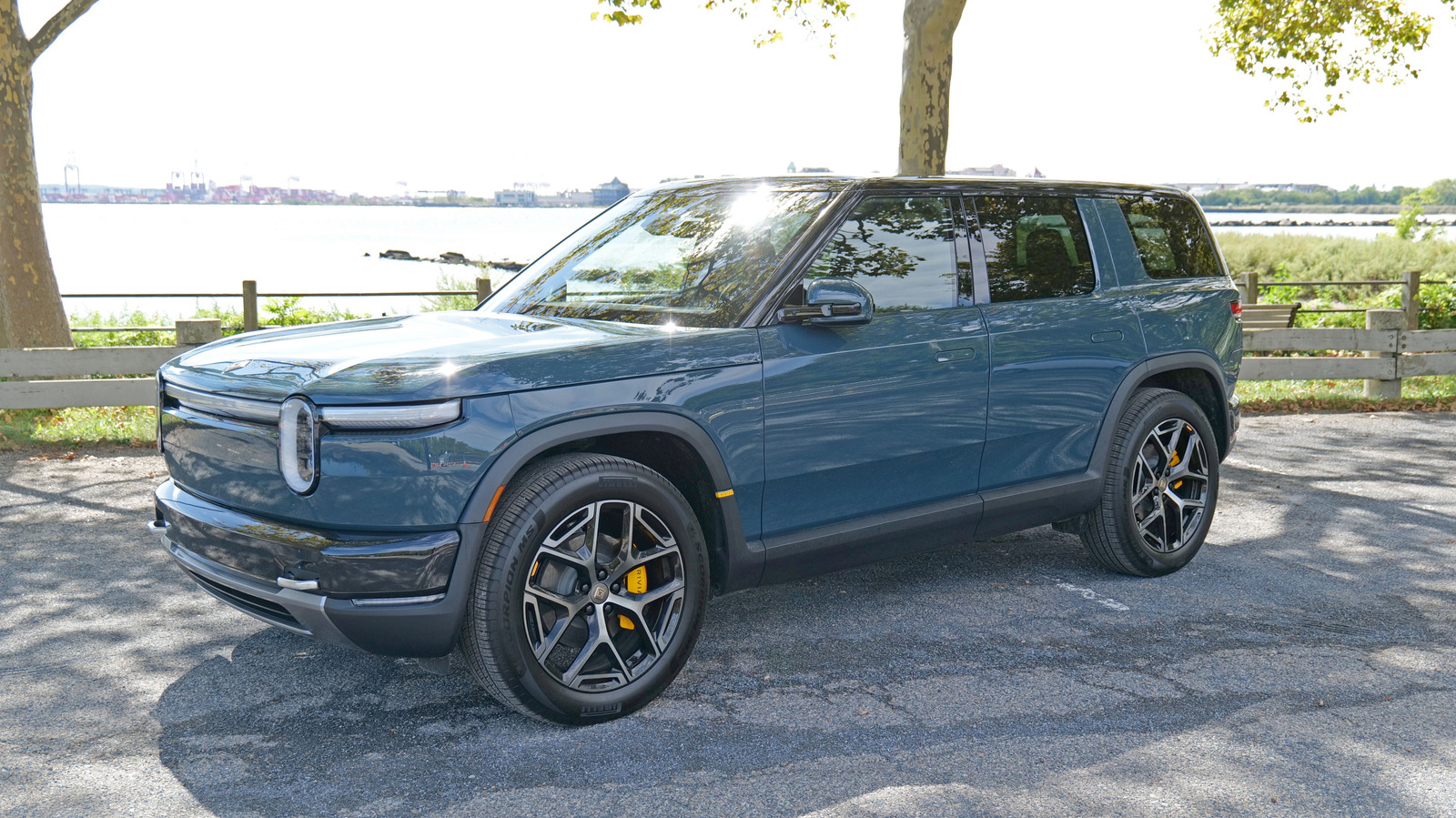
It’s not too big, it’s not too small and it’s not too expensive. It’s just right.
Sam Rutherford for Engadget
RATING : 9 / 10
- Plenty of power and range
- Streamlined but practical interior
- Homegrown infotainment system
- Roomy for its class
- Universal hands-free driving on highways is great
- Rivian Assistant not available just yet
- Hands-free driving on surface streets still needs work
- Base model won’t be out until next year
- Charging speed could be a touch faster
Rivian's first vehicle — the R1T — initially hit the roads in 2021. Despite the industry's best efforts, electric trucks just haven't enjoyed the same popularity as their gas-powered counterparts. Rivian followed that up with the R1S in 2022, which added more room for passengers while also serving as the primary platform for future development. But with three rows of seats and a starting price of over $80,000, it's a bit too big and too expensive to have true mainstream appeal.
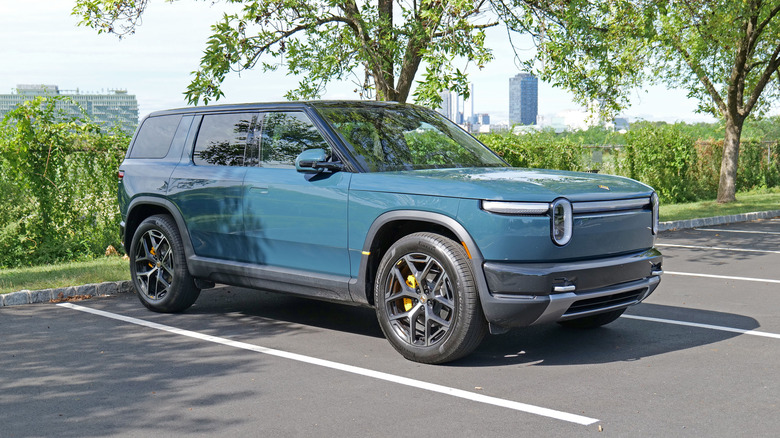
Earlier this year, Rivian's third EV — the R2 — hit the roads. The company distilled nearly all of its best features and tech into a family-friendly mid-size SUV. It blends the ruggedness of an off-roader with the civility of a buttoned-up grocery runner for under $60,000 (or much less depending on the spec). It's not too big, it's not too expensive and it has the right blend of tech and style, which sort of makes the Rivian R2 the closest thing to a Goldilocks EV SUV on sale today.
Design
Sam Rutherford for Engadget
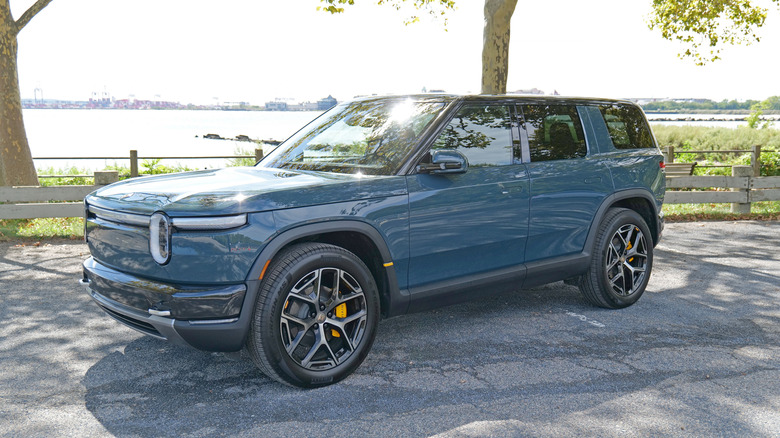
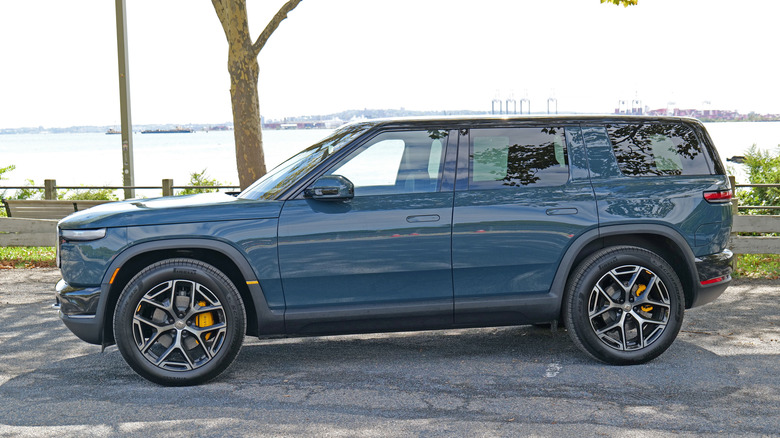
In many respects, the R2 looks like Rivian took the R1S's design, put it in a photocopier and then spit out a new vehicle at 75 percent size. But that's not quite right because Rivian chief design officer Jeff Hammoud previously said the R1 is actually based on an early concept for the R2. The company liked it so much it ended up becoming the template for both models. Naturally, this means the R2 has a lot of the same design cues as its bigger sibling, including a boxy body with flush door handles, chunky bumpers and the company's signature pill-shaped headlights. It's a good look that balances the desire to have the brawny exterior you expect from a rugged SUV without straying too far into retro-inspired designs like you get from many of its gas-powered rivals — such as the current Bronco and Wrangler.
Rivian has also done a great job on integrating a lot of off-road features into the R2 chassis, like the built-in tow hooks in front and recessed mounts for a roof rack on top. The Performance Launch Model I tested also had Rivian's optional tow package, which includes a standard 7-pin connector and a concealed hitch. In the cargo area, there's both a 12v accessory socket and 120v outlet to power pretty much any gadget you would need. If that's still not enough, the R2 even supports bi-directional charging (both V2L and V2H), though we're still waiting on Rivan to release the accompanying charging adapter.
 Sam Rutherford for Engadget
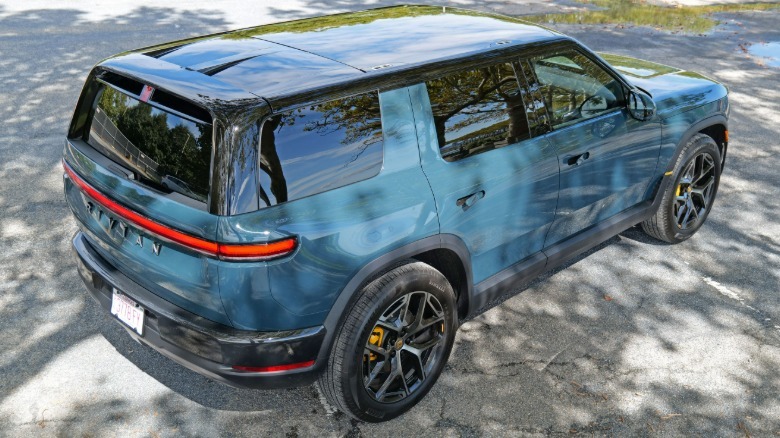
Unlike some other EV SUVs that have ditched their frunks, the R2 still has a good-sized cargo area under its hood that offers 5.2 cubic feet of storage. Plus, there's a drain in case you want to use it as a cooler for tailgating or storing wet gear. All together, you get a very capable car for all sorts of trips and conditions, but without the vehicle feeling like it needs to scream about its versatility.
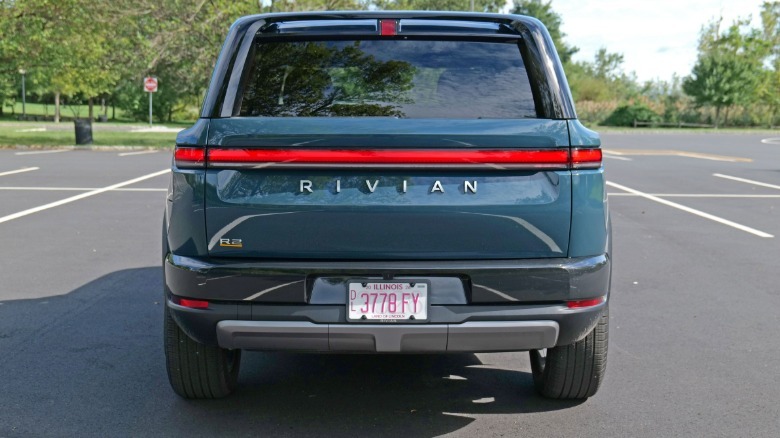
Some of the R2's best features are things like its Matrix LED headlights, which adjust automatically to driving conditions and oncoming vehicles. It feels like there's a little robot manning each beam to shine it exactly where you need it. And while the R2 doesn't have a split tailgate like you get on the R1S, Rivian still included a rear hatch with a retractable window, so you can lower it to transport longer items or just catch some fresh air. There's even a button that lets you lower all four windows and the rear windshield with a single touch, which is a really nice features when the weather is just right.
 Sam Rutherford for Engadget
I also appreciate a lot of the little details hidden throughout the vehicle, like the button for the rear hatch. Instead of being located dead center, it sits off to the left just a touch, directly above the "V" in Rivian around back. So even though there isn't an explicit call out to where it is, you always know where to press. Annoyingly, there are some small oversights, like when I discovered that in order to remove the rear seat headrests, you need a little pin tool. This became a minor issue when I was trying to install car seats for my kids. While there are handy LATCH (Lower Anchors and Tethers for Children) points, there wasn't an easy way of threading a strap through the headset to reach the loop on the back of the rear bench without that tool.
My one personal gripe is that because the R1S and R2 look so similar, I wish Rivian had given it its own unique design trait — like the slanted C-pillar on the R3. Rivian's upcoming compact SUV won't arrive until sometime in 2028, but because the company has already revealed its design, I've lost count of the number of people who have gushed to me about how good it looks. It's a bit sad that the R2 doesn't have its own signature style.
Interior
Sam Rutherford for Engadget
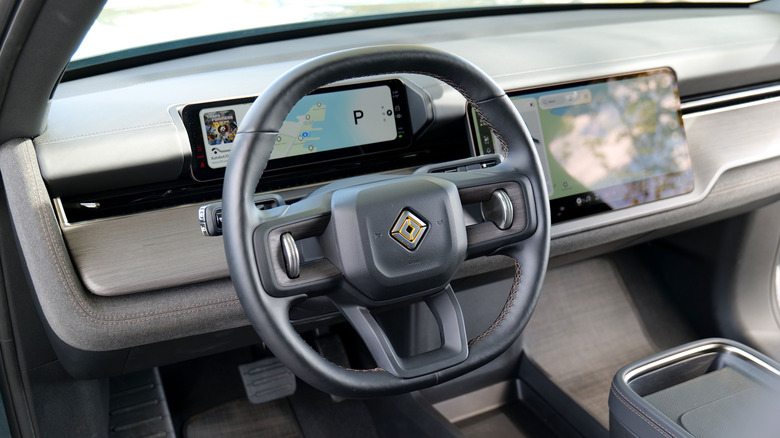
On the inside, the R2 features a cabin that blends modern minimalism with just enough warm accents, which makes things feel spacious and airy but still cozy at the same time. One thing that immediately struck me in comparison to my Mach-E is that even though both cars are essentially the same length (185 inches), the R2 felt noticeably roomier. The dash is made from upcycled birch in either a charcoal or light gray finish, while the infotainment has just enough physical controls to balance out its big 15.6-inch main display and 11.5-inch driver's display. There are also two glove boxes, and you don't need to search for any kind of touch controls to open them. You just press in and voila.
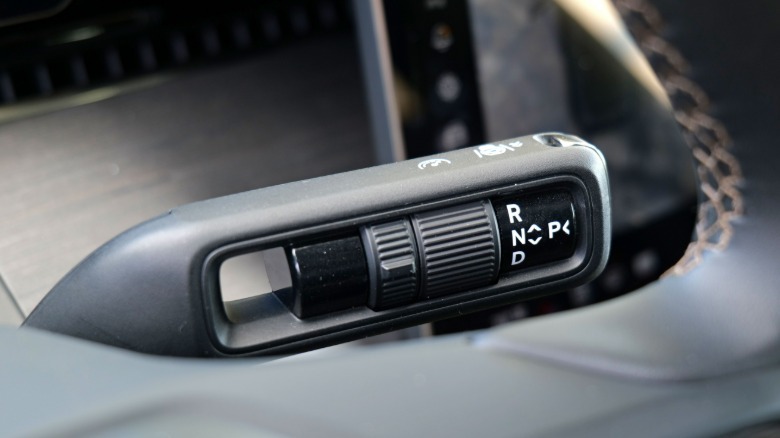
Meanwhile, there are Rivian's Haptic Halo Wheels, which feel like someone took two scroll wheels out of some high-end mice and embedded them into the R2's steering wheel. You can spin them up and down to do things like adjust volume or change your speed when using assisted driving modes, but you can also push them left and right to change tracks and whatnot. It's really simple and really intuitive. And behind the wheel, you get traditional stalks for controlling things like the gear selector, blinkers and windshield wipers.
 Sam Rutherford for Engadget
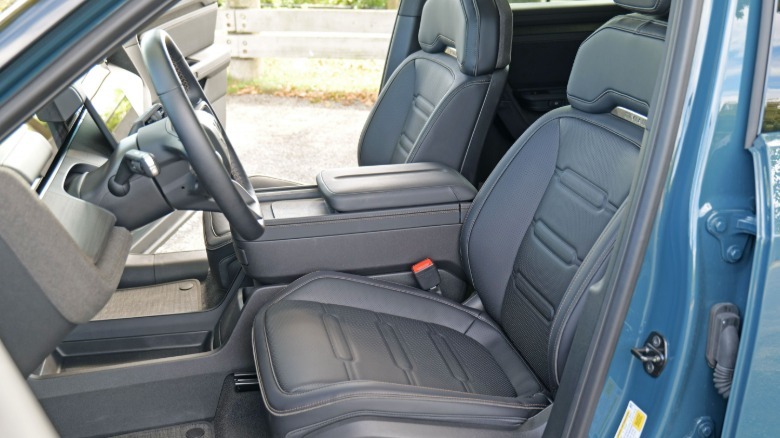
Seats are big and somewhat comfy, though for my taste, I wish they had a touch more lumbar support. On premium and performance models, you also get heated and ventilated seats, the latter of which I enjoyed a lot thanks to our unseasonably warm fall weather in the northeast.
There are also numerous USB-C ports scattered through the vehicle, including one in the back of both front seat headrests. There's a built-in wireless charger in the center console, too. Strangely though, you only get one of those for the driver's side, which could be annoying on a longer trip when multiple people need to top up their phones.
 Sam Rutherford for Engadget
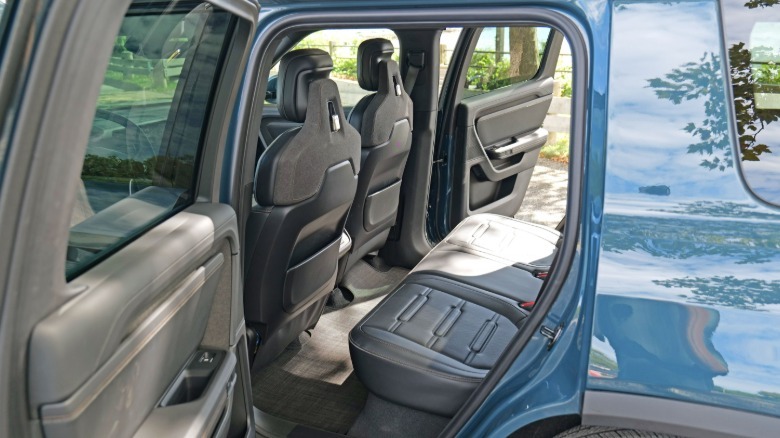
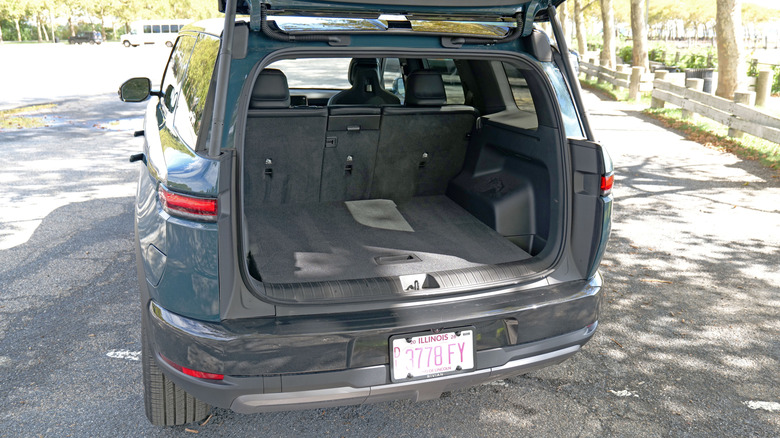
Meanwhile, the second row seats are quite spacious, even for a six-foot tall adult like me. There's ample leg and head room, and from the back, you can more easily appreciate the R2's panoramic glass roof. The rear seats fold down in a 60-40 split so you can maximize passenger room even when you're transporting things like skis and snowboards, while the cargo area offers around 30 cubic feet of storage even with the rear seats up. And if you lift the floor, there's even more room to stash gear.
Making use of every little nook and cranny seems to be something Rivian is quite good at. In addition to all the little cubbies and hidden drink holders stashed throughout the car, the Premium and Performance versions of the R2 even come with little touches like an included flashlight that can be neatly stashed inside the driver's door.
Tech and infotainment
Sam Rutherford for Engadget
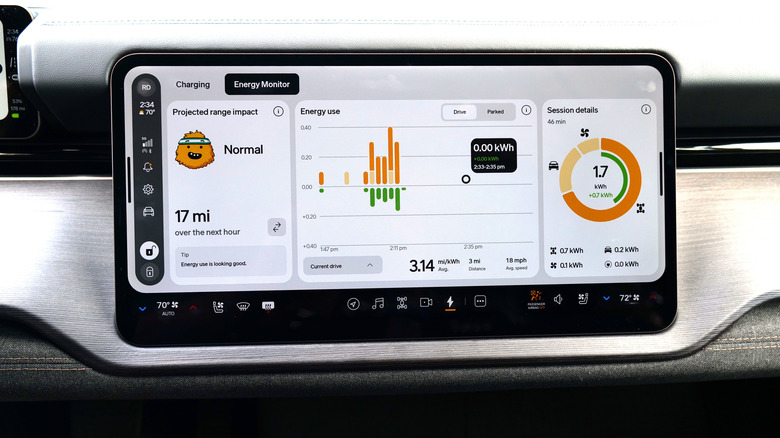
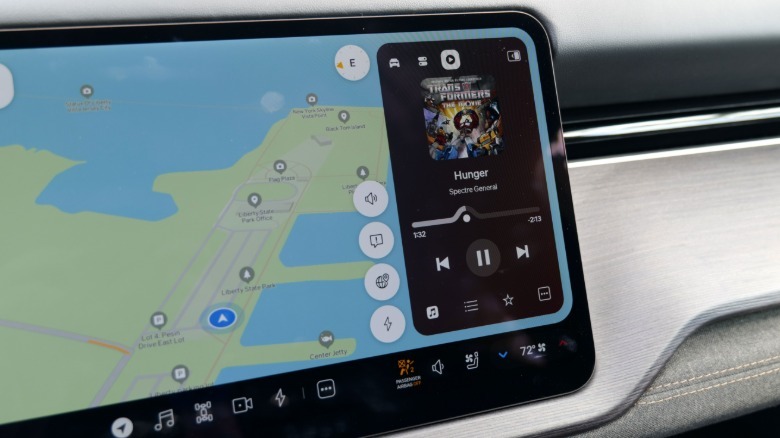
Unlike so many cars that rely on support from Android Auto and Apple CarPlay to make their infotainment functional, Rivian has taken a homegrown approach. It shows that when a system is designed well, you don't need help from your phone's OS. All of the car's core functions are divided neatly into different tabs for things like music, drive modes, navigation and charging. Mapping is powered by Google, so you get a wealth of info, though there are little oddities that still stick out. For example, Rivian's voice assistant pronounces Houston street in NYC the same as the city in Texas, which for locals is a clear sign that you don't live here. But that's largely superficial, because you still get things like traffic alerts and police sightings directly on the map.
The charging screen makes it easy to get quick updates on things like range, energy use and nearby chargers while the video tab makes it easy to access the R2's cameras. Those are used for parking or checking out the feed from Rivian's Gear Guard system, which acts as a built-in dash cam to record footage while driving or stationary. I will die on this hill, but I really think every modern car should have the ability to use a car's onboard cameras to save clips in case of an accident. I'm really glad Rivian's didn't skimp on this functionality like a lot of other car makers.
 Sam Rutherford for Engadget
Selecting tunes is as simple as signing into your Apple Music, SiriusXM or Spotify account. Unfortunately, my service of choice, YouTube Music, isn't supported. However, the bigger caveat is that you'll also need a subscription to Rivian's Connect+ service, which runs $15 a month or $150 a year, that includes other handy features like an in-car Wi-Fi hotspot, video streaming and more.
The one wrinkle is that Connect+ is also meant to include the Rivian Assistant, which adds support for enhanced voice controls and texting integration from your phone. It's currently available on both the R1T and R1S, but it hasn't been ported over to the R2 just yet. Thankfully, Rivian is planning to add it sometime before the end of the year (potentially as soon as this month). I'm not a fan of buying promises though, so if you haven't paid for a reservation, this is one of the features I would wait for before putting my money down on an R2.
 Sam Rutherford for Engadget
In the time since I reviewed the R1S, Rivian added the option to replace the typical chirp you get when locking the car with an owl's hoot, which my two-year-old loved so much she threw a tantrum the one time I switched it back.
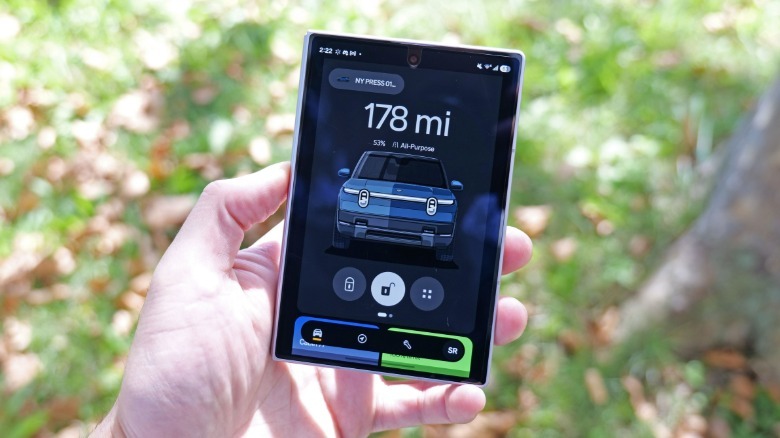
Then there's the Rivian app, which makes it easy to keep tabs on the car, lock/unlock the doors, activate climate control remotely and more. On my Galaxy Z Fold 8, keyless entry worked with the Samsung Wallet app for easy integration. Once I set it up, it was flawless during my week-long test session. Managing the important features from my phone was simple, straightforward and reliable, and I think a lot of competing car makers could learn a lot from Rivian's software.
Driving
Sam Rutherford for Engadget
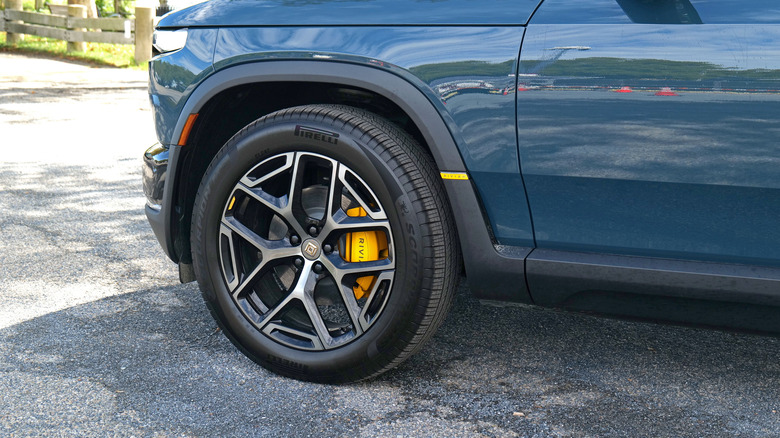
If you simply look at the numbers, you might think that an R2 Performance lags way behind a top-spec R1S, which offers up to 1,025 horsepower with its quad-motor option. But that's not a fair comparison because a dual-motor R1S (533 hp and 0 to 60 in 4.5 seconds) actually has less horsepower and oomph than an R2 Performance (656 hp and a 0 to 60 time of 3.6 seconds). And when you combine that with a lighter curb weight of around 5,000 pounds (versus 6,600 to 7,100 pounds for the R1S), you get an SUV that pulls like a herd of stampeding buffalo. Torque is instantaneous, which makes accelerating onto an on-ramp or passing aggressively delightful. The R2 has so much power that even in its stiffest ride setting, you can still feel the entire car lurch upwards when you slam down on the accelerator.
Now there's no getting around that the R2's suspension is on the firmer side of things, even when it's on Rivian's more forgiving moderate setting. But I don't mind that, as that's sort of expected from a tallish SUV, plus it still lets you feel the road while providing good driver feedback regarding grip and stability. The R2 offers multiple levels of regen which makes one-pedal driving a breeze. Furthermore, while I didn't take it on the trails, the R2's off-road DNA showed through when I drove it across gravel and cobblestones. It casually eliminated the kind of excess turbulence that can result in a truly teeth-chattering ride.
 Sam Rutherford for Engadget
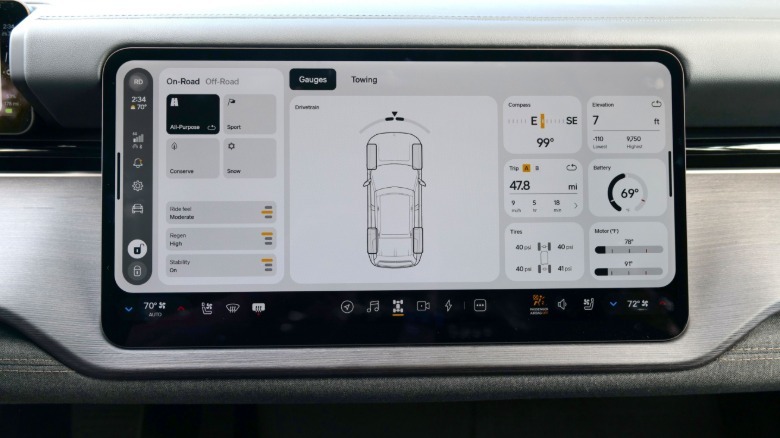
I also appreciate how Rivian didn't mess with the drive mode tab in the infotainment, which serves as a central menu for adjusting things like ride feel, regen, stability and more. This tab also lets you easily see stats like motor temperature, tire pressure and even things like the orientation of your wheels and the elevation. Those last two items can be very helpful in rough terrain.
For those who opt for Autonomy+ (which costs $50 a month or $2,500 for a one-time purchase, after your initial 60-day free trial on new vehicles), you'll get access to Universal Hands-free driving across more than 3.5 million miles of roads in the US and Canada. On the highway, hands-free driving was sublime. It easily handled lane changes and congested roads without drama. In some ways, it even felt a touch smoother than BlueCruise on my Mach-E, as the R2 followed curves a bit more gracefully compared to Ford's system, which can feel a bit robotic at times. I also really like how Rivian allows you to make micro steering adjustments when needed, which on other vehicles will often kick you out of hands-free mode.
 Sam Rutherford for Engadget
That said, while you can use hands-free driving on some surface streets (you'll know when the little icon lights up on the driver's digital cluster display), Rivian's tech needs a little more polishing there. I found that sometimes it would let me activate hands-free mode for just a few seconds, before quickly disabling it when it noticed road markers weren't distinct enough. This is also highly dependent on the specific road and how nearby lines look. So while you can go hands-free on some local streets, the R2 needs a little extra baby sitting. That's okay, because we know it's not meant to be 100 percent autonomous yet, right? Right. You can take your hands off the wheel, but don't close your eyes.
Finally, there are some other little touches that I really like, such as the camera feed from the sideview mirrors that automatically pops up in the driver's instruments when you hit your blinkers. This tech is becoming more popular on new cars and I hope it becomes standard equipment soon. Same goes for the bird's eye 360-view that activates when the car senses that you're maneuvering in tight spaces or when you shift into reverse.
Range and charging
Sam Rutherford for Engadget
Both the premium and performance version of the R2 promise 330 miles of range from an 88kWh battery. Based on my experience, that seems about spot on. That is, assuming you can resist the urge not to take advantage of the R2's power. During a drive of around 100 miles (one third city driving and two-thirds highway), I found the EV averaged around 3.25 miles per kWh. Efficiency wasn't quite as good on surface streets where there's a lot of stop and go, or when you go above 70 mph, but if you're looking to maximize range, getting above 300 miles per charge is very doable.
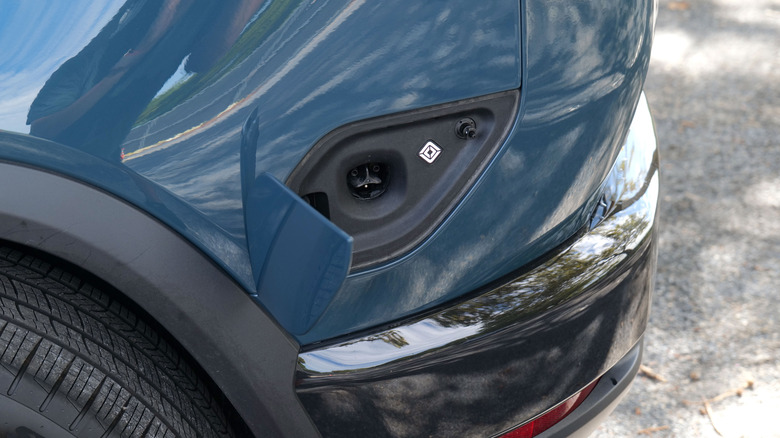
As for charging, the R2 comes standard with an NACS and you can easily get a CCS adapter if you need it. That said, while I certainly wouldn't say it's slow, I feel like the R2's charging speed is somewhat mediocre. Rivan says that the car's 400-volt architecture supports recharging at up to 230 kW, but when I tested this out at an 350kW EVGO station, the R2's charging curve topped out at 161kW. That allowed it to deliver on Rivian's claim of being able to go from a 10 percent state of charge to 80 percent in around 27 minutes. This is fine, but it's still a touch slower than rivals like the Hyundai Ioniq 5.
Trims and pricing
Sam Rutherford for Engadget
The R2 Performance with Launch Package (which is what I drove for this review) is on sale today and starts at $57,990. It features a dual-motor AWD drivetrain with 656 hp, 330 miles of range and a 0 to 60 time of 3.6 seconds. This trim also comes with Rivian's Autonomy+ tech, 21-inch wheels with all-season tires, Matrix headlights, a compact spare and an included key fob.
The R2's premium spec starts at $53,990 for a dual-motor AWD system with 450 hp, 330 miles of range and a 0 to 60 time of 4.6 seconds. This trim still comes with Matrix headlights, standard tow hooks, premium audio and 20-inch wheels, but things like Autonomy+ and the tow packages are now optional extras. This spec is slated to go on sale sometime in late 2026.
Finally, the standard R2 starts at $44,900 for a single-motor RWD setup with 350 hp, 275 miles of range and a 0 to 60 time of 5.9 seconds. Optional upgrades include a larger battery pack for longer range or a dual-motor AWD config alongside things like Autonomy+. However, this trim won't be available until sometime in the spring of 2027.
Wrap-up
Sam Rutherford for Engadget
Driving the R2 is a somewhat strange experience after reviewing the R1S last year. In fact, Rivian's two EV SUVs look so similar that when my neighbors saw the R2 parked on the street, they thought I was actually testing its bigger sibling. I's a similar situation on the inside, where the R2 so closely mirrors Rivian's three-row model (with one less bench, of course) that sometimes you forget that you're driving around in a significantly smaller vehicle that costs between $20,000 to $30,000 less (or more depending on the config). But in a way, that's a big complement to the R2. It has nearly everything I liked about the R1S, but in a more compact package.
I do have a few tiny reservations, such as waiting for the Rivian Assistant to be officially released. I also hope that hands-free driving on surface streets gets some additional tuning. The R2's charging speed could be a touch faster too. But those are very minor dings against what is otherwise an incredibly full-featured and very capable EV. With the R2, Rivian is proving that just because an electric SUV is smaller and more affordable, that doesn't mean it has to make major trade-offs to its style, power and tech compared to the rest of its siblings. And for a family of four, the R2 feels like the Goldilocks SUV that could make people who currently drive gas-powered rivals jump to an EV and never look back.
KioskNews shows a cleaned-up reading view extracted from the publisher’s page — the original always lives on their site, not ours.