Chethan Kumar in Parallax: Why countries sometimes need to reinvent the wheel
Where You Stand Changes What You See
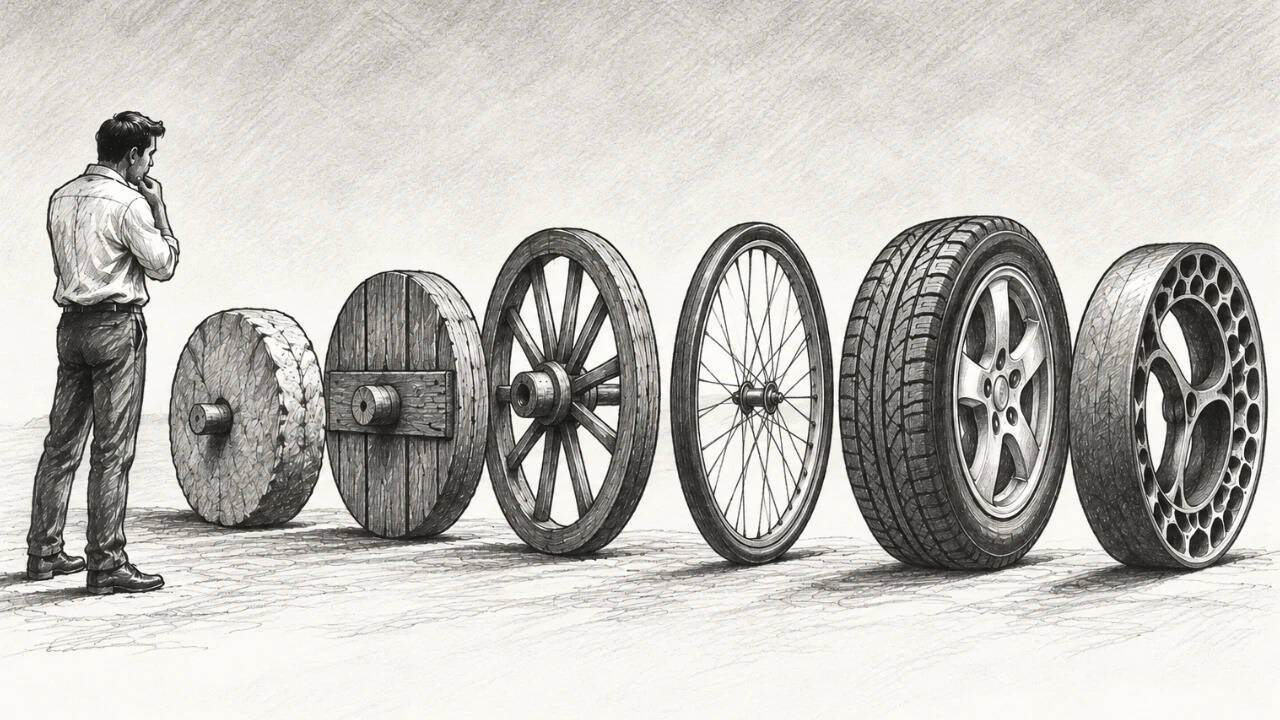
Reinventing the wheel has never enjoyed a particularly good reputation. Somebody has already worked out the geometry, solved the engineering problems and put the thing on sale.
Why spend years developing a version of your own when you can buy one off the shelf? The money saved can be spent on something else. The time saved can be put to better use.This is the logic of the marketplace, and most of the time, it makes perfect sense. Until the person selling you the wheel acquires the power to decide whether you get to use it.Consider satellite internet. A service such as Starlink can connect places that conventional networks struggle to reach, drawing on a constellation of satellites rather than a chain of terrestrial infrastructure. For a country looking to bridge its digital divide, the appeal is obvious. Why build an entire system from scratch when somebody else has already built one that works?

Parallax: An inwards perspective into AI
But the question changes when technology becomes essential.
Who controls the network? Who decides where it operates? Who can change its terms, restrict access or switch it off? The company providing the service may be perfectly well intentioned. That doesn’t alter the underlying arrangement: the country using the network doesn’t necessarily control the conditions under which it remains available.This isn’t an argument against Starlink, or against importing technology.
It’s an argument against confusing access with control.Which people do rather easily sometimes. A country buys equipment, licences software, subscribes to a cloud service or adopts a foreign platform. The system works, the bills are paid and everybody moves on. Dependence rarely feels like dependence when the supplier is reliable and the service is uninterrupted. It looks like efficiency.The problem appears when the assumptions change. A diplomatic disagreement, an export restriction, a corporate decision, a software update or even a major outage can turn a convenient arrangement into a national vulnerability.
The supplier need not be hostile. It only needs to have interests of its own, which is what companies, quite reasonably, have.The same question extends well beyond satellite communications. It applies to semiconductors, telecom equipment, navigation systems, payment networks, cloud infrastructure, medical supplies and artificial intelligence.In each case, the relevant question isn’t simply whether another country can make the product more cheaply or efficiently.
It’s what happens if that product becomes unavailable, and how long it would take to replace it.This is where reinventing the wheel begins to make sense. Not every wheel needs to be reinvented. Nor can a country sensibly manufacture everything it consumes. Complete self-sufficiency would be prohibitively expensive, technologically unrealistic and, in many cases, pointless.International trade exists because specialisation works.
There is little virtue in making something badly at home merely because it can be bought from abroad. But there is a difference between importing something and surrendering the capacity to do without it.A domestic alternative needn’t be cheaper, faster or better at the outset. Its value may lie in the option it preserves. The ability to manufacture a critical component, repair a system, maintain its software or switch to another supplier is a form of insurance.
Most days, insurance feels like an expense. On the day it is needed, the calculation looks different.India’s digital payments experience makes for a good example. The UPI, developed by the National Payments Corporation of India (NPCI), established a common, interoperable system through which banks and payment applications could connect.Its significance lies not merely in its Indian origin, but in the ability to shape the architecture, rules and evolution of an important part of the country’s financial infrastructure.
The lesson isn’t that everything must be built domestically. It is that countries should be able to shape the systems on which they increasingly depend.That requires more than assembling imported equipment or putting a domestic label on a foreign design. It means developing the knowledge to design, test, maintain and improve technology, along with the industrial capacity to produce critical components. It also means allowing competition, welcoming international partnerships and building alternatives that can work with other systems rather than being trapped in technological silos.The objective isn’t to become an island. It is to ensure that remaining connected to the world remains a choice rather than a compulsion. There is, of course, a danger in invoking self-reliance too readily. It can become an excuse for protectionism, inefficient monopolies or the endless subsidising of products that never become competitive.A domestic supplier can be unreliable, too. Nationality is no guarantee of competence, just as foreign ownership is no guarantee of vulnerability.
The test must be whether a capability is genuinely critical, whether alternative suppliers exist and whether losing access would impose costs that the country cannot reasonably absorb.The case for reinventing the wheel is strongest when the wheel is carrying something that cannot be allowed to stop. And a more useful measure of technological progress, then, isn’t how many things a country can buy, or even how many it can make.It’s how many essential things it can keep working when the arrangements that usually sustain them fall apart. The paradox is that a country may have to spend money reproducing something that already exists elsewhere, not because the original is inadequate, but because relying on it exclusively would be.Postscript:Sometimes, the wheel is worth reinventing precisely because somebody else has already invented it. The question is whether we can keep moving when they no longer want to lend it to us. Perhaps that is the parallax: what looks like needless duplication from one vantage point may look like insurance from another.
KioskNews shows a cleaned-up reading view extracted from the publisher’s page — the original always lives on their site, not ours.