ASX falls, Wall Street slumps late as bond market ramps up pressure
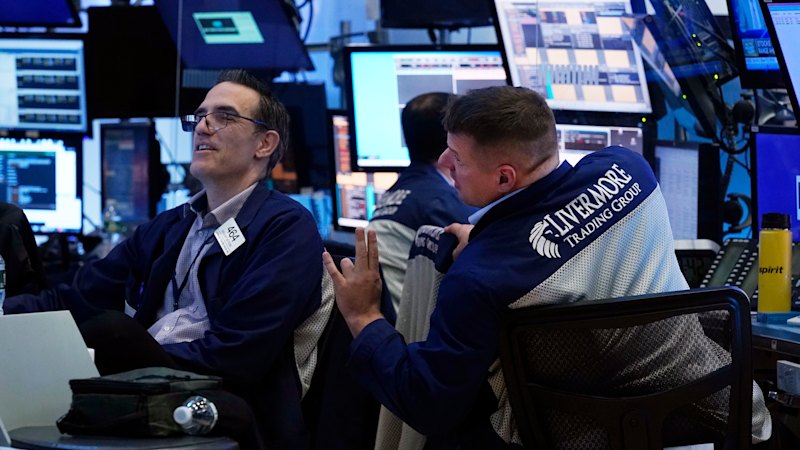
The Australian sharemarket has fallen sharply at the open after Wall Street fell as it contended with the downside of a US economy that keeps powering through its many challenges.
The S&P/ASX 200 was down 82.1 points or 0.9 per cent, at the open. The ASX added 0.9 per cent on Wednesday. The Australian dollar is weaker at US69.58¢.
The S&P 500 slipped 0.3 per cent to close out its third losing month in the last four. The Dow Jones Industrial Average dropped 443 points, or 0.9 per cent, and the Nasdaq composite added 0.2 per cent.
US stocks turned lower after data reports suggested the US economy was even stronger during the spring than earlier thought. That helped yields remain high in the bond market, which in turn kept up the pressure weighing on stocks and all financial markets.
The day began with gains for stocks following an encouraging report that said inflation wasn’t as bad across the United States last month as economists expected. It said the cost of living for US consumers was 3.4 per cent higher overall in August than a year earlier. That was not as high as the 3.7 per cent inflation rate that economists expected, even if it remained worse than the Fed’s 2 per cent target.
The report followed others from earlier in the month about inflation during August, but it’s the one that the Federal Reserve prefers to use.
Shorter-term Treasury yields fell as traders pared bets that the Fed will raise its main interest rate next month to get inflation further under control. They now see just a 37 per cent chance of that, down from the coin flip’s chance seen a day earlier, according to data from CME Group.
That helped the yield on the two-year Treasury briefly fall toward 4.83 per cent before it pulled back to 4.89 per cent, where it was late Tuesday.
But longer-term yields rose in the bond market. That’s in part because worries about high inflation are just one of the reasons longer-term yields have jumped in the United States and around the world.
The seemingly solid US economy is another. Besides Wednesday’s better-than-expected report on the overall US economy, another update said growth in business activity in the Midwest was also stronger than economists expected.
Much of the strength in the US economy is due to consumers, who are increasing their spending by more than their incomes are rising.
“The consumer remains resilient, in a much better position than previously thought,” according to Gary Schlossberg, global strategist at Wells Fargo Investment Institute.
Other factors sending Treasury yields higher are also continuing to churn, including worries about the big debt loads that Washington and other governments worldwide are supporting.
Oil prices, meanwhile, rose in their latest swings amid uncertainty about when the war with Iran will allow the flow of crude to be fully restored. Brent crude, the international standard, climbed 1.9 per cent to settle at $98.03 per barrel.
It all helped the yield on the 10-year Treasury, which is the centrepiece of the bond market, drop as low as 5.20 per cent in the morning before rising to 5.29 per cent. That’s up from 5.26 per cent late Tuesday, and it’s back to where it was more than two decades ago in 2002.
The 30-year Treasury yield, which takes into account expectations for inflation and economic growth many years down the line, climbed to 5.64 per cent from 5.59 per cent late on Tuesday.
Higher yields slow the overall economy by making borrowing money more expensive for everyone, while undercutting prices for all kinds of investments.
On Wall Street, Cal-Maine Foods dropped 0.7 per cent after the country’s largest egg company reported a larger loss for the latest quarter than analysts expected. With plenty of eggs available in the market, Cal-Maine Foods saw a sharp drop in prices it could charge, compared with a year earlier.
Helping to limit the market’s losses was Hewlett Packard Enterprise, which rose 3.9 per cent. It increased its forecast for revenue from its networking business, which is benefiting from the boom in artificial-intelligence technology.
MongoDB climbed 3.4 per cent after the database company’s board boosted its program to send cash to shareholders by $US1 billion ($1.44 billion) through buybacks of its own stock. That helped MongoDB recover some of its sharp loss from earlier in the week, after it said Chirantan “CJ” Desai was stepping down as CEO for a senior role at Meta Platforms.
All told, the S&P 500 fell 19.30 points to 7,651.54. The Dow Jones Industrial Average dropped 443.87 to 50,906.05, and the Nasdaq composite added 63.52 to 26,861.06.
In stock markets abroad, indexes dipped in Europe following a mixed finish in Asia. Japan’s Nikkei 225 jumped 1.9 per cent, while France’s CAC 40 fell 0.9 per cent for two of the world’s bigger moves.
KioskNews shows a cleaned-up reading view extracted from the publisher’s page — the original always lives on their site, not ours.