She was the Royal Ballet’s first ‘young choreographer’ – Charlotte Edmonds’ next 10 years show how dance is changing

At the age of 18, Charlotte Edmonds was such a promising choreographer (“astonishing”, in the words of the Observer) that the Royal Ballet invented a whole new job for her. As the company’s “young choreographer”, she spent three years learning everything she could at one of the world’s biggest dance institutions. “It’s mad to think that happened,” she says, a decade on.
With that kind of start, you’d expect Edmonds’ career to have followed a predictable narrative, choreographing for the big ballet brands, maybe setting up her own company. But that’s not exactly how it’s gone. Her eclectic portfolio reflects how the dance industry has changed and become ever more precarious, but also expanded in uncharted directions. She has indeed made short works for a number of European ballet companies, but she’s spent more time recently making films, music videos and adverts for the likes of Budweiser and Nike, as well as advocating for artists with dyslexia and launching her own video series, Cameo, in which she interviews female and non-binary choreographers to counter a lack of representation.
I ask her to tell me about the practical challenges of making a career in choreography. “I would say, ‘Ohh,’” Edmonds laughs. “It’s really fucking tough. It’s really, really hard to get things going. It was hard back then but it feels even tougher now. Because of Covid, funding cuts, cost of living …” She will have conversions with Arts Council England, she says, during which they remark: “‘This is a project that would have been funded 10 years ago.’ And it’s frustrating for them because there’s only a certain amount of resources.” She goes online to apply for smaller grant funds, “and on the website it says, ‘We’re closing our doors for this year and rethinking how to structure our grants.’”
Nevertheless, Edmonds says, “When you do something you love, it’s so consuming.” The challenge is “making a living while still being creatively intact. It’s such a juggling act and that can really take a mental toll.” Everyone has had to diversify – some of Edmonds’ colleagues have become intimacy coordinators; Edmonds does movement direction for singers, recently with Lola Young on a TV appearance (there was no dancing; Edmonds’ job was to help Young navigate the set and cameras, hone the “intention” and emotion of the performance, and even to be “a support system” for a jet-lagged singer).
There’s a boom in dance online, with brands making arty short films instead of straight ads and old songs going viral with new dance routines. Edmonds has also experimented with digital art. Amid the flush of excitement over NFTs in 2021, she created several works with the artist Brendan Dawes for Sotheby’s. “With that Sotheby’s exhibition, I remember going into the rehearsal room thinking, am I going to suddenly walk out a millionaire? ‘No’ was the answer. But we could all dream,” she smiles. “The making of the NFT itself was really interesting. It was fascinating where choreography could go and how it could be utilised.”
Edmonds is endlessly curious, and entrepreneurial. You have to be a hustler in this business, yes? “Yeah, but not in a Wolf of Wall Street way,” she says. “In a really conscious, intentional sense.” Getting an email just offering you a gig is rare (“Oh my gosh, that literally feels like the lottery”), and you have to make your own opportunities. In the early days Edmonds got a £15,000 Arts Council grant to make an ambitious project, the film Sink or Swim, featuring Royal Ballet principal Francesca Hayward in a giant water tank. She raised another £5,000 herself. It took her a year to raise the money and she didn’t pay herself a fee.
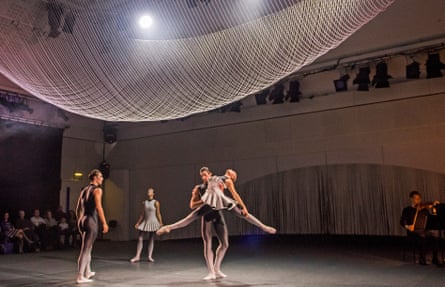
These days, at 29, she has to think more seriously about supporting herself. “There are so many social pressures,” she says. And then she starts two or three different sentences before saying, “You can see I’m whirring away about the conversations I have with myself about sticking to it. People do step away [from dance] to have stability, have a family; all these elements that naturally creep up as you get older.” For those who choose to leave, even when it’s a profession you’ve been training in your whole life, “it’s not a failure”, she says. “It is a choice of what’s right for you in life.”
For Edmonds, though, the drive and passion for choreography she had as a teenager is still strong. I watch her in a studio at London Contemporary Dance School where she’s rehearsing a group of students for her new film, Ladette, examining 90s gender roles. (Edmonds was only a baby in the 90s, but the theme is in sync with the current nostalgia for all things pre-smartphone.) A mass of 43 bodies move with a powerful pulse, shifting from sharp, blunt stamps and jutting shoulders to snakey and molten movement. Edmonds works out steps and shapes on her own body and shares them with the dancers, her classical and contemporary training now shot through with street and club dance influences. She’s in her element in the studio, and it’s still her ambition to make major works for large ballet companies. “I really want to make live work in the UK,” she says. “I’ve been planning and writing and curating ideas that are close to my heart and I’d love to see them take off.” Watch this space.
KioskNews shows a cleaned-up reading view extracted from the publisher’s page — the original always lives on their site, not ours.