Scientists created artificial, life-like muscles for humanoid robots
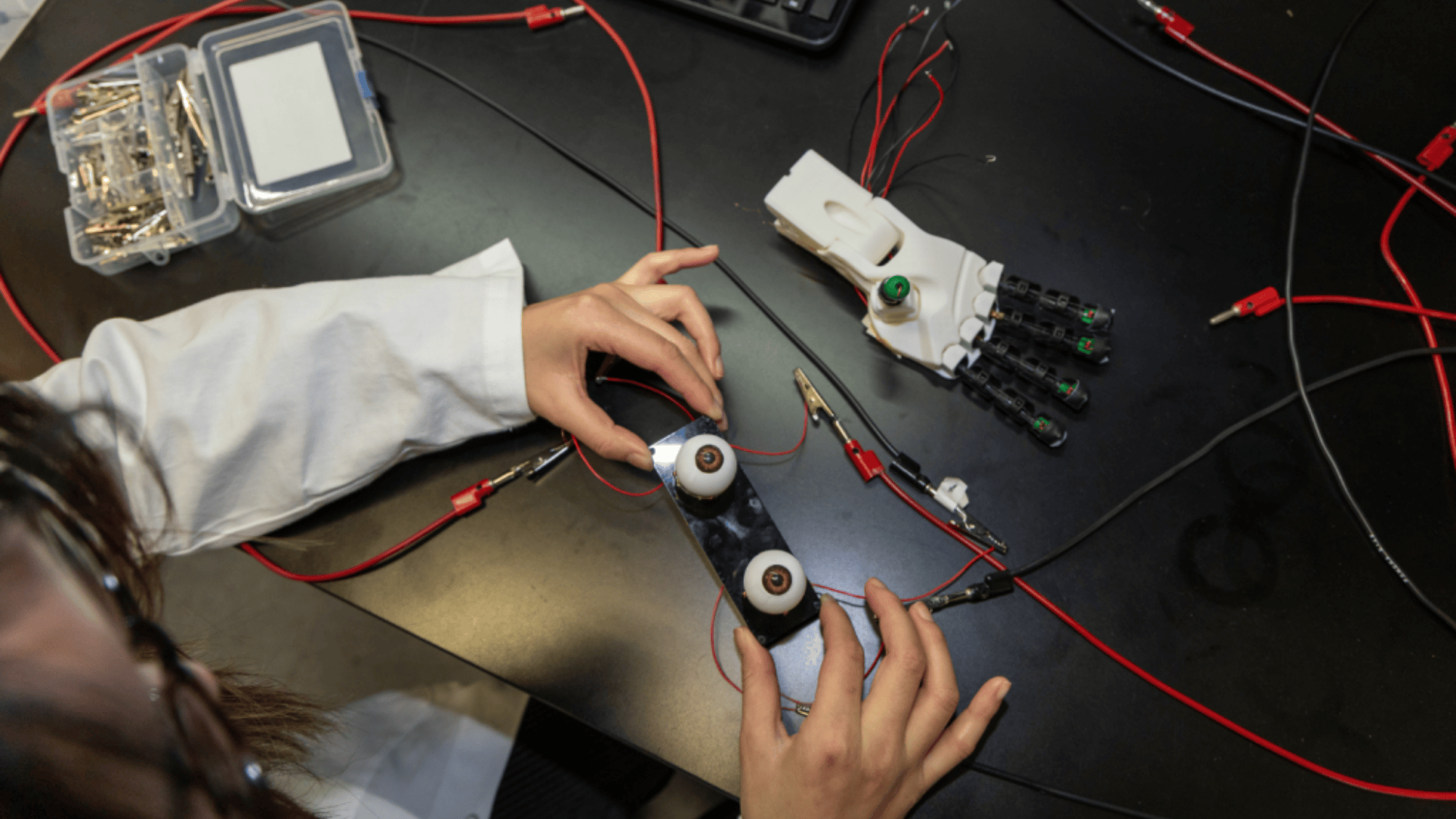
For better or worse, some scientists seem dead set on infusing humanoid robots with more lifelike qualities. They’ve already experimented with stretching lab-grown human skin over robot faces and with a synthetic hydrogel skin that lets robots really “feel” burns and cuts. Now, a team of engineers at the University of Pennsylvania wants to dig under the skin. In a study published this week in Advanced Functional Materials, the team describes a highly controllable artificial robot muscle inspired by the small muscles in human eyes and fingers. They put them to the test by having a robot hand strike piano keys at varying intensities and made a set of human eye muscles able to maintain a gaze. It all feels quite uncomfortably adjacent to the 1973 sci-fi film and HBO series Westworld.
Human hands and eyes are deceptively complex
Designing robot muscles that act like the real thing poses some engineering challenges right off the bat. For starters, most large robots today, especially humanoid ones, rely on bulky, rigid motors and components. That’s fine for more straightforward actions like walking and lifting, but recreating the muscles that move our eyes or fingers requires far more delicate precision. In this case, the engineers needed a material that prioritized flexibility and fine control while staying strong enough to hold up after repeated use. As with many aspects of robotics, tasks that seem quite easy for humans to do are actually often the most difficult tasks for machines. While bipedal robots have been pulling off dance routines and performing acrobatics worth of a Marvel superhero for years, they still fall flat when it comes to something as simple as folding laundry or holding a gaze.
“Soft robotic muscles need to be both strong and flexible to mimic human movements, but these properties are rarely found in the same material,” study co-author and University of Pennsylvania engineer Shu Yang said in a statement.
For their muscle fiber, the team settled on liquid crystal elastomers (LCE) combined with graphene and an embedded ultrathin copper coil. The LCE, a rubber-like material, acts as the actual muscle, both contracting and stretching. The graphene serves as a reinforcer, making the material both a bit softer and tougher, so it holds up even when opposing muscles pull in other directions. Together, these two ingredients can produce movement, but on their own they struggle to stay put. When heated, the LCE stretches but then keeps contracting, eventually creeping back toward its original length as it rapidly cools. That’s a problem for subtle movements like holding a gaze or pressing a piano key with light, steady force, where the muscle needs to hold a precise position over a period of time.
That’s where the coil comes in. The team added the coil inside the fiber to serve as a kind of temperature gauge, and the sensors determine when the muscle is losing heat and contracting. With those readings, the team could then gradually increase temperature to ensure the muscle held its position.
“We used the resistance of the embedded copper coil as a feedback signal and adjusted the heating power in real time to keep the resistance near a target value,” added study co-author and University of Pennsylvania Ph.D. student Xuelin Wu. “Because the coil served as both a heater and a sensor, we did not need a separate sensor for feedback.”
Bring artificial muscles into the real world
With their artificial muscle designed, it was time to test it in real-world scenarios. First, the team fitted the muscles into a 3D-printed robot hand built to mimic finger movement. They then made the fingers press various piano keys at different levels of force and speed. Sensors placed on the bottom of the keys were able to tell how hard each note was played. The detached hand was no Mozart, but it worked.
Next, they mounted a pair of robotic eyeballs on freely rotating ball joints inside 3D-printed shells. The muscle fibers were attached around the edges of opposing pairs, which were meant to mimic how muscles in the eyes stretch and contract. In testing, the eyes shifted their gaze on demand, with controlled, repeatable movements. The resulting video demonstration is both impressive and unsettling.
The research joins a growing field of labs and companies racing to build artificial muscle systems. In 2025, Polish startup Clone Robotics took the idea to an extreme with a horrifying video of a faceless, human-sized robot dangling from a ceiling and writhing, its movements supposedly powered by synthetic muscles and a hydraulic system meant to mimic human muscles and blood vessels. They call their creation the world’s first “musculoskeletal android.” Though it is likely that their video was more a shocking proof-of-concept than an actively working prototype, it nonetheless provides a glimpse into a potentially unsettling future where robots replace mechanical motors and actuators with more human-like muscle fibers.
The University of Pennsylvania researchers say the next step is combining more of these muscles into larger, integrated systems, where dozens of small muscles have to work together to produce more natural expressions. Down the line, they’re interested in potentially using AI computer vision to coordinate those into even more complex systems. Authenticity is the point. The long-term goal, they note, is to create robots that look and feel more and more like the real thing.
“I’m excited about the possibility of using this approach to create robots that move with the same subtlety and expressiveness we see in human faces,” concluded University of Pennsylvania engineer and paper co-author Ziyun Zhang.
KioskNews shows a cleaned-up reading view extracted from the publisher’s page — the original always lives on their site, not ours.