Group proposes AI system to predict, prevent roadkill
DATA SHARING: TaiRON’s prediction system would involve a network of electronic signs linked to a real-time warning system to alert drivers to animals near roads
The Taiwan Roadkill Observation Network (TaiRON) has proposed using artificial intelligence (AI) to simulate and predict road sections at high risk of wildlife-vehicle collisions, along with an early warning network to help prevent roadkill and other traffic accidents.
Over the past eight years, an average of 3,000 traffic incidents per year involving animals have been reported, TaiRON said, citing government statistics.
Motorcycles accounted for 95 percent of the cases, while the accidents caused a total of 25,345 injuries over the period, it said.
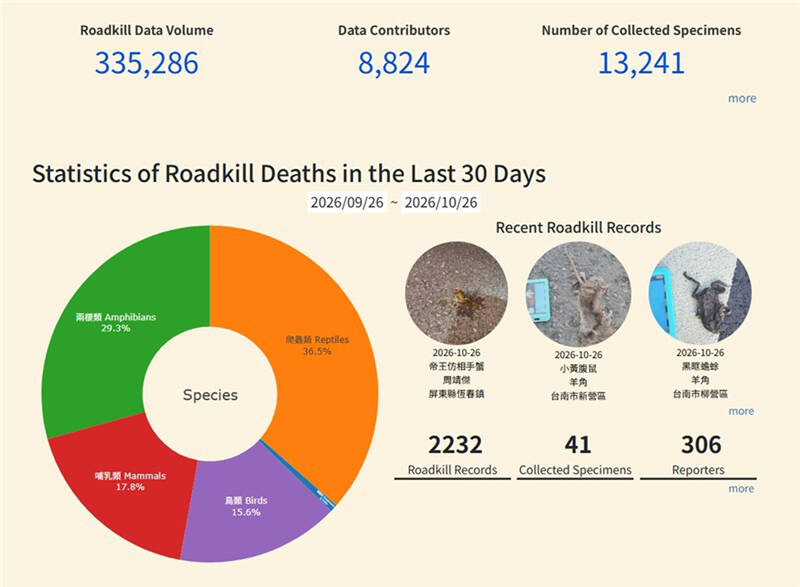
An infographic shows roadkill incidents in the past 30 days.
Photo: Screen grab from Taiwan Roadkill Observation Network’s Web site
Authorities estimated that the incidents have resulted in NT$800 million to NT$6.4 billion (US$24.61 million to US$196.9 million) in economic losses per year, it added.
The actual number of traffic accidents involving animals is likely much higher, as available data cover only major cases, TaiRON said.
It estimated that 500,000 to 1 million collisions involving medium-to-large mammals occur annually.
The AI proposal aims to identify high-risk road sections to create warning systems rather than waiting to put up signs after an animal has been killed, the group said.
To do so, TaiRON proposed integrating existing datasets, including its own records of animal deaths, wildlife activity data from the Taiwan Biodiversity Network, reports of injured or dead wild animals made through hotlines and Ministry of Transportation and Communications data on traffic accidents involving animals.
These data would be cross-referenced with road maps, speed limit and traffic volume information, gridded microclimate data from the Central Weather Administration and Google Street View images to identify conditions associated with frequent roadkill.
AI would then be used to simulate and predict high-risk areas, according to the proposal.
TaiRON also proposed installing a network of electronic signs linked to a real-time warning system equipped with heat and light sensors to alert drivers to animals crossing or approaching roads.
The prediction system would initially focus on pangolins as a pilot species, with plans to expand it to other wildlife such as leopard cats, endangered land crabs and frogs.
The group has also developed a low-cost, solar-powered warning device that works in low light and uses infrared sensors to detect passing warm-blooded animals and light sensors to detect vehicles.
The device would be tested on roads managed by the New Taipei City Government before potentially being deployed nationwide, TaiRON said.
The proposal was submitted to the Presidential Hackathon and is among 20 proposals advancing to the final round next month.
Winners would receive government support to implement their proposals, the Ministry of Digital Affairs said.
TaiRON is a citizen science initiative launched by the Ministry of Agriculture’s Taiwan Biodiversity Research Institute in 2011 to document wildlife deaths associated with roads, with the aim of reducing threats to wildlife, improving road safety and preventing collisions.
More than 36,000 people have contributed over 330,000 records of animal deaths involving more than 600 terrestrial vertebrate species to the network, its official Web site says.
KioskNews shows a cleaned-up reading view extracted from the publisher’s page — the original always lives on their site, not ours.