Michael Murphy: The students glorifying terrorists as they riot across France
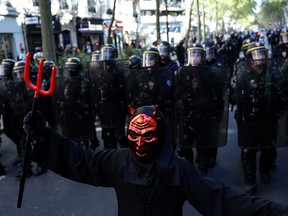
France has entered its third week of unrest, ostensibly over a lack of funding for schools. In a quest for better classroom conditions, students blockading their school in the north-central region Beaugency last week chanted along to M*R*H,* a song by the rapper Boro700. The title bears the initials of Mohamed Merah, the French-born terrorist of Algerian descent who in 2012 murdered three soldiers, then a teacher and three children at a Jewish school in Toulouse. One of them was an eight-year-old girl he chased down and shot at point-blank range.
Sign In or Create an Account
Released this summer, the song captures the nihilism animating a significant part of what has charitably been called a movement. Students in Nice have played it too, and prosecutors are investigating both cases for glorification of terrorism.

Columnist Jesse Kline keeps you up to date with what’s happening in Israel and the effects of antisemitism on life here in Canada. Friday mornings.
By signing up you consent to receive the above newsletter from Postmedia Network Inc.
A welcome email is on its way. If you don't see it, please check your junk folder.
The next issue of Channel Israel will soon be in your inbox.
We encountered an issue signing you up. Please try again
The protests began on Sept. 17 when students at Saint-Exupéry, a school in a disadvantaged Parisian suburb, blockaded their school in support of teachers striking over under-staffing and overcrowded classrooms — real problems that France seems unable to solve, despite spending well above the OECD average on secondary education. Much of that money is spent on overheads and salaries, which lag below OECD average, and little is left for structural reform. One can understand the frustration of teachers and students, some of whom find themselves without a teacher for months ahead of exams that will shape their life prospects.
But the protests, 250,000 strong on Tuesday by official counts, have been punctuated by spasms of violence, spreading across France in a pattern of rudderless, memetic escalation.
In Marseille, a masked man used a lighter and an aerosol to set fire to a woman’s face. Dozens of teachers have been assaulted, and schools have been closed across the country — including the Nelson Mandela high school in the western city of Nantes, after arsonists set fire to its entrance hall. According to the government, the protests have been the most violent in decades, leaving at least 700 police officers, 85 school staff and 215 teenagers injured. One teenager’s hand was blown off by a police stun grenade.
Whatever France’s education shortcomings were at the outset, the riots have hardly improved matters. Yet the left, led by socialist and presidential candidate Jean-Luc Mélenchon, has seized on the protests to galvanize its base ahead of elections in April. “Our country is witnessing the most powerful movement of high school and college students it has seen since May 1968,” Mélenchon said, referring to the riots that forged a new settlement in France, including a raft of labour rights. Mélenchon’s embrace of a movement born in the Paris banlieues (suburbs) of Seine-Saint-Denis and Val-de-Marne may prove a gift to Marine Le Pen’s populist National Rally, especially due to viral social media footage showing a preponderance of migrant-descended rioters. It appears to be a risk Mélenchon is willing to take. The protests have mobilized his base ahead of the first round of April’s presidential election, where turnout is key.
Much of the mainstream coverage, meanwhile, has taken the protests more or less at face value: young people rightly angered by a dysfunctional — and increasingly heavy-handed — state. This is only part of the picture. It cannot explain the chants for a jihadi who murdered Jewish children; nor the lyrics in the same song revelling in the murder of 90 innocent people in the Bataclan massacre. It is true that many of the schools affected by shortages are in the banlieues, where ethnic minorities have long been concentrated on the edges of French cities, sprawling concrete suburbs, afflicted with crime and ennui, that have been a thorn in the side of the Fifth Republic for decades. But that fact does not illuminate the glee with which some students have embraced violence against their teachers, many of whom share their grievances. Figures from what one might call the Global Right have observed that many of these scenes, circulating on social media, have shown a disproportionate number of perpetrators hailing from migrant-descended backgrounds. Donald Trump posted on Truth Social: “This isn’t about schools, this is about Islam wanting to take over a once great Country!” Like sympathetic mainstream accounts, the U.S. president is only partly correct.
After the 2005 banlieue riots, experts explained away the violence with the usual alibis of poverty and discrimination. The philosopher Alain Finkielkraut rejected this interpretation. Instead, he observed a nihilistic spasm from the “wretched of the earth,” a reference to the title of a book by the French-Martinician writer Frantz Fanon. There was ultimately no programme or ideology, apart from white-hot hostility towards the dominant culture and all it represents. While the protesters have legitimate grievances, the unrest has been gripped by something deeper that has proved markedly stubborn to reason.
Michael Murphy is a journalist based in London. He writes for the Daily Telegraph and presented the documentary, ‘Ireland is full! Anti-Immigration backlash in Ireland.’
Join the Conversation
This website uses cookies to personalize your content (including ads), and allows us to analyze our traffic. Read more about cookies here. By continuing to use our site, you agree to our Terms of Use and Privacy Policy.
KioskNews shows a cleaned-up reading view extracted from the publisher’s page — the original always lives on their site, not ours.