MOE sets teacher protection guides
CLEAR CRITERIA? Although the guidelines were welcomed by the National Teachers’ Association, it said in a statement they lacked concrete accountability mechanisms
By Rachel Lin and Jake Chung / Staff reporter, with staff writer


The Ministry of Education (MOE) has issued guidelines to help schools prevent and handle workplace violence and harassment against teachers, including psychological abuse, online attacks and malicious complaints.
Department of Information and Technology Education official Lien Shan-li (連杉利) on Friday said that the term covers more than physical assaults, and also includes verbal abuse, psychological violence, persistent harassment and being assigned duties outside one’s job responsibilities.
The Guidelines on Preventing Workplace Violence and Harassment in Schools and Early Childhood Education and Care Facilities (各級學校及教保服務機構職場不法侵害預防指引) cover teachers at all school levels, early childhood education and care personnel, and other school staff, Lien said.
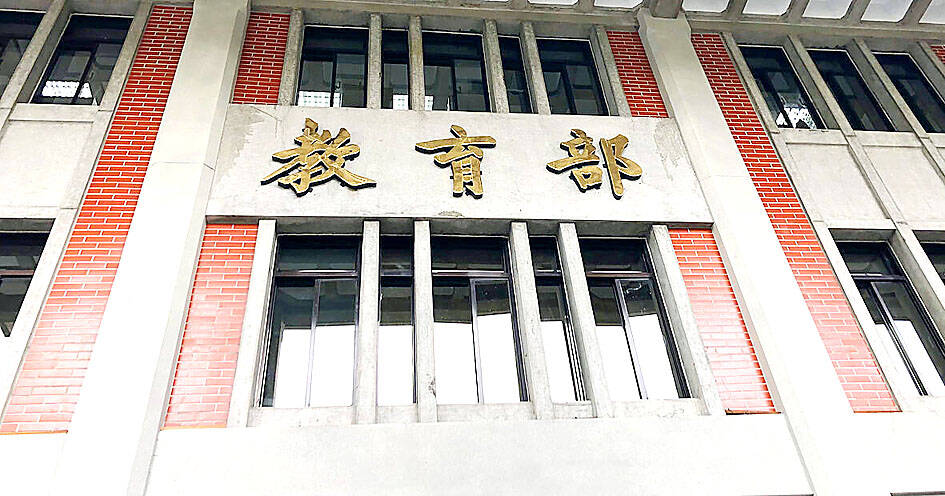
The Ministry of Education building in Taipei is pictured in an undated photograph.
Photo: Rachel Lin, Taipei Times
The guidelines identify guardhouses, student affairs and counseling offices, meeting rooms and school entrances as places where incidents involving outsiders are more likely to occur.
High-risk periods include students’ arrival and departure times, meetings between parents and school staff, discussions over serious student misconduct or disputes, and after-school study periods.
Schools are advised to install surveillance cameras and emergency contact equipment at these locations, while avoiding excessive monitoring. Surveillance footage should not be arbitrarily made public or shared, the guidelines state.
Schools must reject anonymous complaints, those lacking specific details and cases that have already received a final decision, it added.
Complaints involving only ordinary disciplinary matters should be handled under teacher performance assessment rules, rather than triggering investigations that could lead to dismissal or non-renewal of contracts, it said.
The guidelines also advise schools not to assign work or contact teachers about parent-teacher matters outside working hours, except in cases involving campus safety, major emergencies or urgent official duties.
A task force to investigate the issues should be formed within three days of receiving a complaint and complete investigations within one month, it said.
If a principal or preschool director is implicated, an impartial third party should conduct the investigation, it said, adding that whistle-blowers or complainants must be protected against retaliation.
The guidelines also protect teachers’ right to legally discipline students, stipulating that necessary disciplinary measures in line with legal requirements should not result in punishment or adverse performance assessments.
Schools and early childhood education and care institutions with at least 100 employees must also draw up prevention plans and retain records for three years, the guidelines state.
The ministry said that the guidelines constitute administrative guidance. Cases involving workplace bullying or sexual harassment should continue to be handled primarily under relevant laws.
The National Teachers’ Association (NTA) in a statement welcomed the guidelines, but said that they lacked concrete accountability mechanisms, calling for clearer employer responsibilities.
NTA chairman Yeh Ching-chi (葉青?) said vague provisions could allow school administrators to avoid taking action.
Schools should help teachers establish the facts and provide legal and administrative support when they face pressure or retaliatory complaints from parents over lawful student discipline, rather than demanding apologies or imposing unreasonable measures, Yeh said.
The association urged the ministry to set clear criteria for identifying repeated or malicious complaints and harassment, and to include teacher representatives in workplace risk assessments and reviews of prevention measures.
KioskNews shows a cleaned-up reading view extracted from the publisher’s page — the original always lives on their site, not ours.