Corruption, massacres or town gossip? The bid to unearth secrets a rural Queensland police officer took to his grave
Was it by the light of a full moon that Constable Edward Robb dug a hole in the yard of the Mount Larcom police station to bury a trove of documents he had been ordered to destroy?
To what did those papers speak? To police corruption that was rampant in the era of Joh Bjelke-Petersen – premier at the time Robb buried them, four decades ago? To the German settlers forced into internment camps during the world wars? Did they carry echoes of the massacres that took place here during the frontier wars? Or were they simply the quotidian accounts of a central Queensland railway town?
What exactly is the secret that the rural police officer took to his grave?
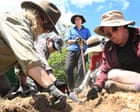
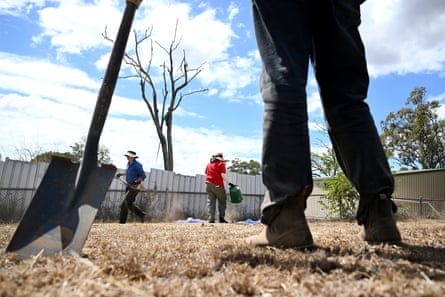
This is the question that may be answered by an unlikely team led by a museum curator and an archaeologist. On a hot afternoon in September, they scratch out trenches in the dusty slate behind the timber building off the Bruce Highway between the cattle city of Rockhampton and the industrial and coal port of Gladstone.
But just as blustery winds scatter away the dark clouds above without a drop of rain, the dig is in danger of failing to deliver on its promise on its very first day. The Queensland police museum’s collections manager, Katherine Figueiredo, was told Robb placed corrugated iron atop his cache of buried files.
But the pings of the local detectorists she engaged proved to be false positives.
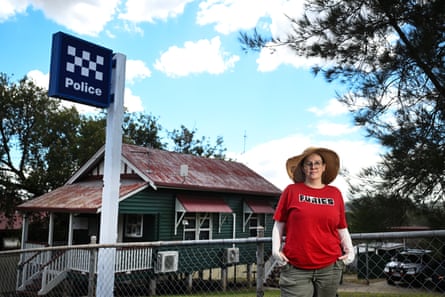
Now, without this promised X marking the spot, Dr Caitlin D’Gluyas, an archaeologist, says the five-strong team can only dig shallow trenches and “hope to get lucky”.
The University of Queensland lecturer wouldn’t normally take on such a job, she says. But given the potential public interest, she is willing to make an exception. “There’s a saying in archaeology that ‘it’s not what you find, but what you find out’,” she says. “But this is way more like digging for buried treasure.”
Like all good treasure hunts, this began with an old story, told in secret.
Moral quandary
Last December, a retired officer walked into the police museum in Brisbane to share a few nuggets of information from his days of service.
This, in and of itself, was not unusual, Figueiredo says. Old coppers and crooks alike, victims of crime and injustice too, enter the Roma Street building with tales to tell. But the assistant curator had never heard anything like what she was told had occurred, four decades ago, in a town of a few hundred people more than 560km up the Bruce.
The ex-cop said his old colleague, the late Constable Robb, had defied orders to incinerate papers and instead buried them somewhere in the station’s back yard.
“Allegedly [Robb was] given the directive to destroy documents there at the station that were older than 10 years,” she says. “[He] had a lot of moral quandary around that.”
What stoked his conscience?
Robb was the sole officer stationed at Mount Larcom for years during the 1980s. By the end of that decade, the watershed Fitzgerald inquiry into police corruption brought down Bjelke-Petersen, ended more than 30 years of National party governance of Queensland and led to the jailing of three former ministers as well as the state’s disgraced police commissioner.
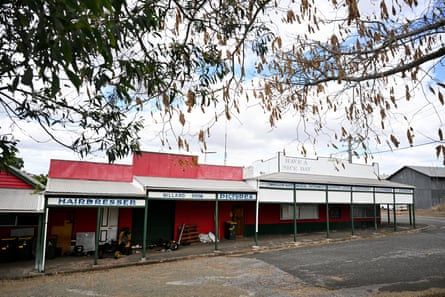
Did the constable feel duty-bound to preserve documents that contained evidence of police misconduct? And if not, what other sweeping historic events might this small town’s history shed light upon?
From 1910 a wave of German colonists helped establish the nascent railway town. But when the first world war broke out, it unleashed a tide of anti-German sentiment around Australia, with many sent to internment camps. Acts of parliament compelled them to register as “enemy aliens” with local police. Were these documents in Robb’s buried cache?
Or could they have carried any whispers from the silences of even earlier and darker times? In 1855, settler violence against Indigenous people led to an attack on the settlers at the Mount Larcom sheep station, in which at least five people were slaughtered. This sparked a wave of brutal killings, including by a posse of settlers and mounted police who tracked and killed at least 11 Indigenous people in retribution.
The massacres of the frontier wars here predate the founding of the Mount Larcom police station in 1916. But could its historic accounts have shed light on its survivors – and perpetrators?
“We came to the decision that, if there is something out there … it’s our responsibility to obtain and preserve,” Figueiredo says.
So Figueiredo and her colleagues tracked down Robb’s widow and son, who confirmed the story, and gleaned what fragments of detail they could recall from about 40 years ago that might recover those lost papers.
Archaeology 101
D’Gluyas reads the dirt like an angler reads a river. To a trained eye, ripples on the surface of water can reveal the type and size – even frame of mind – of the fish that would otherwise swim unseen in the murk and shadow.
Archaeologists use terms like “bioturbation”, but apply the same principle to their search for artefacts.
D’Gluyas, Figueiredo and their three volunteers scrap away the thin layer of top soil in trenches. Once revealed by mattock and trowel, the archaeologist can tell almost instantly if the subsoil has been dug through before, even decades or centuries earlier.
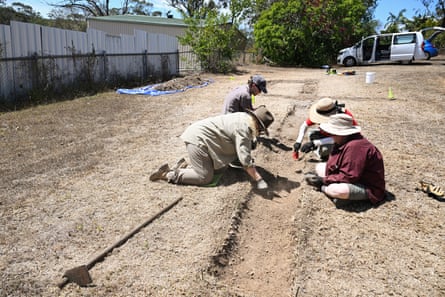
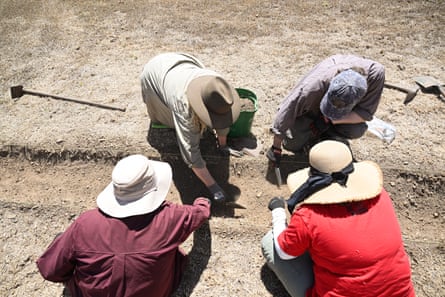
“We’re looking for disturbed ground,” D’Gluyas says.
“If we find the edge of a disturbance, we follow it ‘round to see its shape. This is archaeology 101.”
But though the trenches are only an inch or so deep, the ground soon feels like concrete. The sprawling police yard seems to acquire dimensions far greater than its several hundred square metres.
after newsletter promotion
Objects emerge from the dirt. Shards of porcelain. An old belt buckle. A shell brooch. A packet of atomic tomato Samboy chips. A crushed beer can. On a more traditional archaeological dig, this might be the stuff of research.
“One of the misconceptions of archaeology is that you’re looking to find something particular,” D’Gluyas says. “The question I always get asked is: ‘What’s the coolest thing you’ve ever found?’
“But it is the chasing of knowledge and understanding that is more interesting than particular finds.”
This is no regular dig though. Time is short. The workers are volunteers; the brief highly specific.
“I’ve never wanted to find a thing so bad,” D’Gluyas admits.
As the day draws to a close, the diggers keep gambling on one last swing of the mattock, like anglers convinced they will finally land a catch with one last cast despite knowing, deep down, that the fish aren’t biting.
‘Good on him’
On the morning of the second and final day of the dig, Alice Major sits in the sun on the patio of her single-storey timber home on the other side of town. There is a giant fig tree out the back of her acre block, a Hills hoist, a garden of bromeliads and a scattering of concrete ornaments.
Major is 87, legally blind and has lived here for 60 years – back when Mount Larcom was “still called a village”. She does a double-take when she hears about the archaeological dig, but quickly sides with Constable Robb.
“Good on him,” she says. “There’s too much of this destroying stuff without thinking twice or thrice about it.”
Major believes the old owner of a neighbouring home on Bismark Street was a German Australian sent to an internment camp during the war. That ought to be in police records, she says.
But the unsolved mysteries to which Major’s mind turns are of a more parochial kind.
There was a dry well, the stumps of an old house and remains of a chicken coup when the Majors moved on to their Mount Larcom block, and they have always sought to know who used to live there before them. But local council records were destroyed when it amalgamated.
As for hidden criminality, you can’t keep those secrets in a little town, says Major, leaning forward. And she doesn’t know of any really bad stories.
“Or if I do, I’ve forgotten them,” she says with a mischievous smile.
Playing Lotto
An excavation is like “a giant 3D puzzle”, D’Gluyas says.
The archaeologist is responding to scraps of memories she’s been told, pouring over old satellite images, trying to extract clues from beneath the dirt to make ever evolving decisions about where to swing the next mattock.
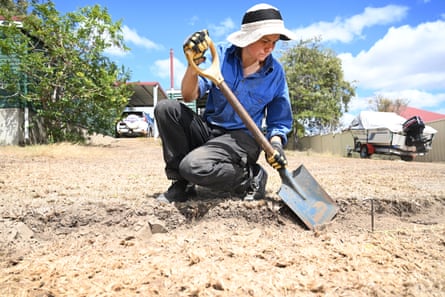
This is the thrill of the chase, she says, of the gamble. But halfway through day two, the team decides that the odds are too heavily stacked against them.
The story of the tin roof that was supposed to make this such a simple extraction seems to be just a story. Was that a invention of memory? Had it been a sheet of non-metallic roofing? Had someone else already dug it up?
Without the roof, and with the tools at hand, the dig was feeling “too much like playing Lotto,” D’Gluyas says.
If the cache of papers is still there, she says, they needed ground-penetrating radar to find it, or machine excavation to remove swathes of topsoil.
They would need another season.
“There’s a very good chance it’s still here,” the archaeologist says, as she walks around the dusty police yard, one last time.
KioskNews shows a cleaned-up reading view extracted from the publisher’s page — the original always lives on their site, not ours.