Founder of Russia’s largest cargo airline escalates fight with Ottawa over sanctions as jet racks up fees at Pearson
The Russian founder of Russia’s largest private cargo airline group stepped up his battle with Ottawa over Canada’s sanctions against him in retaliation for Russia’s invasion of Ukraine.
Sign In or Create an Account
Aleksey Isaykin lost his court challenge seeking his removal from Canada’s sanctions list targeting Russia in August but on Tuesday he filed a notice of appeal in the Federal Court of Appeal in Ottawa.
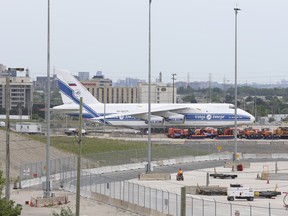
Appealing sanctions alongside Isaykin is the airline he founded, which owns a massive cargo jet — the world’s largest — that remains stranded at Toronto’s Pearson airport since landing shortly before Canada closed its skies to Russian aircraft in 2022 after Russia’s attack on Ukraine.

Get a dash of perspective along with the trending news of the day in a very readable format.
By signing up you consent to receive the above newsletter from Postmedia Network Inc.
A welcome email is on its way. If you don't see it, please check your junk folder.
The next issue of NP Posted will soon be in your inbox.
We encountered an issue signing you up. Please try again
Isaykin and Volga-Dnepr Airlines were both put on Canada’s sanctions list in 2023 under regulations allowing Ottawa to list a person or corporation on reasonable grounds to believe they have directly or indirectly helped or supported Russia’s “violation or attempted violation of the sovereignty or territorial integrity of Ukraine.”
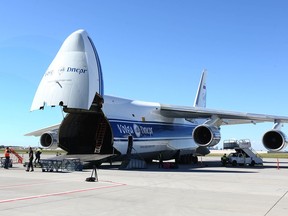
The hulking frame of the four-engined Antonov An-124, a Russian strategic airlift cargo jet with a NATO codename of Condor and the white-blue-and-red flag of Russia on its tail fin, parked at the Toronto airport is the most public sign of the continuing rift.
The plane remains on an out-of-the-way apron at the edge of the airport, accumulating sky-high parking fees. Based on the plane’s long wingspan, the 1,678 days it has been there, and the average of fluctuating per-minute fees for inactive apron space between 2022 and 2026, the parking fees could exceed $4 million.
Ottawa announced plans to seize the plane for “complicity in President Putin’s war of choice” and give it to Ukraine to help compensate for war damage back in 2023, but the process has been bogged down in court.
Isaykin, 74, is a citizen of Russia and Cyprus. He was elected chairman of the board of Volga-Dnepr Airlines LLC in 1990 and served as the airline’s president from 2002 to 2019, according to court records. His name is sometimes spelled Alexey Isaikin.
Although the company flies Antonov An-124 planes, which were designed as a heavy military aircraft, Volga-Dnepr told the court it has refused to carry military cargo since 2018. The airline is part of a larger Russian conglomerate, called the Volga-Dnepr Group (VDG), which is also on the sanctions list.
When sanctioning the airline, Ottawa alleged it had agreed with the Russian government in April 2022 to import goods from countries that had not imposed sanctions on Russia. Ottawa said the airline’s contracts in Moscow restored supply chains that had been interrupted by sanctions and the airline received subsidies from the Russian government to counteract the impact of sanctions on the Russian economy.
Being placed on the sanctions list prevents the businessman and the company from conducting business in Canada or with Canadians.
The airline’s objection to their listing said they are a “peaceful carrier” and that Isaykin had divested his role as majority shareholder and resigned his position as chairman. It said it is not owned by the Russian government, nor involved in Russian politics or war efforts, and not close to the government.
Isaykin was added to the sanctions list at the same time as the airline, on April 5, 2023.
A few months later, he asked to be taken off the list on the grounds that he no longer had any ownership or involvement with the airline. Isaykin said that he is not close to the Russian government and did not provide military services to Russia.
“I confirm that neither I nor any of the companies that form part of the Volga-Dnepr Group provide any aviation service to the Wagner Group or otherwise in relation to the military operations in Ukraine,” Isaykin said in a sworn statement in the court record.
The Wagner Group was a notorious mercenary organization with close ties to Russian President Vladimir Putin and heavily involved in the fighting in Ukraine. It was widely seen internationally as doing much of Russia’s dirty work.

Last October, the Minister of Foreign Affairs at the time, Mélanie Joly, declined to lift sanctions from him or the airline.
Joly wrote that Isaykin was the “majority shareholder of the Volga-Dnepr Group and its subsidiaries, and actively involved in the management of the Volga-Dnepr Group when its subsidiaries benefited from subsidies from the Russian government and were awarded contracts to assist with activities intended to ease or otherwise circumvent the effects of sanctions imposed against Russia by Canada and its partners.”
She said the airline helped mitigate the impacts of sanctions on Russia’s supply chain.
As such, he “engaged in activities that directly or indirectly facilitate, support, provide funding for or contribute to a violation or attempted violation of the sovereignty or territorial integrity of Ukraine,” Joly wrote.
Joly said his transfer of ownership months after he was listed was a sanctions evasion tactic.
Isaykin asked the Federal Court to intervene in Joly’s decision in November 2024, claiming the decision was unreasonable and procedurally unfair.
He complained that all documentation on him and the airline was not given to Joly when she was making her decision. He said evidence of the airline’s role in humanitarian aid, such as delivering masks, COVID testing kits and vaccines during the pandemic — including vaccines for the United Nations International Children’s Emergency Fund — was not provided to her by government officials. The plane was delivering COVID test kits to Canada during the pandemic when it landed in Toronto and became stranded.
He said that information could have changed the decision. The government argued that while the specific documents weren’t given to Joly, the information in them was summarized for her.
Similar arguments were made by the airline in its motion for a judicial review and the two cases were heard together at a five-hour hearing in April.
Justice Ann Marie McDonald ruled in August on both cases that the procedural fairness protection required in such government decisions was minimal and that Parliament granted the minister wide latitude when passing the sanction regulations.
As for the documentation complaints, McDonald said missing information would have to have been completely omitted from the record to have an impact, but in these cases information from the documents was summarized in the government’s memorandum to Joly and in Isaykin’s delisting application.
“Mr. Isaykin has not identified any errors or misinformation in the summaries that were before the Minister,” her judgment said.
McDonald dismissed both requests for judicial appeals.
Her decisions are now being appealed.
Vincent DeRose, a managing partner of the Ottawa law firm Tereposky & DeRose LLP, declined to comment on the August judgments or the decision to file appeals, saying he had no instructions on it from his clients.
Our website is the place for the latest breaking news, exclusive scoops, longreads and provocative commentary. Please bookmark nationalpost.com and sign up for our newsletters here.
Join the Conversation
This website uses cookies to personalize your content (including ads), and allows us to analyze our traffic. Read more about cookies here. By continuing to use our site, you agree to our Terms of Use and Privacy Policy.
KioskNews shows a cleaned-up reading view extracted from the publisher’s page — the original always lives on their site, not ours.