Jensen Huang Under Fire: What Nvidia Crisis Means For US-China AI Cold War
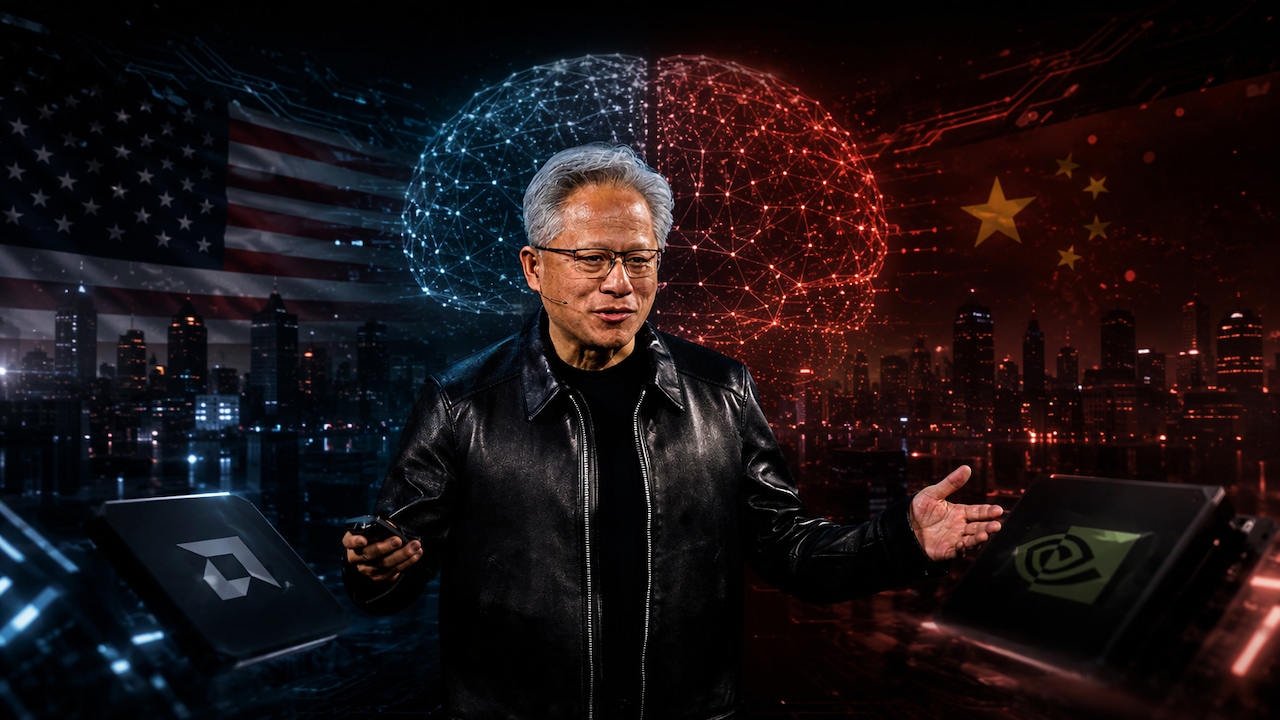
The controversy surrounding Nvidia CEO Jensen Huang is no longer just about the personal life of one of the world's most powerful technology executives. It has opened a new front in the battle between the United States and China for control of artificial intelligence.
At stake is not merely the reputation of a billionaire CEO. It is the future of a company that has become central to America's AI ambitions, the security of advanced chip technology and Washington's efforts to restrict China's access to computing power.
Nvidia's board announced an independent investigation on November 8 after reports that Huang had been targeted by a foreign intelligence effort. The company said it had no reason to believe that national security or its secrets had been compromised. It also expressed confidence in Huang and his leadership team.
Also Read | Layoffs Are Rising In Tech, But These Skills Are Helping People Unlock Better Pay
Huang, meanwhile, acknowledged infidelity in a message to employees and apologised to his family and colleagues. He has not been accused of criminal wrongdoing, and the intelligence allegations remain unverified independently.
But the episode has raised questions that go well beyond the investigation.
Nvidia's Jensen Huang Is More Than Just a CEO
For Nvidia, the immediate danger may be reputational and political rather than technological. "Jensen Huang is not an ordinary CEO. He is synonymous with Nvidia and, in many ways, with America's AI leadership," said Jaspreet Bindra, founder of AI&Beyond, India, and Tech Whisperer Limited, UK.
Bindra believes the controversy could create serious pressure on Nvidia, particularly because of the political sensitivity surrounding China and export controls. However, he does not see the episode automatically derailing Nvidia's technological future. "Unless the investigation uncovers something materially damaging, I do not see this derailing Nvidia's AI future," he told NDTV.
Nvidia's dominance rests on years of chip development, software infrastructure and relationships with customers building AI systems. Those advantages cannot simply disappear because its CEO faces scrutiny. Yet the company's dependence on Huang makes the situation unusually complicated.
Huang has led Nvidia for more than three decades. He is its chief strategist, public face and one of the most influential advocates for AI infrastructure. His presence has also helped Nvidia build relationships with governments, technology companies and investors.

Jensen Huang (middle) allegedly had extramarital affairs with Nvidia executive Kimberly Powell and Megaspeed executive Alice Huang.
Why Nvidia's Chips Have Become a US-China Strategic Weapon
The controversy comes at a time when Washington is increasingly treating advanced AI chips as strategic assets rather than ordinary commercial products. Nvidia's powerful graphics processing units, or GPUs, are critical to training and running advanced AI models. Access to them can determine how quickly companies develop sophisticated AI systems.
This has made chip exports a central issue in the US-China technology rivalry. "Controlling access to the most powerful GPUs can influence who can train frontier models, build military or cyber capabilities, and create the next generation of AI companies," Bindra said.
He added that restrictions on Nvidia chips are not simply trade policy. They are part of America's effort to preserve its technological and national-security advantage over China. The current controversy could therefore intensify scrutiny of Nvidia's China business, its relationships with intermediaries and the effectiveness of US export controls.
Recent reports have also raised questions about whether networks linked to a suspected Chinese intelligence asset helped facilitate shipments of restricted Nvidia chips into China. These claims have not been independently established in full.
America Leads AI. But China Is Closing the Gap
The Nvidia controversy could become more significant if it coincides with a shift in the broader AI balance between the two countries.
The US still leads in several crucial areas, including frontier AI models, advanced chips, computing infrastructure and global adoption. But China is catching up rapidly. "America leads at the frontier, while China is increasingly formidable across the broader AI stack," Bindra said.
China's strengths include open AI models, cost efficiency, research, manufacturing and real-world deployment. It is also building substantial energy capacity to support AI infrastructure, including clean energy.
Bindra believes the competitive gap is narrowing much faster than many people assume. "In some areas, the gap is now measured in months, not years," he said.
That could make the chip battle even more consequential. If China can develop competitive AI systems using less expensive computing infrastructure, or deploy them at scale, American restrictions may become less effective over time.
Nvidia's Biggest Risk May Be Its Dependence on Jensen Huang
There is another question Nvidia cannot afford to ignore: what happens if Huang eventually steps aside?
Nvidia has not announced his departure. But the episode has brought succession planning into sharper focus. Ritwik Batabyal, CTO and Innovation Officer at Mastek, told NDTV that Nvidia's leadership challenge is more complicated than finding another CEO.
"The interesting question is not simply who succeeds Jensen Huang, but whether Nvidia has to redesign itself to be succeeded," Batabyal said. According to him, Nvidia's organisational structure has been built around Huang's unusually central role in decision-making.
The CEO reportedly has more than 60 direct reports, many of them technical leaders. That structure allows Nvidia to bring technology, strategy and ecosystem decisions together at the top.
But it also creates a potential weakness. "Replacing the individual may therefore require changing the operating model itself," Batabyal said.
Could Jensen Huang's Exit Become a Shock for the Entire AI Industry?
The implications of a possible leadership change would extend well beyond Nvidia. The company sits at the centre of an AI ecosystem that includes hyperscalers, AI laboratories, enterprise technology companies and governments building sovereign AI infrastructure.
A disruption at Nvidia could affect technology roadmaps, investment decisions and the supply of computing power across this network. Batabyal believes this makes Huang a different kind of corporate leadership risk.
"Jensen Huang is not merely a key-person risk for Nvidia; increasingly, he represents a form of systemic key-person risk for the AI economy," he said.
When one leader influences technology roadmaps, capital allocation, government relationships and the supply of a strategic computing platform, succession becomes an ecosystem-resilience question rather than merely a corporate-governance issue. This is particularly relevant as countries invest billions of dollars in AI infrastructure and companies make long-term commitments based on Nvidia's technology.
KioskNews shows a cleaned-up reading view extracted from the publisher’s page — the original always lives on their site, not ours.