‘I suffer a lot’: Villarreal owner Fernando Roig on not enjoying games and the prospect of Liverpool
The first time Fernando Roig watched Villarreal play as their president, he sat in the stand at a tiny whitewashed ground that had concrete fever and was half empty. It was a Sunday night in the second division, they lost 3-0 to Badajoz, and he didn’t enjoy it much.
But then, he doesn’t ever enjoy it much. Even on Tuesday at Anfield, he will not: into his 30th year, the longest presidency in Europe, that is about the only thing that hasn’t changed. More than 1,000 games and still it happens. “I don’t get nervous. It’s worse: I get worried, very anxious,” he says. “I suffer a lot.
“It’s emotional to play Liverpool. This will be the fifth time we have faced them, the third at Anfield. The other two were European semi-finals. I’ll watch the morning training session, travel with the team. We’ll go and eat; everywhere we go we get treated very well and we treat them well back. The next day I’ll watch the under-19s in the morning, that I do like. And then the game, which I don’t. Then we’ll fly back here very, very late. It’s very stressful.”
It is the morning after Villarreal have beaten Napoli in the Champions Leagueand Roig is in an office at the headquarters of Pamesa, the ceramics company he owns, on the edge of town. He is better now, the tension subsided. They needed that victory, their first in the competition going back to before they last faced Liverpool, in the 2022 semi-final, and, besides, he is always better the next day.
A cabinet holds pictures, mementoes, footballs, a basketball too. Three paintings by his wife, Elena Negueroles, fill the far wall. He has been talking a short while when two people join him, at the long table, in front of the cabinet. He introduces them as Villarreal’s consejero delegado, CEO, and Pamesa’s director of communications; they are also his son, Fernando, and daughter, Elena, named after their parents.
“I can enjoy it today, the day after, tomorrow and the day after that,” the 79-year-old says. “Until Elche comes on Saturday and it’s time to suffer again. And then the Liverpool day. It’s very stressful for me.”
So why do it? “Because when the game ends, there’s that satisfaction, that feeling the town, the province, have enjoyed it, that they admire their team. It’s about community. It costs people money to come and watch a game. What they want is to enjoy it and what we want is to give them that.”
They have done that, come a long way. “I remember that Badajoz match, thinking ‘so this is how it starts’,” he says. “We didn’t have a training ground. We trained on any patch of grass we could find. The stadium held fewer than 4,000 people. The first thing was to try to build a squad that could go up, find a pitch to play on, a decent dressing room, create an academy.”
It was May 1997 and Roig describes the offer to buy the club as an opportunity, but it was more like a plea. For survival and stability, not success: asking for Anfield would have been absurd.
Villarreal had spent most of their history in tercera, reaching the regionalised Segunda B nine years earlier, and had never played in primera. In the second division for the first time, they had barely 1,500 members, were struggling to stay afloat and the former player and current president was seriously ill. His family were looking for someone to take on the club and assume a debt near €80m.
The man they entrusted to find a buyer was José Manuel Llaneza. One day, Llaneza came to these offices. Roig had money and experience with sports: Valencia Pamesa basketball club. His brother Paco owned Valencia’s football team.
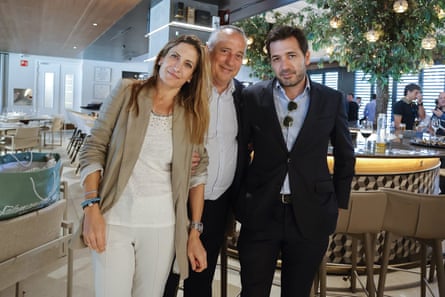
So why take on another club? And why in Villarreal, an hour up the coast? “All my factories are here: here, in Almassora, Onda, L’Alcora; 98% of all the ceramics made in Spain are made here in a 50km radius around the town. We knew a lot of people in Villarreal, in the province of Castellón. This was our place, where we could give something back.
“And the owner wanted to sell; it was an opportunity. They came to us. I had been at Pamesa Valencia since 1986. We had been in the second tier and taken them to the ACB [the top professional basketball division in Spain], so I had some experience. I still watch them. Yesterday, after the [Napoli] game, I watched them against Olympiacos on the tablet.
“I was president of both for a while, but you couldn’t combine them. I remember winning the Copa del Rey in basketball at the same time as we were playing at Numancia.”
Another of Roig’s brothers, Juan, continued at Pamesa Valencia. Alongside Llaneza, manager general, consejero delegado and vice-president, he began building at Villarreal. “In a city of 52,000 people, we did something we can be proud of,” he says. What they did is barely believable, although investment was heavy and Roig keeps insisting there was never any doubt. This, he says, is exactly as they imagined it.
Well, maybe not exactly. “We went up, probably before we were really ready, then came straight down again. Went back up. We got into Europe, reached a Champions League semi-final in 2006. We’ve been promoted three times, been relegated twice.
“The second relegation in 2012 was terrible: really, really awful. We started that year in the Champions League, but didn’t win a game and went down in the last minute of the final game. We were in the second division for one second all season, but it was the last second. We had to sell players, rebuild. I had to ‘compensate’.”
That was a warning they heeded. Roig sold a 2.4% shareholding of the 9% stake he had in the supermarket Mercadona to balance the books. Villarreal had in effect been part of the Pamesa group, but they were separated, only the sponsorship remaining, the whole model restructured. Now he says the first thing every year is survival – “42 points and it’s time to raise a toast” – even if ambitions, and indeed the model, see Europe as a minimum.
The size of the club does, too. How much have you invested over the years? “I couldn’t say. Maybe about €200m. There has been a lot of investment: the training ground, another training ground, the stadium.”
Roig looks at his son. “€180m, maybe? I haven’t calculated it all, but Villarreal is worth more than all of it. We can’t compete economically with the biggest clubs, the state clubs. We can’t have salaries of €10m, €12m, €15m, €20m. Our policy is clear: be sustainable, spend what we can generate. We’re not a selling club, but if someone offers the right amount maybe we sell, for two reasons: one, economics. And two, we won’t curtail a player’s career.
after newsletter promotion
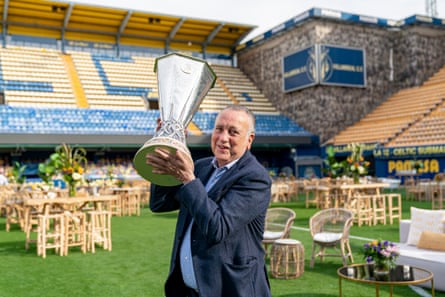
“We keep growing: we’ve extended the stadium: over 23,000. Very nice, very comfortable, very yellow. We’re constantly reforming.”
There’s another glance across the table, something Roig repeats often. “The consejero delagado does everything now: he’s the one that decides, leads and executes,” he says. “He has us on a good path. I don’t do anything any more. All I do is suffer during games. We think we have done something important, but what really matters is what’s next. In 30 years we’ve spent 27 seasons in the first division, 19 in Europe.”
If Anfield offers a symbol of how far they have come, so do Liverpool’s rivals to the east. “When we went to sign Diego Forlán from Manchester United, I said to Llaneza: tell them to come and play a friendly here, make it part of the deal. And they said: “Where? Villarreal?” Roig says. “I said: ‘Don’t worry, they’ll come next year … and they’ll do it for free.’ And then next year, or maybe the year after, they came in the Champions League.
“Diego wasn’t playing much, but we looked after him, gave him affection, and he was a great player. He won the golden boot here. Because he was at Villarreal, no one talked about it much. When he won it again, at Atlético, then they talked about him.”
“If you want, you can call us a family club; we admit it. It’s a club with no pressure, not much media attention, none of the toxic surroundings other clubs have. We have to create the pressure ourselves, the demands. Above all, we create an ecosystem.”
It works. It started with investment on established players, particularly from South America. But they searched among emerging footballers as well and bit by bit the academy, built on an old orange grove, bore fruit. Mention Santi Cazorla, who joined as a teenager, and Roig’s eyes light up. “An excellent player and an excellent person. He came as a kid. Real Madrid wanted him, but we convinced him to stay.
“He overcame so much with those injuries, then came back for at the end. He didn’t know if he would be able to play again, but we welcomed him back, were pleased to give him that opportunity and he gave us three more superb years.”
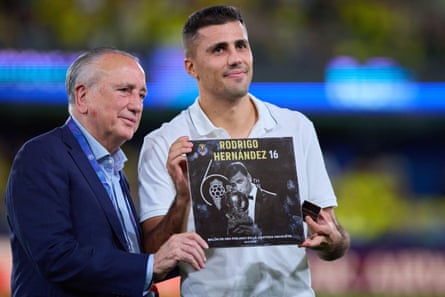
“And we had a Ballon d’Or winner here. Rodri was with us for five years. He wanted to progress and we weren’t going to stop him: he went to Atlético Madrid, from Atlético to Manchester, and won the Ballon d’Or. We have great memories of him, a good relationship. It fills me with pride to see him win the World Cup.
“Not just him: Álex Baena came to Villarreal at 11. He had those first years of melancholy, not being back at home in Almeria, but he grew up here. Yeremy [Pino] came very young. Borja Iglesias too. That’s an example of what we want to be.”
Ask Roig for a player from all those who have been at Villarreal and beyond Juan Román Riquelme or Robert Pires, Marcos Senna, Bruno Soriano and Gerard Moreno it is Pau Torres that comes to mind. “He’s born in the town and triumphed here, won a European title,” he says, “which was the only game I couldn’t go to.”
All those matches and Villarreal’s president missed that one. The 2021 Europa League final, the greatest, most epic victory of all, the one that completed a journey and belonged to everyone, their first trophy. Football can be cruel.
“I had Covid the week before,” Roig says. “I got certificates from every lab in Villarreal: they all showed I was negative. But as I was in the team bubble, Uefa demanded some other certificate. There was no time. We tried to argue, put some pressure on. It was no good. But it filled me with pride. And when Pau dedicated the win to me, it meant so much. He even came back from Poland and gave me his medal.”
It is here, a simple gold disc on black ribbon, around a match ball in the cabinet behind Roig’s son and daughter. “Pau won it there. As for me, I had to fly back and watch the final calmly at home with my wife. Well, ‘calmly’? I suffered there too, terribly.”
KioskNews shows a cleaned-up reading view extracted from the publisher’s page — the original always lives on their site, not ours.